
The companies that call me often begin with an apology.
“What we do is complicated.”
Then they explain the business, and the complication disappears. The technology has a purpose. The services connect. The audience makes sense. The distinctions matter. Inside the company, people understand all of it because they have spent years learning the territory.
The trouble begins when they try to carry that understanding outside the room.
Their website turns expertise into a list of capabilities. Sales tells the story differently from marketing. Product language leaks into customer language. Every page is accurate, yet a first-time visitor cannot tell what the company makes possible or where to begin.
That is not a complexity problem. It is a translation problem.
Key Takeaways
- Expertise loses value when customers cannot see how its parts relate.
- Simplifying the language is not the same as simplifying the thinking.
- A strong brand gives different audiences clear paths into the same truth.
- Translation has to hold across messaging, design, sales, content, and systems.
- The goal is not to say less. It is to help people understand more.
Complexity Is Often the Evidence
There is a kind of complexity that comes from disorder: duplicate offerings, vague ownership, language nobody has challenged, and systems assembled without a plan. That complexity needs to be removed.
But there is another kind. It comes from experience.
A specialist sees distinctions a newcomer cannot yet see. An engineering firm understands why two apparently similar environments require different systems. A clinical-trial organization knows where one decision changes an entire workflow. A cybersecurity company has to explain a platform, its products, its open-source foundation, several audiences, and several ways to deploy it.
Flatten those distinctions and the company may become easier to describe, but less true.
“We make technology simple” is not a strategy. It is usually what remains after the valuable parts have been removed.
I am not interested in making expertise smaller so it fits a headline. I am interested in finding the structure already inside it: the relationships, priorities, evidence, and sequence that let another person follow it.
The work is closer to drawing a map than writing a summary. A map does not eliminate the landscape. It makes the landscape navigable.
Accuracy Is Not Yet Understanding
Specialized companies tend to have plenty of accurate content. They have service descriptions, product specifications, process diagrams, technical documents, biographies, case studies, and years of institutional knowledge.
Accuracy matters. But accuracy alone does not tell a reader what matters first.
A visitor has a different set of questions:
- Is this for someone like me?
- Do you understand the condition I am in?
- How do these capabilities work together?
- What makes your approach different?
- What evidence gives me confidence?
- What do I do next?
When every fact arrives at the same volume, the reader has to perform the strategy. They have to decide which terms are important, connect services that appear unrelated, and translate internal language into their own situation.
Most will not do that work. They will leave with a vague impression that the company is capable but difficult to explain. In a committee decision, that problem compounds. A buyer may understand enough to remain interested, then fail to repeat the value clearly to a colleague, executive, or procurement team.
The brand has not merely lost attention. It has lost transmission.
Translation Preserves the Depth
Good translation is not substitution. It does not replace a precise idea with a friendlier but less accurate one. It carries meaning from one frame of reference into another.
That is why the work begins with discovery, not copywriting.
Before deciding what to say, I need to understand the business as the people inside it understand it. Where does value actually come from? Which distinctions affect a customer’s decision? What does the company know that its market does not? Which relationships are hidden by the current organization? What can be removed, and what would be damaged if it disappeared?
Only then can we build layers.
A first-time visitor needs an intelligible promise. A serious prospect needs the logic underneath it. A technical evaluator needs depth and evidence. These are not three different stories. They are three entrances into the same one.
I think of this as progressive understanding. The overview earns the next question. The next layer answers it without contradicting the first. Technical depth is available when it becomes useful, not placed at the door as an admission test.
The result feels simple because the structure is doing difficult work beneath the surface.
Three Different Businesses, the Same Problem
The clearest evidence comes from seeing the same condition in unrelated fields.
AVN | SYS: Decades of Expertise, Seen One Page at a Time
AVN | SYS had spent more than three decades designing and integrating audio, video, networking, and production environments. Its breadth was real, but customers tended to encounter only one piece of it. Solutions, services, technologies, industries, projects, and locations existed as separate information instead of one connected body of expertise.
The answer was not a shorter service list.
We built a connected knowledge network. Every point of entry became a pathway to related capabilities and evidence. Someone arriving through a recording-studio project could discover the technologies, services, and experience behind it. Someone entering through an enterprise solution could follow a different path into the same company.
The expertise did not change. Its visibility did.
Dana-Farber: Knowledge That Had to Become Navigation
In complex healthcare work, clarity cannot come at the expense of accuracy. The people using the system may have different roles, pressures, and levels of familiarity, but the underlying knowledge remains precise.
Our work with Dana-Farber CTRIO + Streamline turned years of clinical-trial operational knowledge into navigation physicians and research teams could trust. The value was not in reducing the institution’s expertise to a slogan. It was in organizing that expertise around the decisions people actually needed to make.
That distinction matters. Information architecture is not filing. It is an argument about relationships: what belongs together, what leads somewhere else, what a person needs now, and what must remain available next.
NetFoundry: An Invisible Product Made Legible
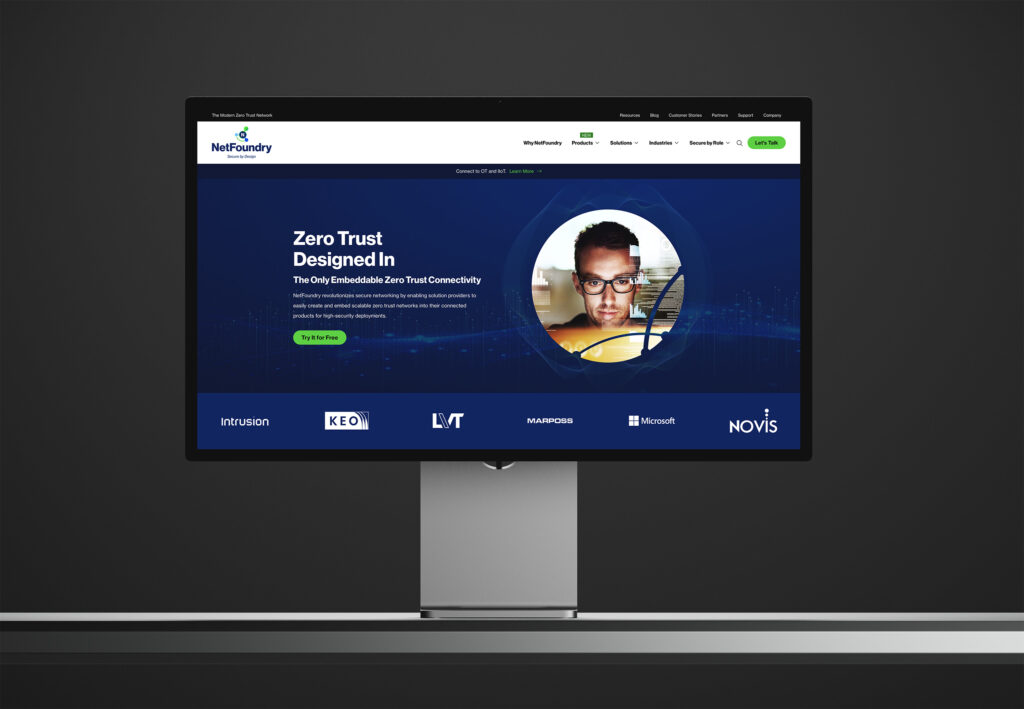
NetFoundry entered a crowded zero-trust market with strong technology and a story almost no one could follow. Products, solutions, services, audiences, and deployment models blurred together. The category added another problem: competitors used the same fear, the same vocabulary, and much of the same visual language.
Discovery revealed that the product was not the problem. Legibility was.
We separated the terms, defined the audiences, and organized the company around one platform with clear paths into it. The brand identity, messaging architecture, website, publishing system, infographics, and sales deck all carried the same map.
Marketing gained a story it could publish. Sales gained a story it could present. Technical audiences could still reach the depth they expected. The relaunch was followed by the first venture round in NetFoundry’s history. The timing marked an important moment in the company’s growth without reducing the outcome to any single cause.
Three domains. Three very different kinds of knowledge. The same work: reveal the relationships so people can understand the whole.
The Brand Is the Translation System
A brand is often reduced to its visible assets: a logo, palette, typography, voice, and perhaps a set of templates. Those elements matter, but they are not the system’s purpose.
The brand’s real job is to keep meaning coherent as it moves.
It moves from an executive’s understanding into a positioning statement. From the positioning into a website. From the website into a sales conversation. From a sales conversation into a presentation, campaign, proposal, product experience, or customer relationship.
At every handoff, meaning can weaken. One team emphasizes technology. Another emphasizes service. A designer dramatizes what is visually interesting. A writer chooses what is easiest to explain. A platform forces the content into its own structure.
Eventually the company still looks polished, but no longer sounds like itself.
Translation prevents that drift. Discovery establishes what is true. Messaging gives the truth language. Information architecture gives it sequence. Identity makes it recognizable. Content supplies evidence. The publishing system helps the organization keep extending the story without rebuilding its logic each time.
Different outputs. One understanding.
Clarity Is Not the Absence of Complexity
I sometimes hear clarity described as if it were minimalism: fewer words, fewer pages, fewer choices, fewer details. Restraint is useful, but reduction is not the goal.
Clarity is knowing why something is present and how it relates to what surrounds it.
A complex organization may need a substantial website. A technical buyer may need detailed documentation. A service may require explanation before a prospect can evaluate it responsibly. None of that is a failure if the reader knows where they are, why the information matters, and where to go next.
The strongest companies do not hide their depth. They stage it.
They make the first idea graspable. They let evidence arrive at the moment it becomes persuasive. They give each audience a recognizable entrance. And they preserve a coherent through-line from the broadest promise to the most technical proof.
That is how complexity becomes an advantage. Competitors can imitate a phrase or visual style. They cannot easily imitate a body of knowledge that has been structured, expressed, and connected around what the company uniquely understands.
Start With What You Know
If your company is difficult to explain, the first impulse may be to rewrite the homepage. Resist it.
Begin further back.
Gather the explanations your people already give when someone asks a serious question. Look at the distinctions your best customers eventually learn. Find the diagrams drawn during sales calls, the phrases that make a prospect lean forward, and the evidence that changes a conversation. Notice where internal teams use the same word to mean different things. Then notice where they use different words to mean the same thing.
That material is not the mess standing between you and the message. It is the source of the message.
Your expertise is probably not too complex for customers. It may simply be organized around the people who already understand it.
Translation changes the point of view. It gives the customer a way in without asking the company to leave its depth behind.
If your value is real but difficult for the market to follow, begin Discovery. We will find the structure inside the expertise and turn it into a story people can understand and trust.