Opens in a new tab

NetFoundry

Securing networks no one can see. With a story anyone can follow.

NetFoundry entered the loudest conversation in enterprise security with a quiet, ambitious goal:

Embed zero trust networking inside the world’s software, products, and services.

Bowman Design Direction partnered with NetFoundry to rebuild more than a website. We rebuilt the way the company explains itself: a brand system, a messaging architecture, a creative framework, and a publishing platform that translate deep networking technology into a story every buyer can navigate.

Challenge

NetFoundry had the technology to lead its category and a story almost no one could follow. Solutions, services, and products blurred into each other, terms were commingled, and three very different audiences arrived at the same site to find one undifferentiated pitch.

The market compounded the problem. Every vendor was shouting zero trust, the category sold through fear, and its visual language had collapsed into the same blues and reds. NetFoundry needed software providers, product manufacturers, and service providers to each understand it quickly, without flattening the depth its engineers had earned.

Direction

Discovery kept returning to one observation: the product was never the problem. Legibility was. NetFoundry sells invisibility, and it had become invisible in the one place it could not afford to be: its own story.

So the strategy became a map. One platform at the center. Three audiences and three ways to deploy, each given its own named path to the same destination. Zero Trust Your Way stopped being a slogan and became the organizing architecture of the brand, the message, and the site.

Outcome

NetFoundry relaunched as the legible leader in embeddable zero trust networking: one identity, one vocabulary, and persona paths that carry a first-time visitor to technical proof without a dead end.

Marketing published without waiting on developers. Sales walked in with a story instead of a sprawl. And soon after the 2024 relaunch, NetFoundry closed the first venture round in its history: $12 million led by SYN Ventures, expanded past $15 million when Cisco Investments joined as a strategic investor.

Takeaway

Zero trust works because of what it hides: no open ports, no visible network, nothing to attack. A brand works the opposite way. You can’t attack what you can’t see. But nobody buys what they can’t understand. The work translated an invisible product into a legible company, one platform serving three audiences three ways, drawn clearly enough that the market, and then its investors, could see the leader that had been there all along.

What We Built

Brand & Identity

We created NetFoundry’s logo, color, typography, and identity as a compass for the category: endpoints entering the platform and leaving protected, with green claimed as the color of arrival in a market crowded with alarm reds and corporate blues. Secure by Design became the promise the whole system keeps.

Messaging Architecture

We separated what had blurred together, defining solutions, services, and products so each term meant one thing, then mapped the message to every persona and vertical. A product manager, an IIoT leader, and a service provider each hear the platform explained in the language of their own risk.

Creative Framework

A layered design system organizes complex offerings into simple persona paths. High-level storytelling carries visitors in, technical depth rewards the ones who keep going, and every layer keeps the same visual logic, so the deepest page still feels like the homepage’s brand.

Publishing Platform

We built a scalable WordPress CMS with dynamic content blocks, faceted navigation, and cross-linking, so the marketing team publishes with consistency and speed instead of waiting on developers. The site’s structure holds the strategy in place as the content library grows.

Compass mark of a navy N circled by endpoints, a light blue node entering along the green arc and leaving deep blue, protected.

The Through-Line

What began as a tangle of commingled terms became a map that software providers, manufacturers, and service providers could each follow to the same destination.

The identity made the strategy visible. A compass built from the platform’s own topology promises arrival before a word is read, and the messaging architecture keeps that promise in language, giving solutions, services, and products their own names and their own audiences.

The creative framework translated the map into persona paths. Each audience enters through its own door, descends exactly as deep as it needs to, and never loses the path back to the platform.

The publishing system keeps the clarity operational. Structured content, faceted navigation, and cross-linking let the marketing team extend the story every week without re-tangling what discovery untangled.

And the pitch deck proved the system in the room. In a category that competes on volume, NetFoundry stopped shouting. The clearest map in the market became the differentiator.

Every Deliverable Points the Same Direction: One Platform, Three Audiences, a Clear Way Through.

Watch the Brand
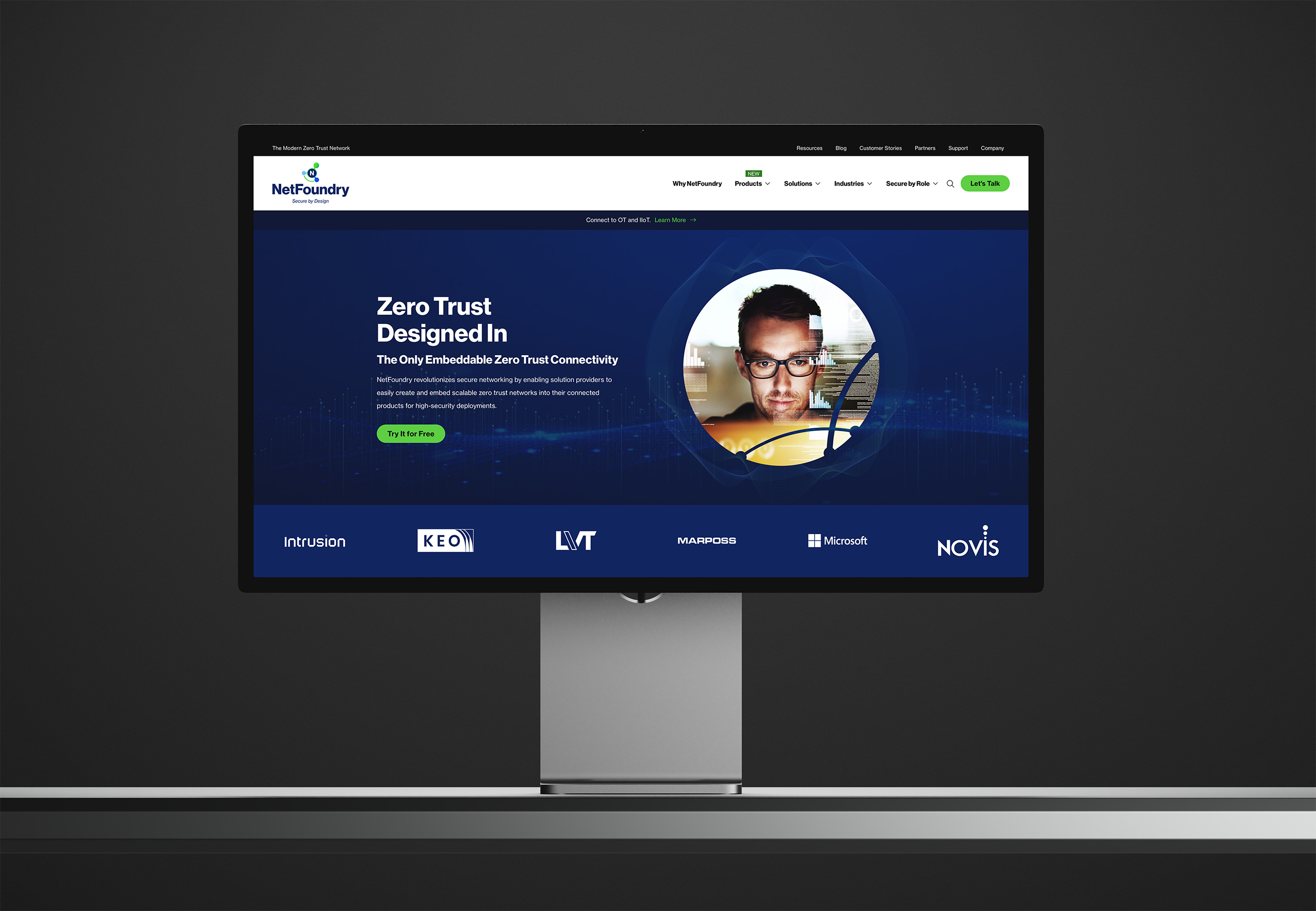
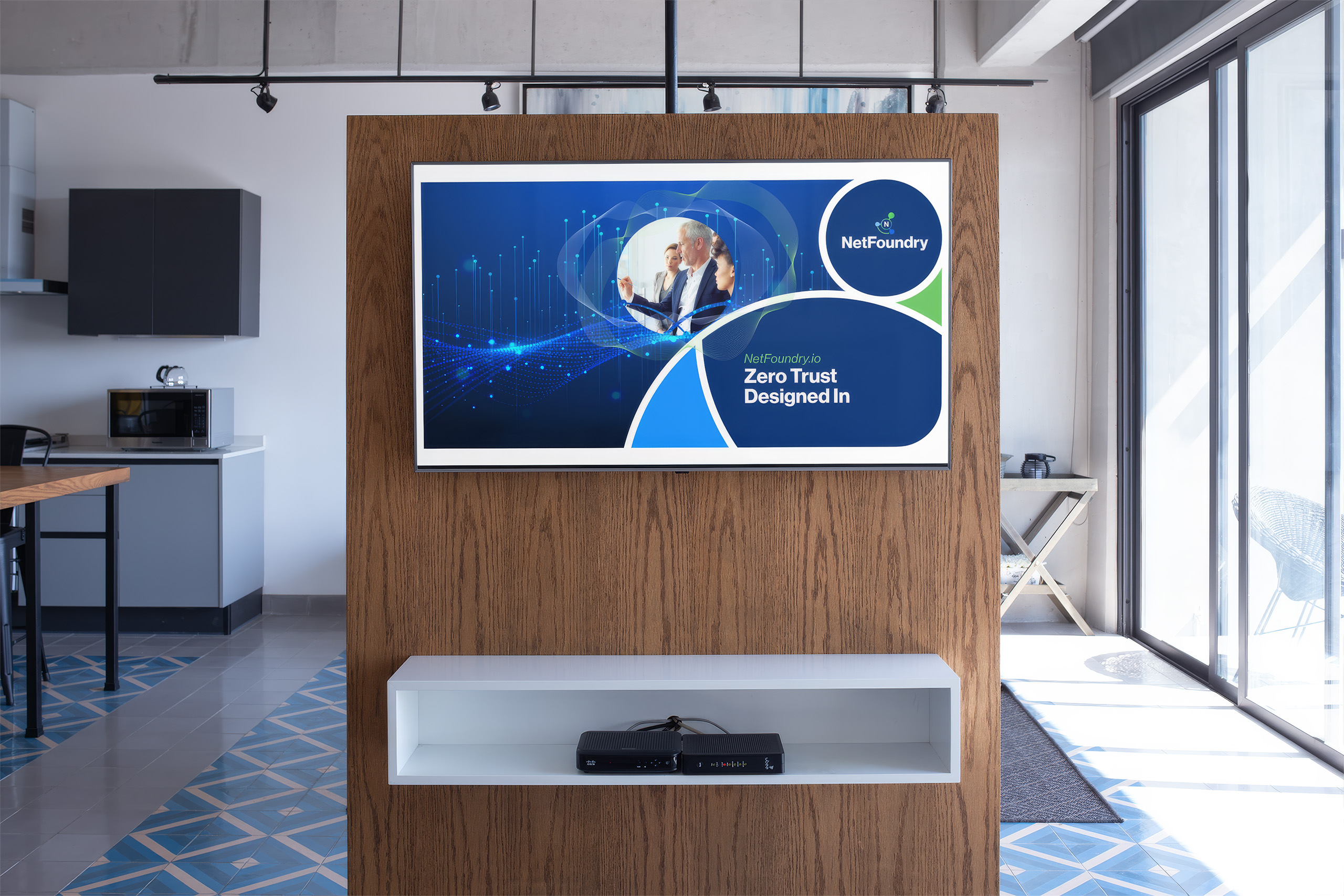
Studio display showing the Zero Trust Designed In homepage hero, a portrait in the wave ring above client logos.

Discovery + Strategy

Before design, we drew the map every audience would follow.

  • Business Roadmap

    Growth was waiting behind clarity. We aligned the platform story, three audiences, and the funnel into one roadmap built to shorten the distance between first visit and signed contract.

  • Brand Architecture

    One platform, a family with jobs. NetFoundry, AppNets, and OpenZiti each earned a defined role, so the product, the networks it builds, and the open source underneath reinforce one another instead of blurring.

  • Audience Architecture

    Three audiences, three paths, one destination. Software providers, connected-product manufacturers, and service providers each got a mapped path from first question to technical proof.

  • Zero Trust Your Way Strategy

    Deployment became the promise. Cloud, managed on-premises, or self-hosted: we framed choice itself as the differentiator in a category that dictates terms to its customers.

  • Words to Own

    Fabric. Mesh. AppNets. Zero Trust Your Way. We defined the vocabulary NetFoundry could own outright, then used it identically across site, sales, and product until the words meant the company.

  • Competitive Positioning

    The audit showed a category of blues and reds selling fear. NetFoundry took green, took clarity, and took the one position no competitor was holding: the platform you can understand.

Brand Identity

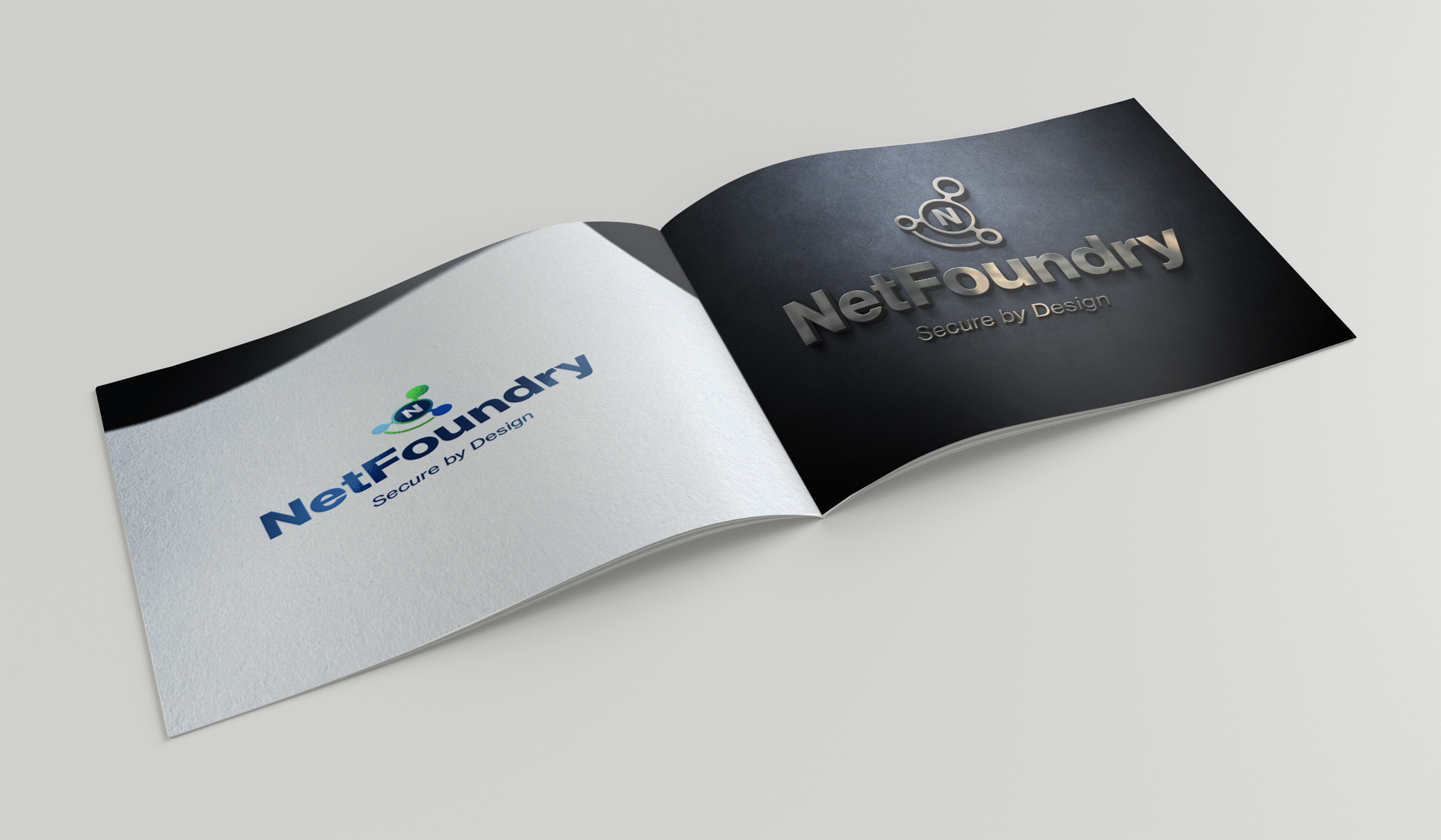
Navy NetFoundry wordmark and compass icon above the italic Secure by Design brand promise line.
White NetFoundry wordmark and compass icon above the Secure by Design tagline, reversed on a dark field.
Green AppNets wordmark beside the small compass icon, the horizontal product lockup in the family system.Rust OpenZiti wordmark beside the small gold compass icon, the horizontal open source lockup in the family system.

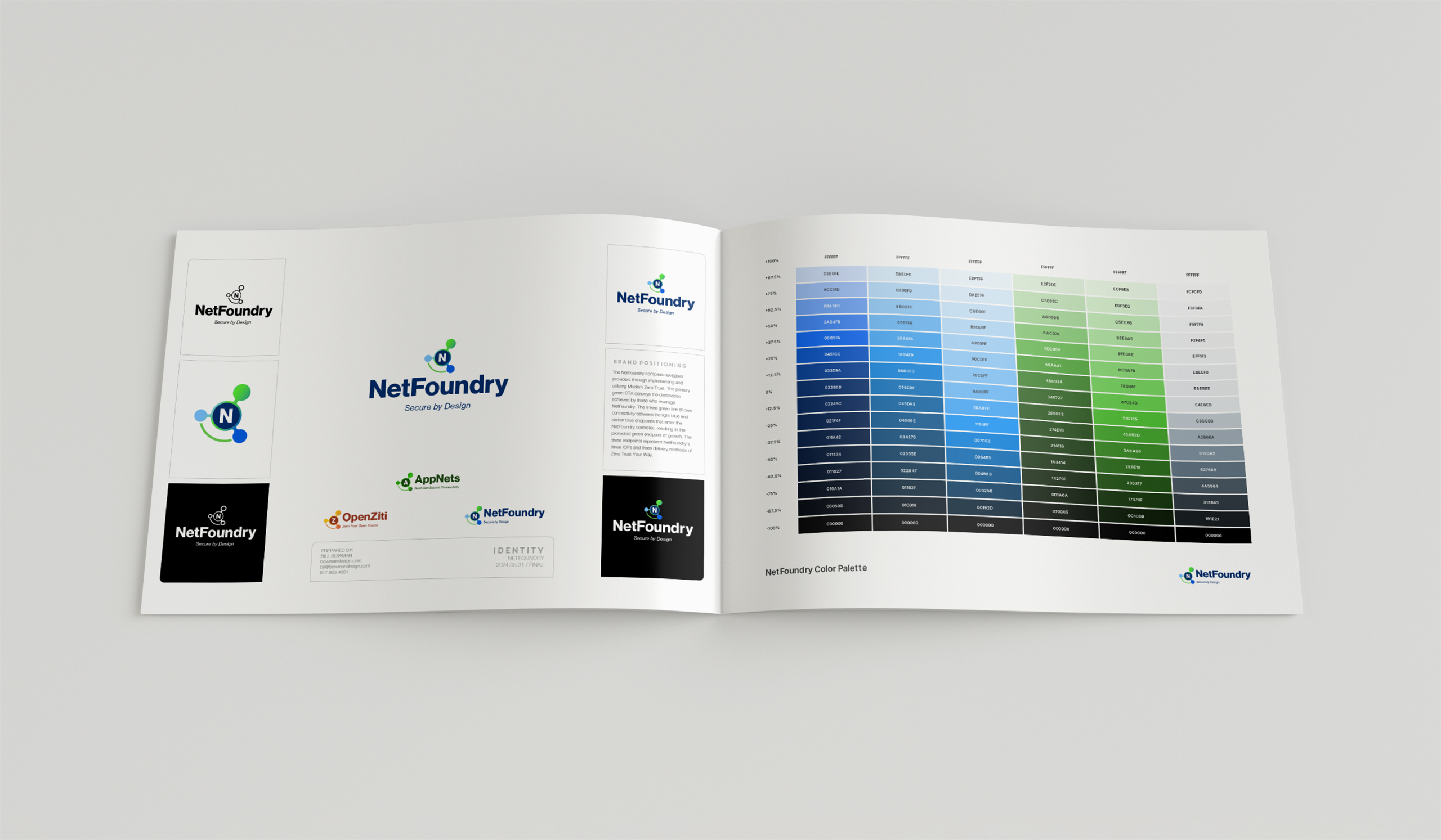
The NetFoundry mark is a compass drawn from the network it secures. Two endpoints, one light blue and one deep, enter the platform at the center; a linked green line carries them through; and a protected green endpoint emerges on the other side. The logo does not decorate the architecture. It diagrams it.

Green was a strategic capture. The category audit showed security living in the same blues, oranges, and alarm reds, every palette shouting threat. Green was unclaimed, and green is what arrival looks like: growth, safety, go. It became the color of every primary call to action, the destination for those who build on NetFoundry.

The three endpoints carry the whole strategy. They are NetFoundry’s three audiences: software providers, connected-product manufacturers, and service providers. They are also its three delivery methods: cloud, managed on-premises, and self-hosted. Zero Trust Your Way, drawn in a single mark. Secure by Design, written underneath.

The identity extends to a family. AppNets names the networks customers build, OpenZiti carries the open source at the platform’s heart, and each lockup holds the parent’s geometry.

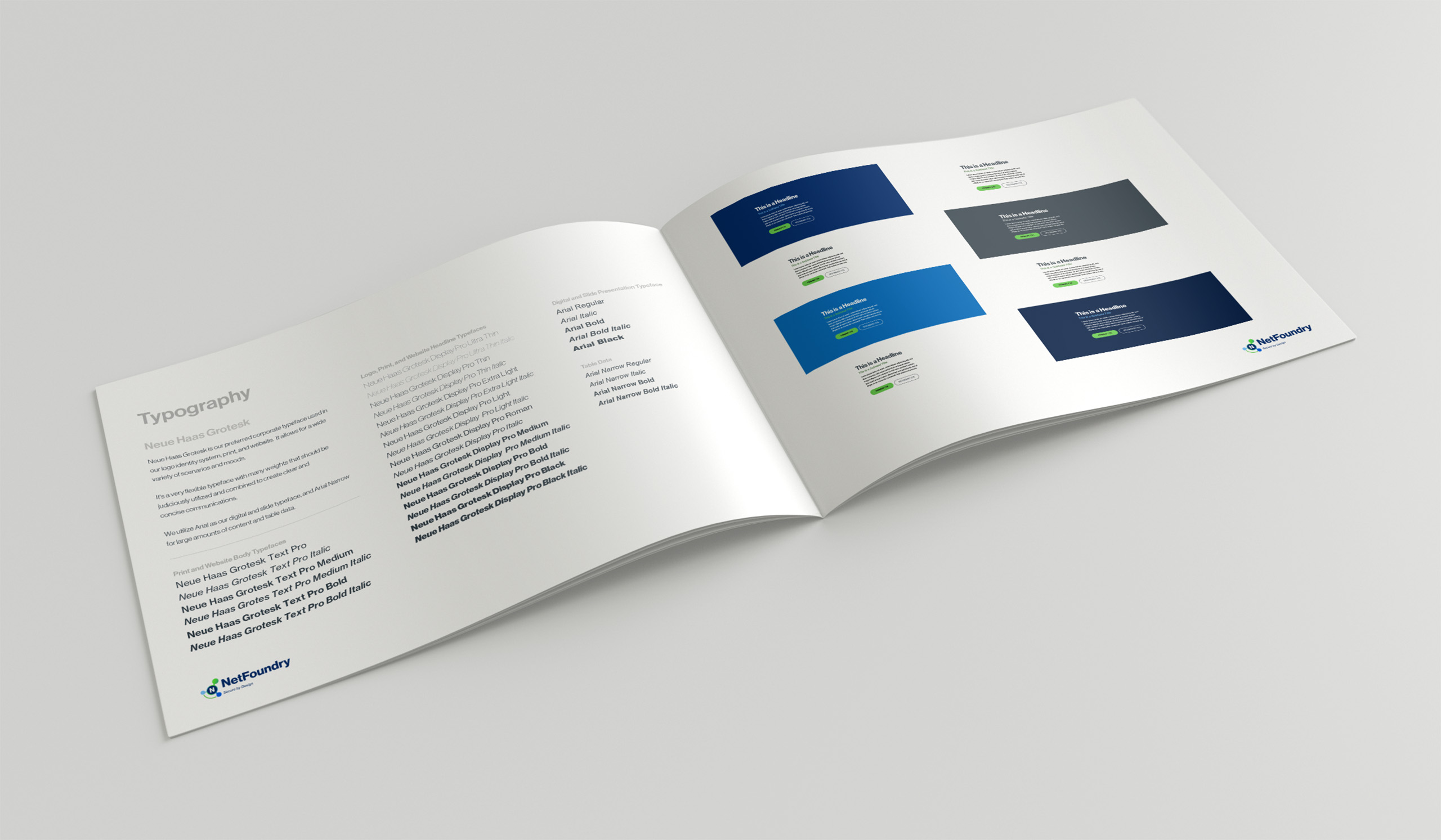
Typography and standards keep every application on course, an identity that navigates as dependably as the network routes. Each offering keeps its own purpose while remaining visibly part of the same network.

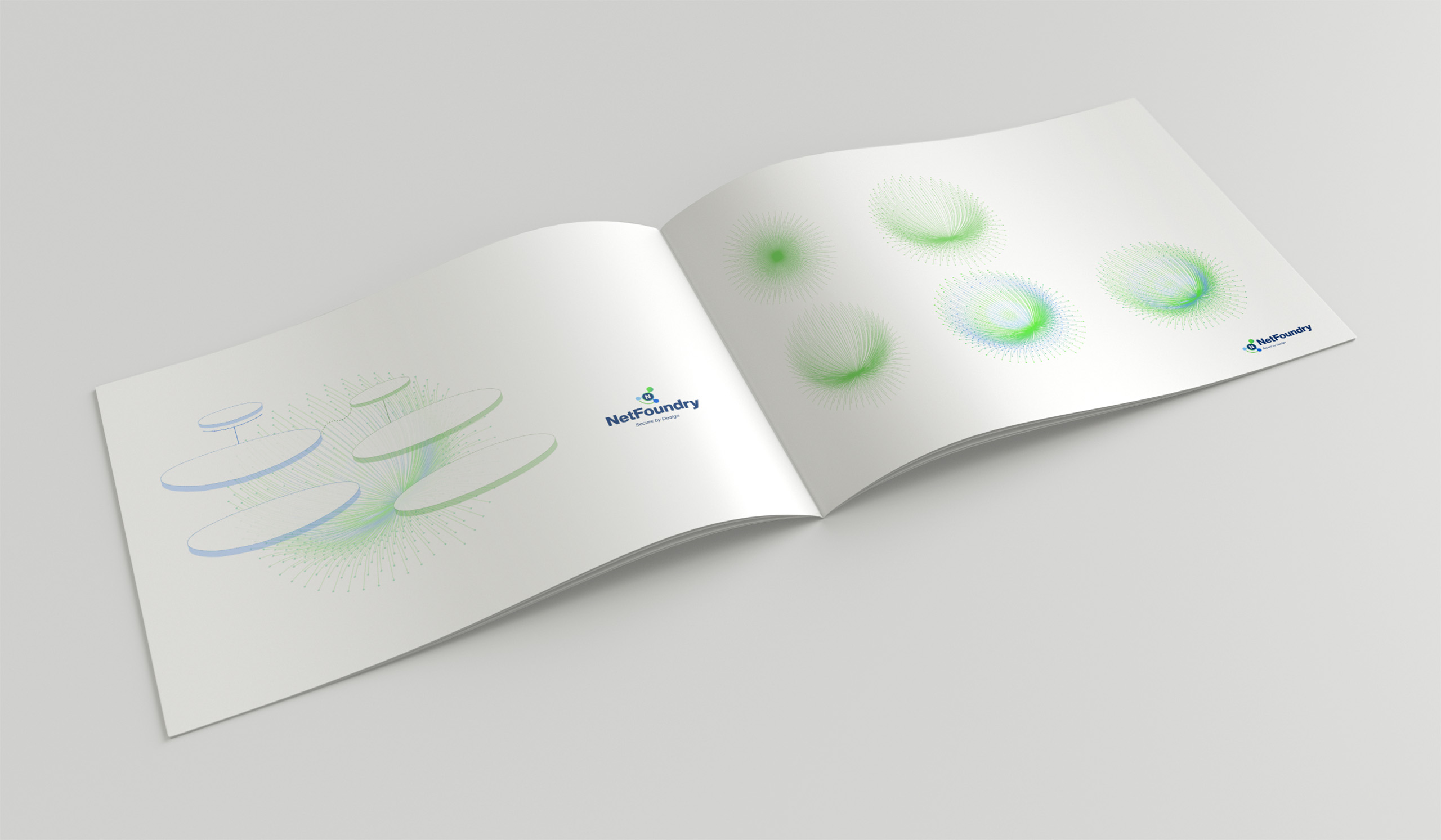
We extended that geometry into a repeatable persona image system. Each person is held within a circle, intersected by two network lines with four endpoints, and wrapped in a fluid ribbon of mesh. The circle focuses the individual, the endpoints connect the portrait to NetFoundry’s network language, and the flowing material suggests adaptive Zero Trust protection surrounding the subject. Persona photography became a branded explanatory graphic, consistent enough to scale across audiences without becoming generic. Together, the library maps the people NetFoundry serves through one consistent explanation of identity, connection, and security.

The system made an invisible platform recognizable at every scale, from the parent mark to persona imagery, preserving the architecture connecting them.

Color System

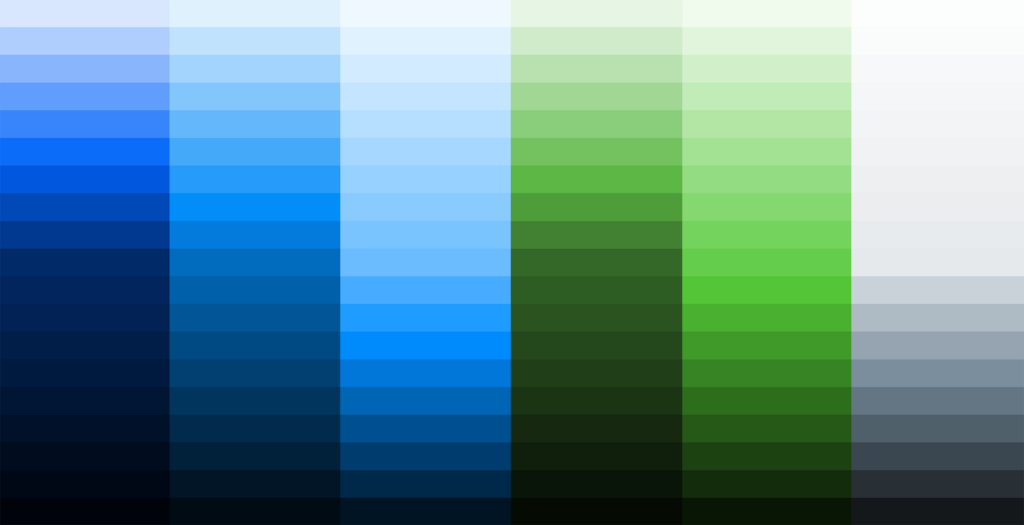
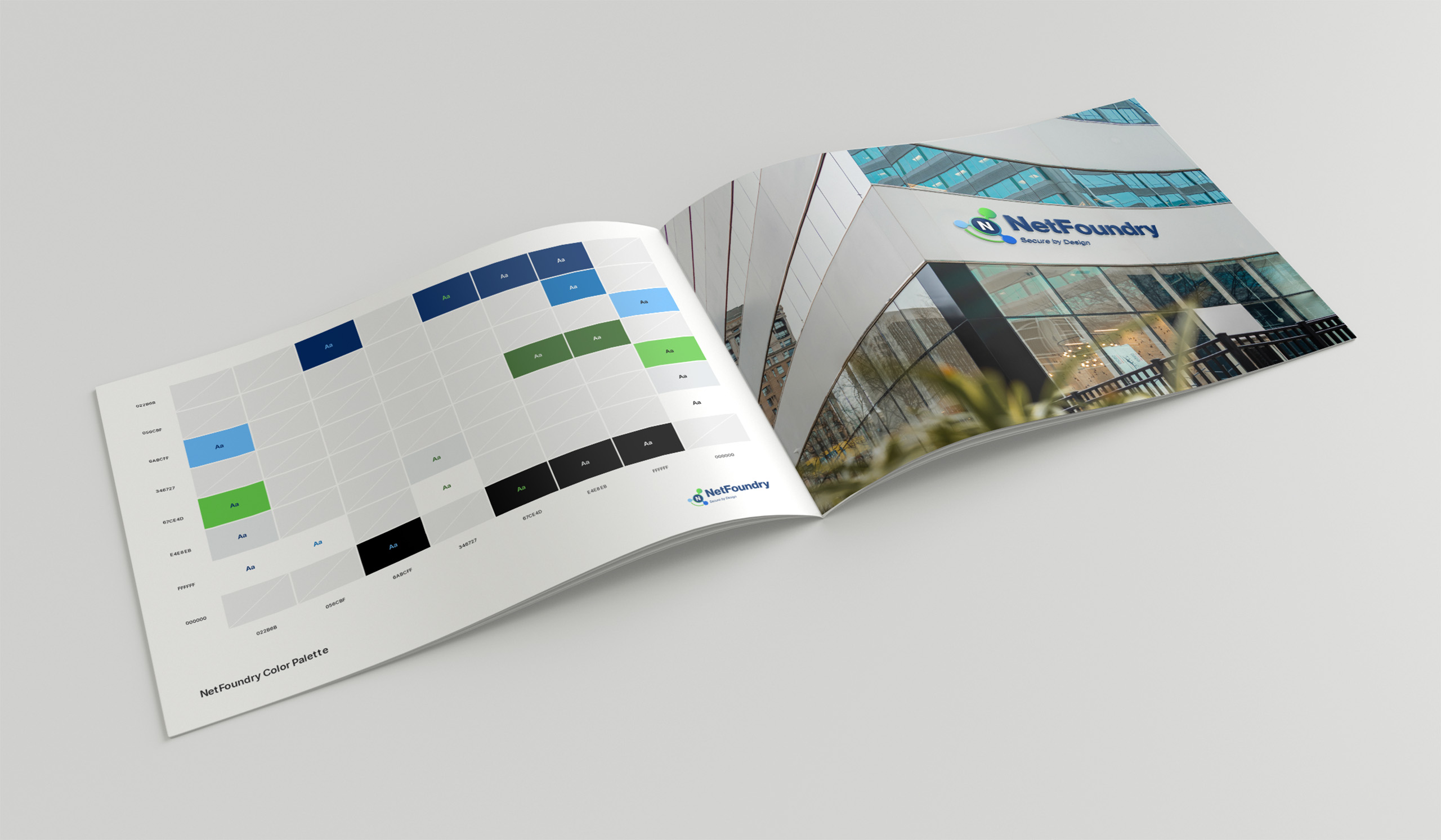
Six tint-ladder columns stepping two blues, a pale blue, two greens, and gray from light washes to near black.

Style Guide

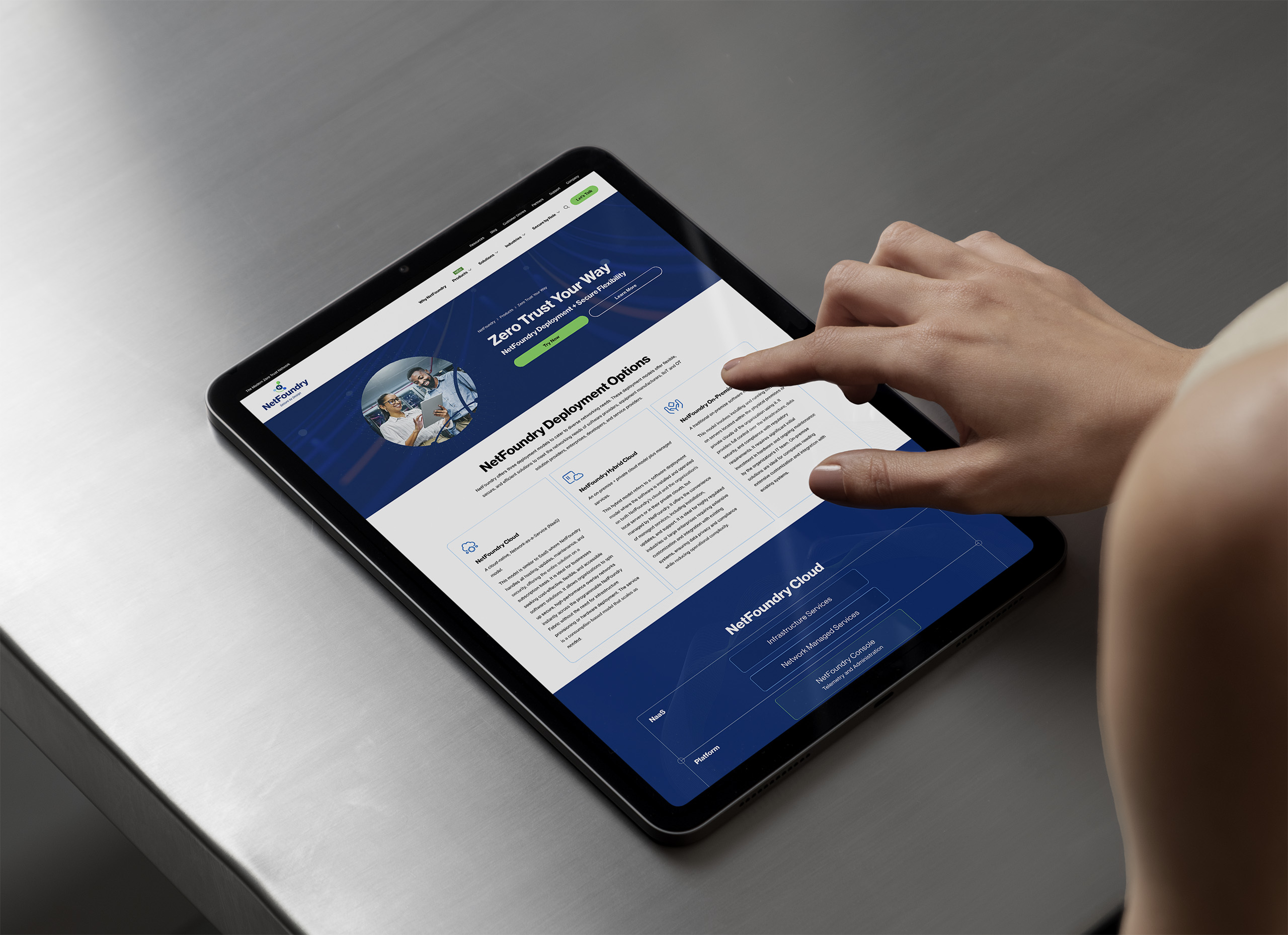
Finger scrolls the Zero Trust Your Way deployment options on a tablet, cloud details filling the navy panel below.
Compass mark of a navy N circled by endpoints, a light blue node entering along the green arc and leaving deep blue, protected.

Putting the Brand to Work

Feature Image System

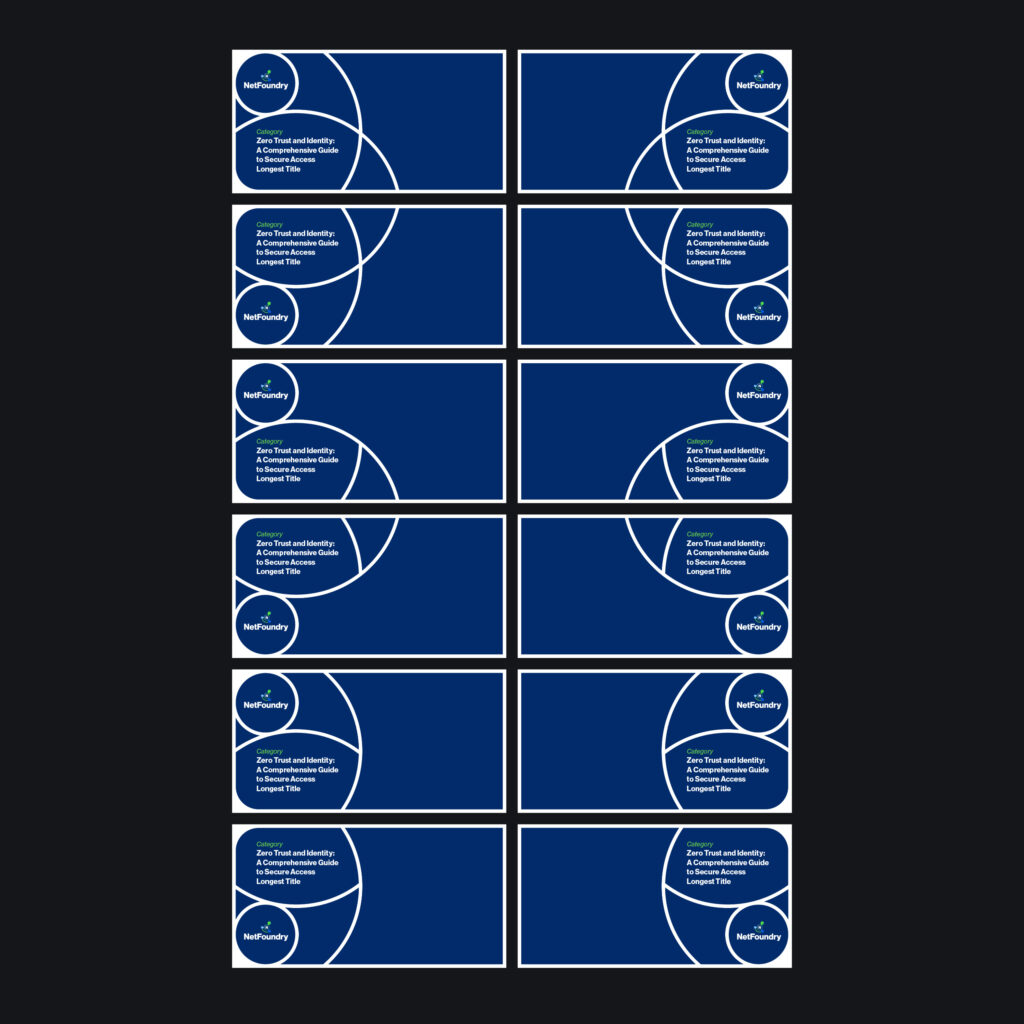
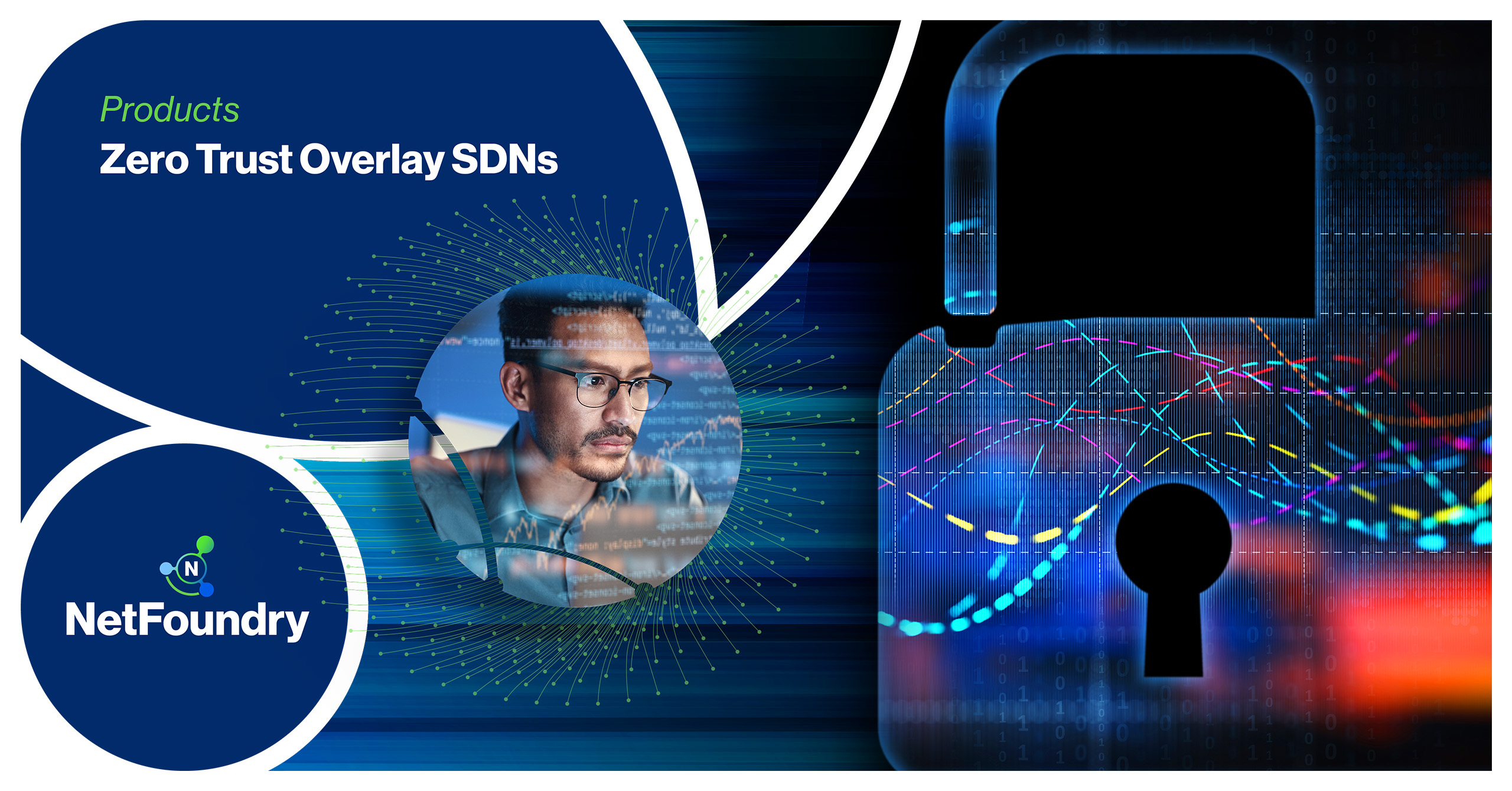
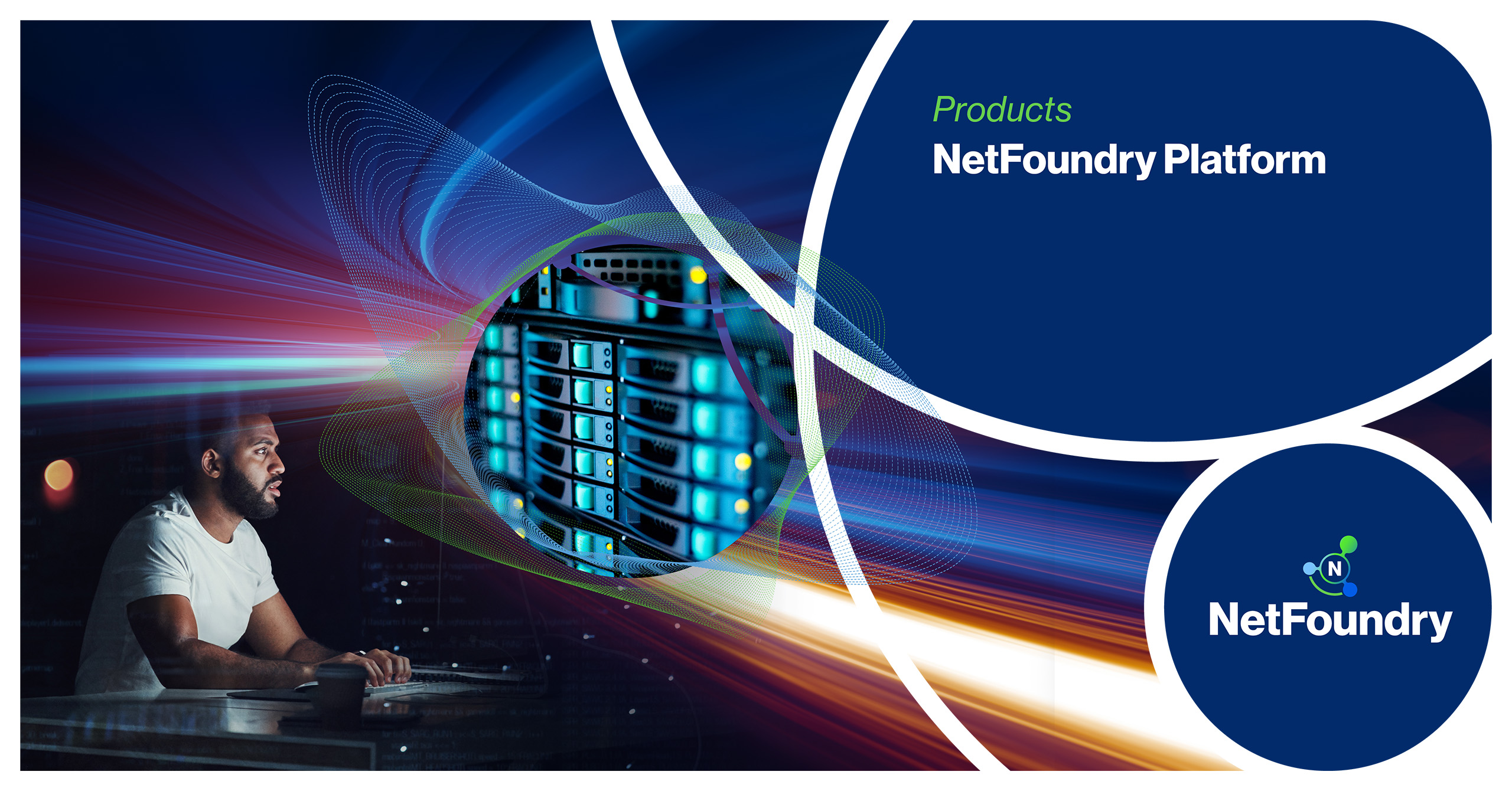
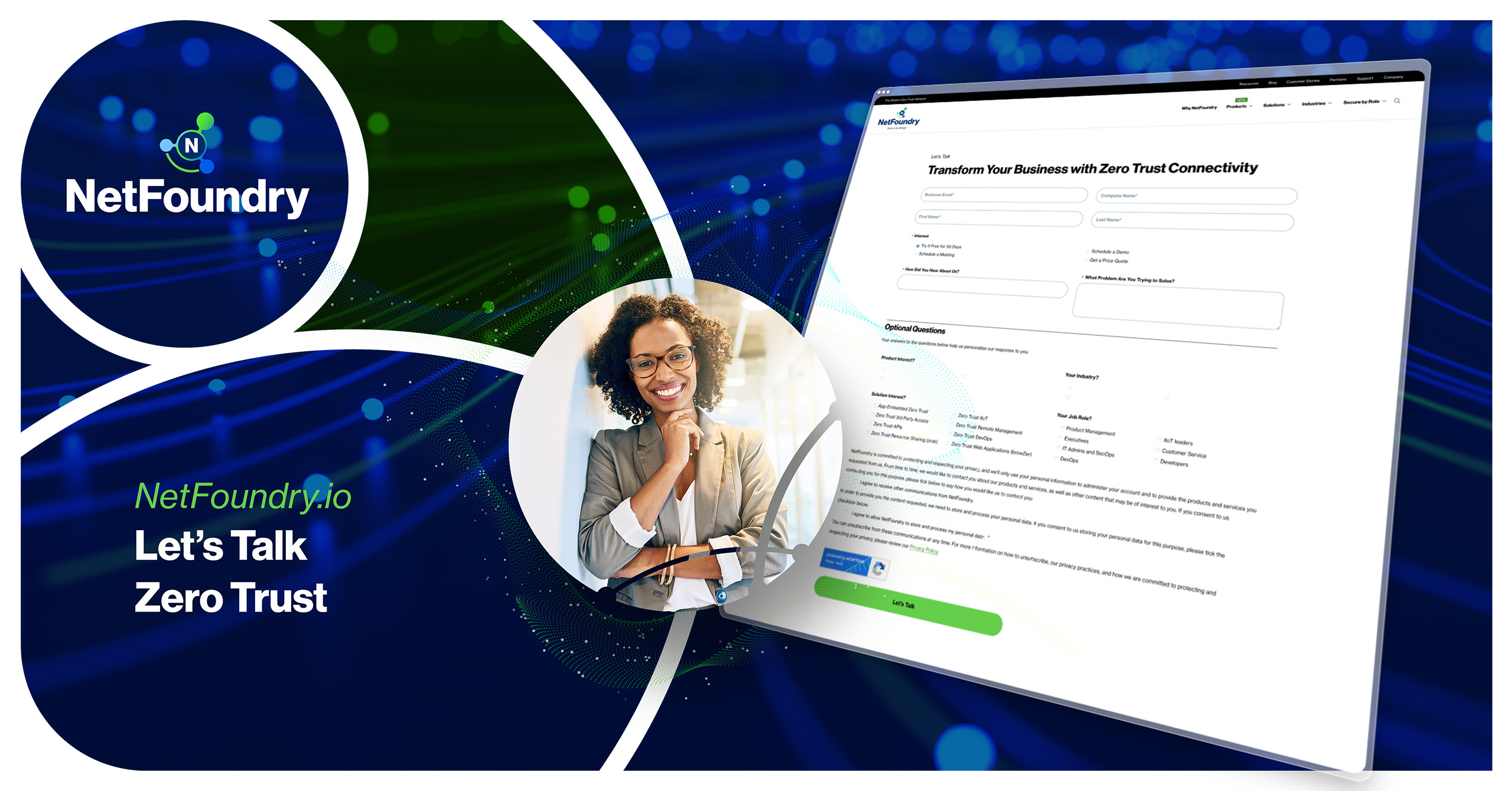
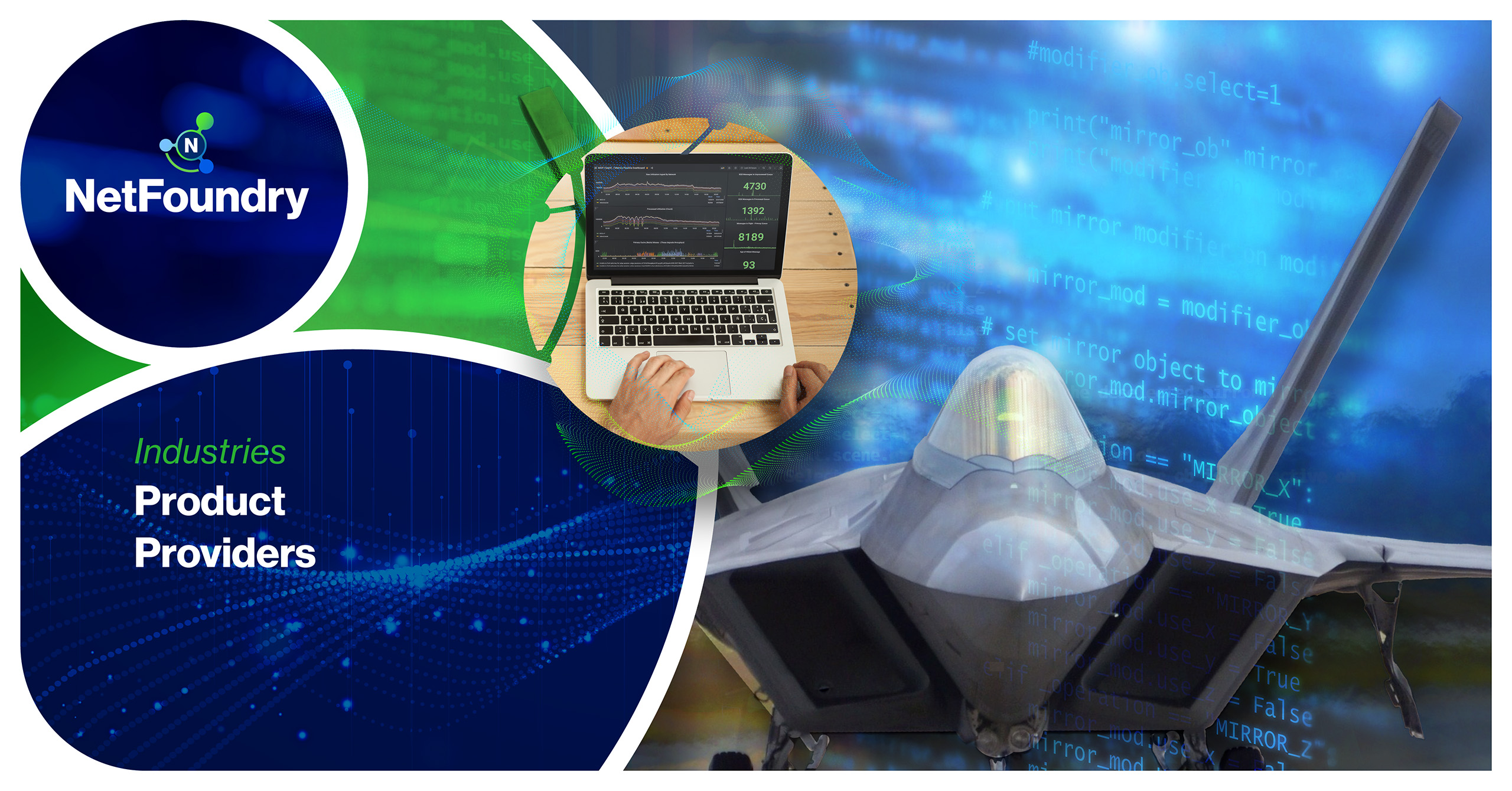
The brand does not stay home. Feature templates give every blog post, resource, customer story, and announcement a branded visual the moment it ships, carrying the compass, the palette, and the vocabulary into feeds, inboxes, and search results far beyond the site.

  • Feature System

    Feature Template System

    A library of templates gives every content type its visual foundation. A marketer chooses imagery and message inside rails the system already set, and a finished, on-brand feature ships in minutes, no designer required.

    Twelve navy feature card layouts in a grid, logo circles and headline blocks shifting position across each variant.
  • Feature System

    Blog + Resource Features

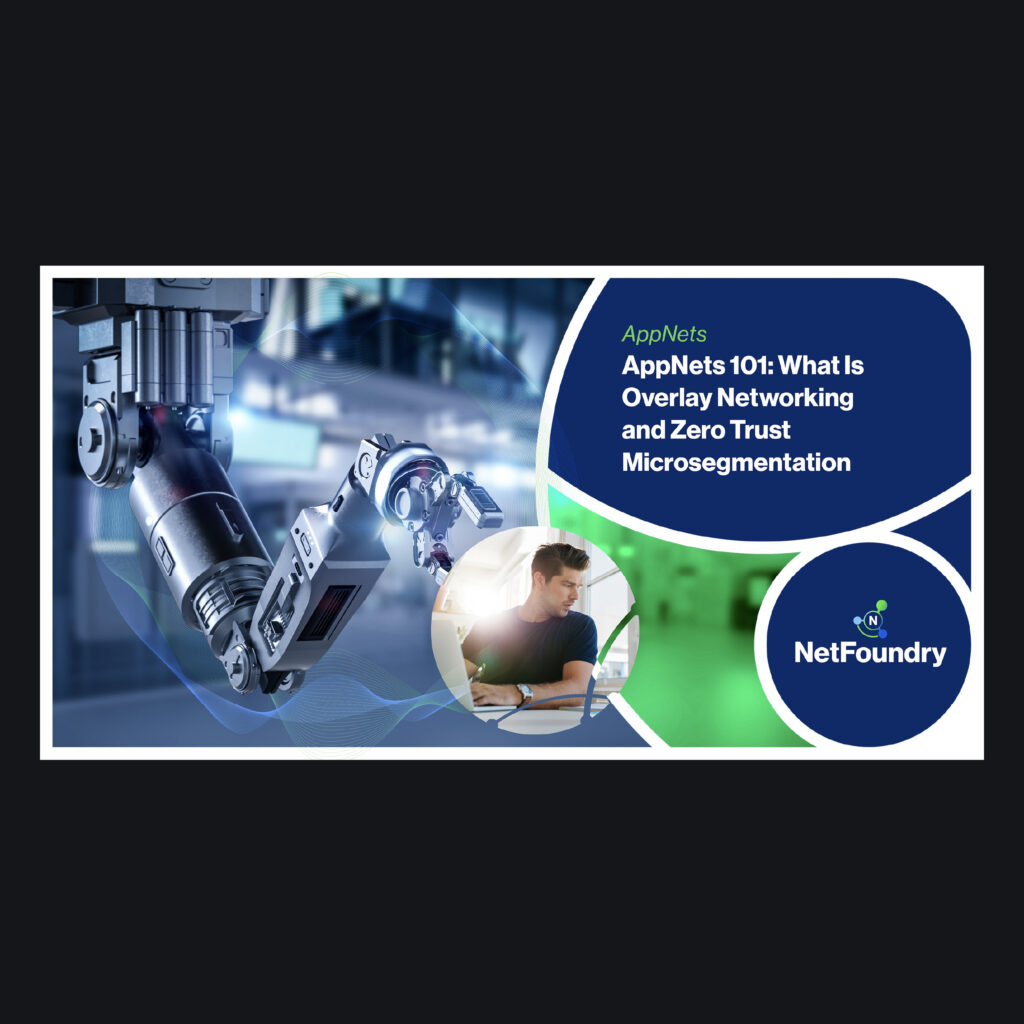
    NetFoundry publishes constantly: engineering posts, release notes, events, customer stories. Each feature pairs the story’s message with its imagery while the system holds palette, typography, and voice steady underneath, so a DevOps deep-dive and a funding announcement arrive wearing the same brand.

    Explore Features
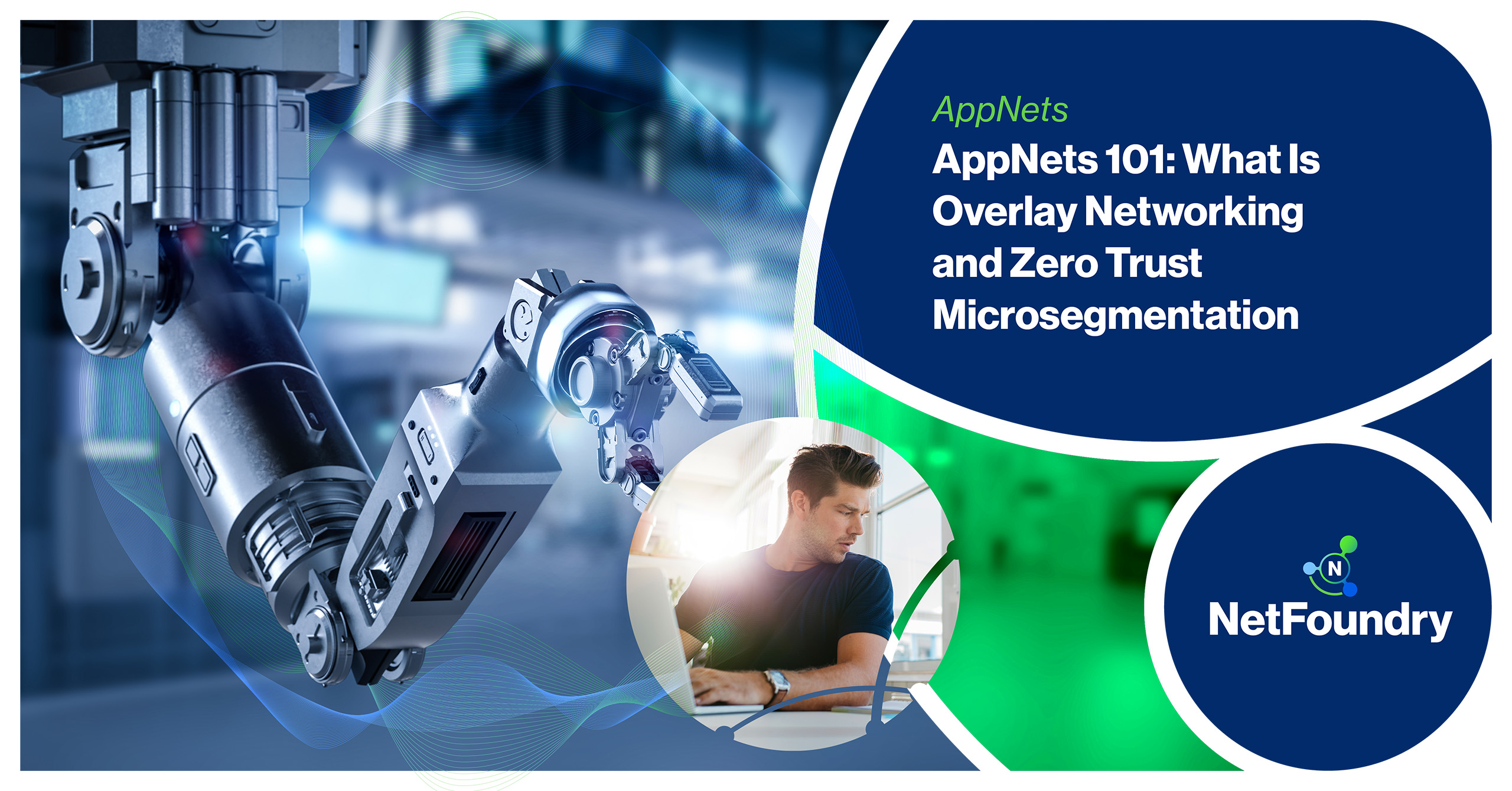
    Framed AppNets 101 feature card, robotic arms and a developer circle beside the overlay networking headline.
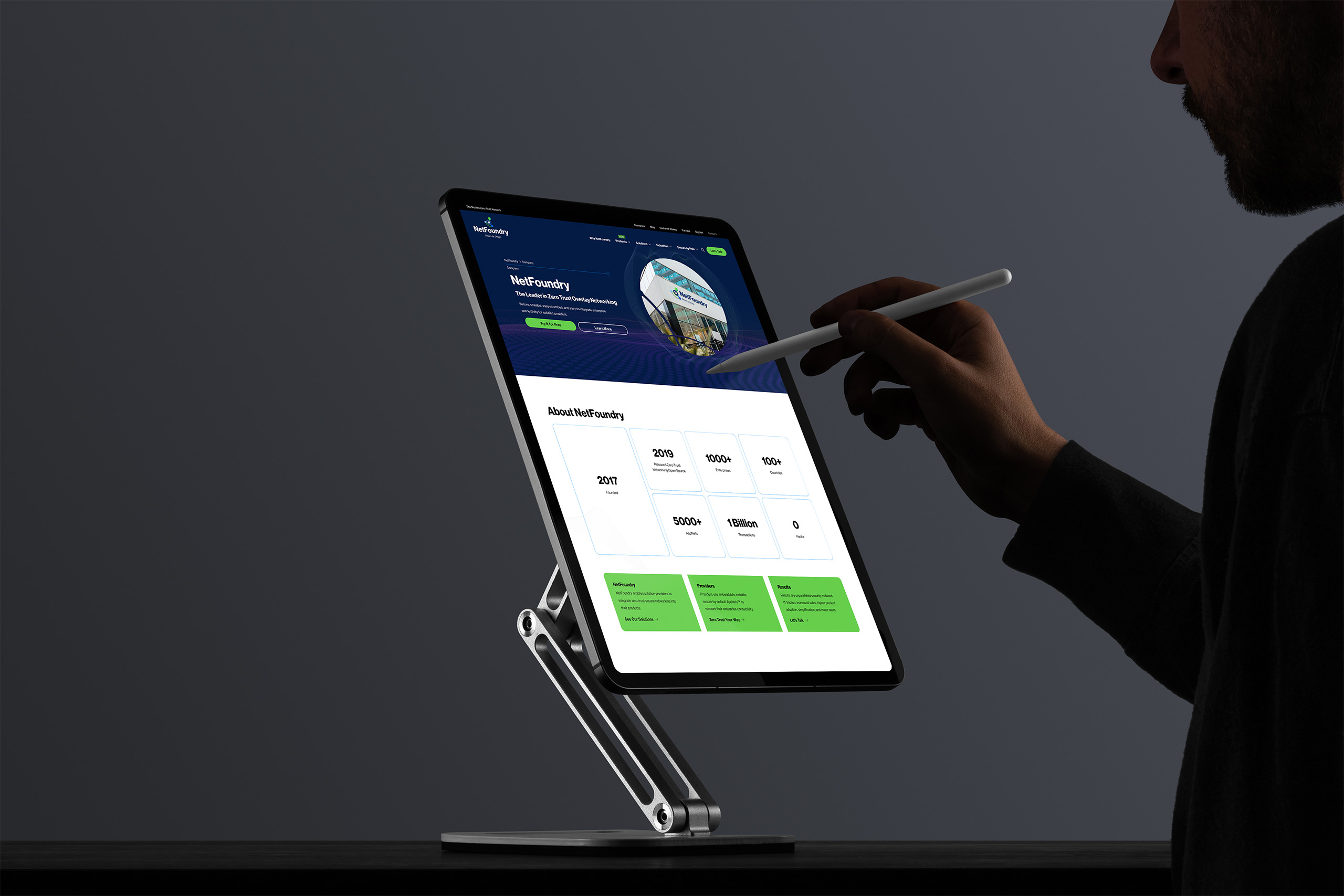
Silhouetted man with a stylus reviews the About page on a stand-mounted tablet, stat tiles glowing green below the hero.

Website + Publishing System

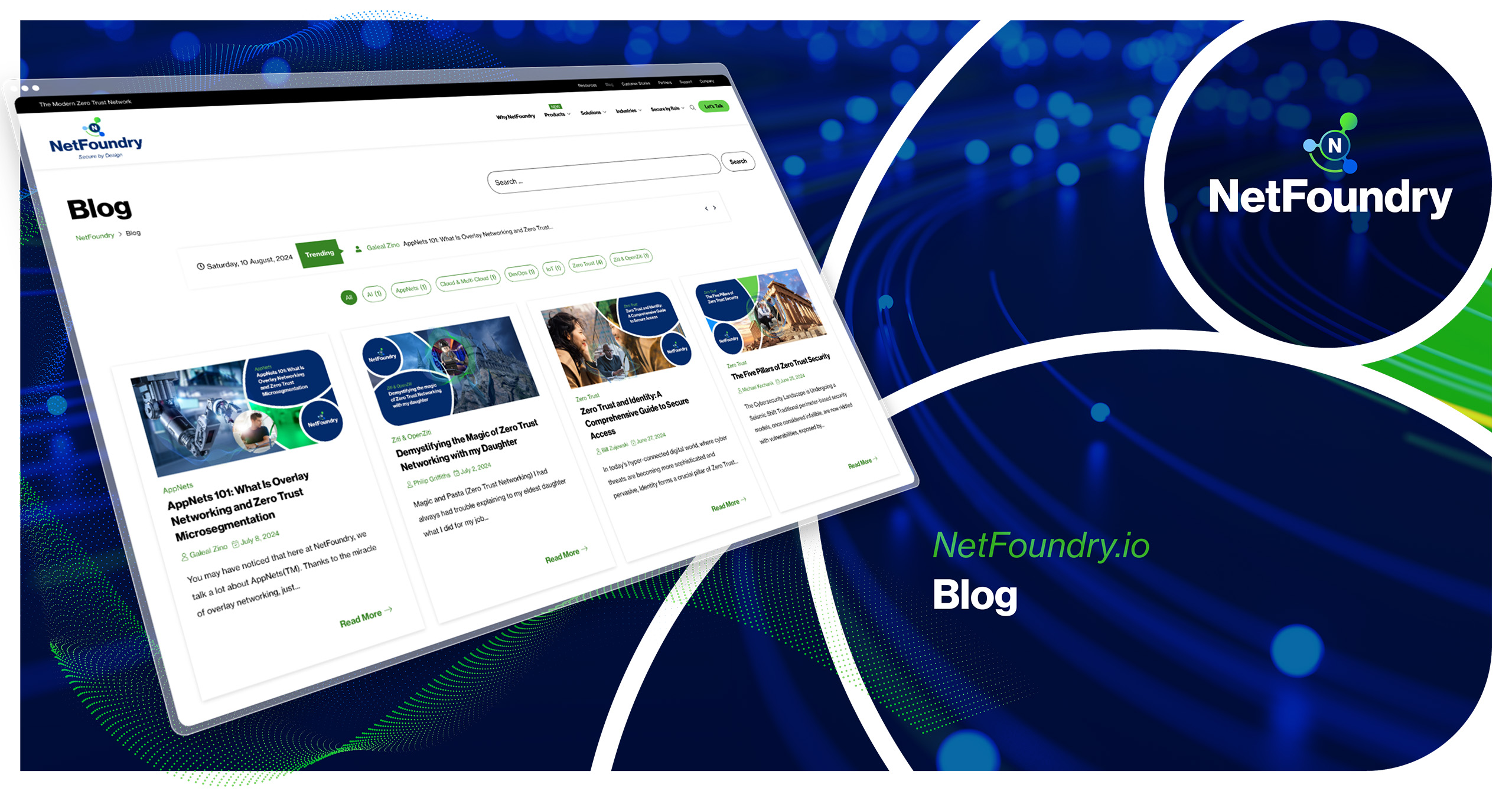
The website is organized around who is visiting, not what the organization contains. Products, solutions, industries, and personas each hold a defined role in the navigation, so a deep technical site stays easy to move through and no audience has to translate someone else’s page.

Paths begin wherever the visitor does. A software provider, a product manufacturer, and a service provider each find a path written in their own language. Persona and industry pages lead through solutions to the platform itself, with high-level story giving way to technical proof exactly as fast as the reader wants it.

Underneath is a publishing system shaped like NetFoundry’s content.

Dynamic blocks, faceted navigation, and cross-linking assemble pages from structured data, so a solution page pulls the right proof by default and a new one takes its place in the map the moment it publishes.

The system returned the site to the marketing team. Publishing that once waited on developers now happens at the speed of the news it carries, the framework holds the design so firmly that speed never loosens the brand, and every new page lands already knowing where it belongs.

New products, personas, resources, and stories entered through a shared architecture, deepening the site without changing how people understood it.

Studio display showing the Zero Trust Designed In homepage hero, a portrait in the wave ring above client logos.
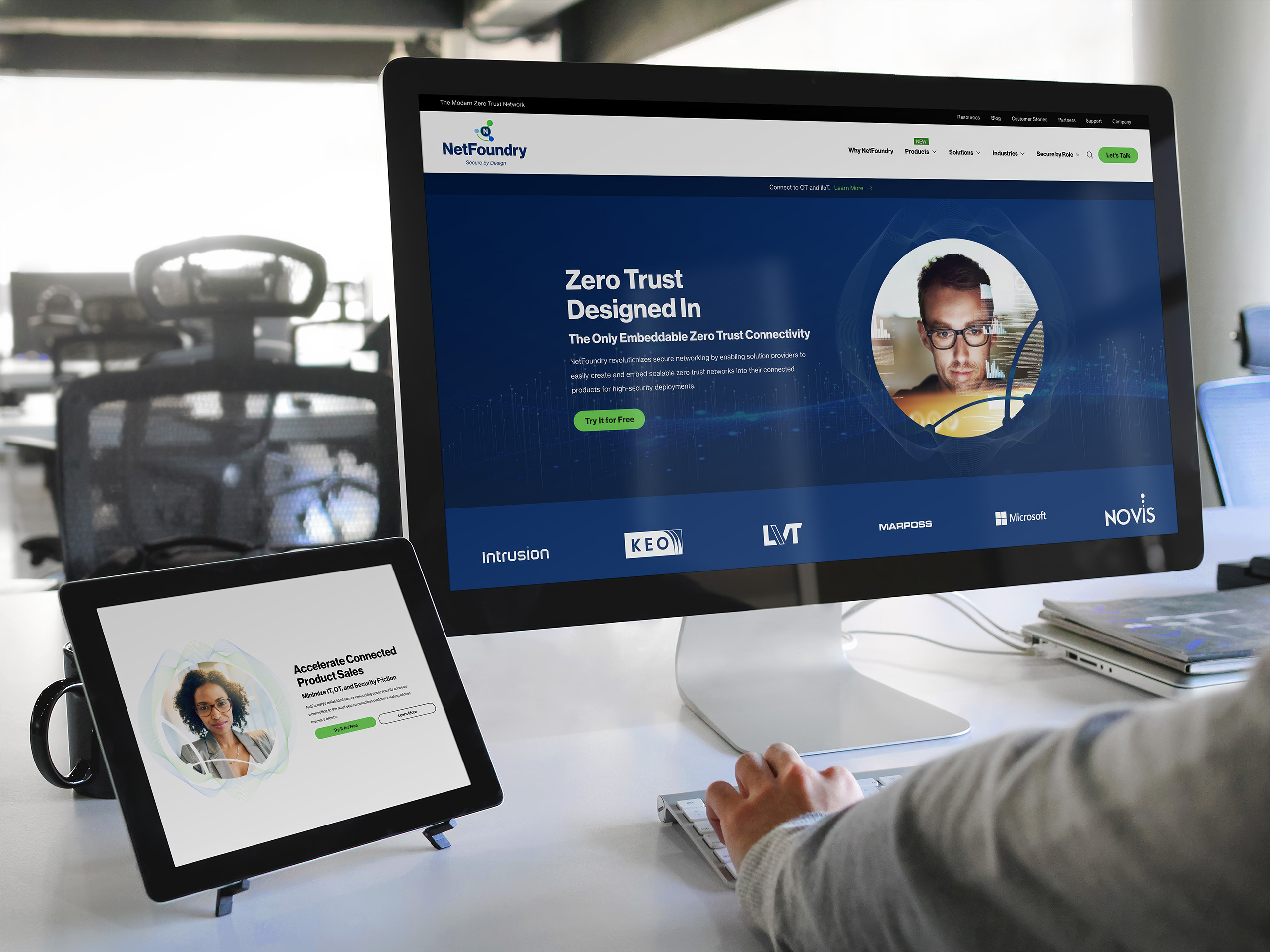
Desk with the homepage hero on a monitor and the product sales persona page propped on a tablet beside it.
Silhouetted man with a stylus reviews the About page on a stand-mounted tablet, stat tiles glowing green below the hero.
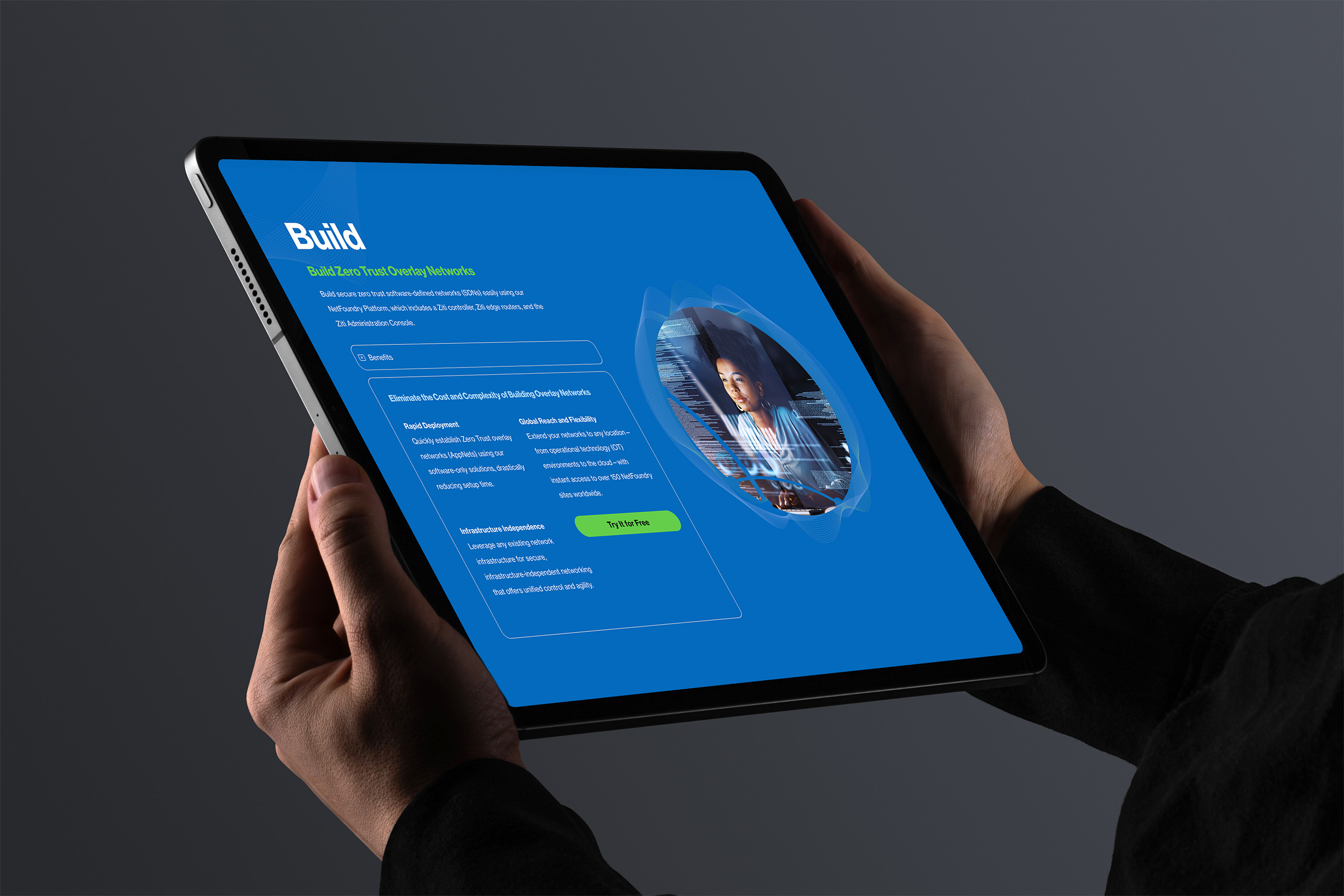
Hands hold a tablet showing the blue Build page for zero trust overlay networks, an engineer circle beside the checklist.
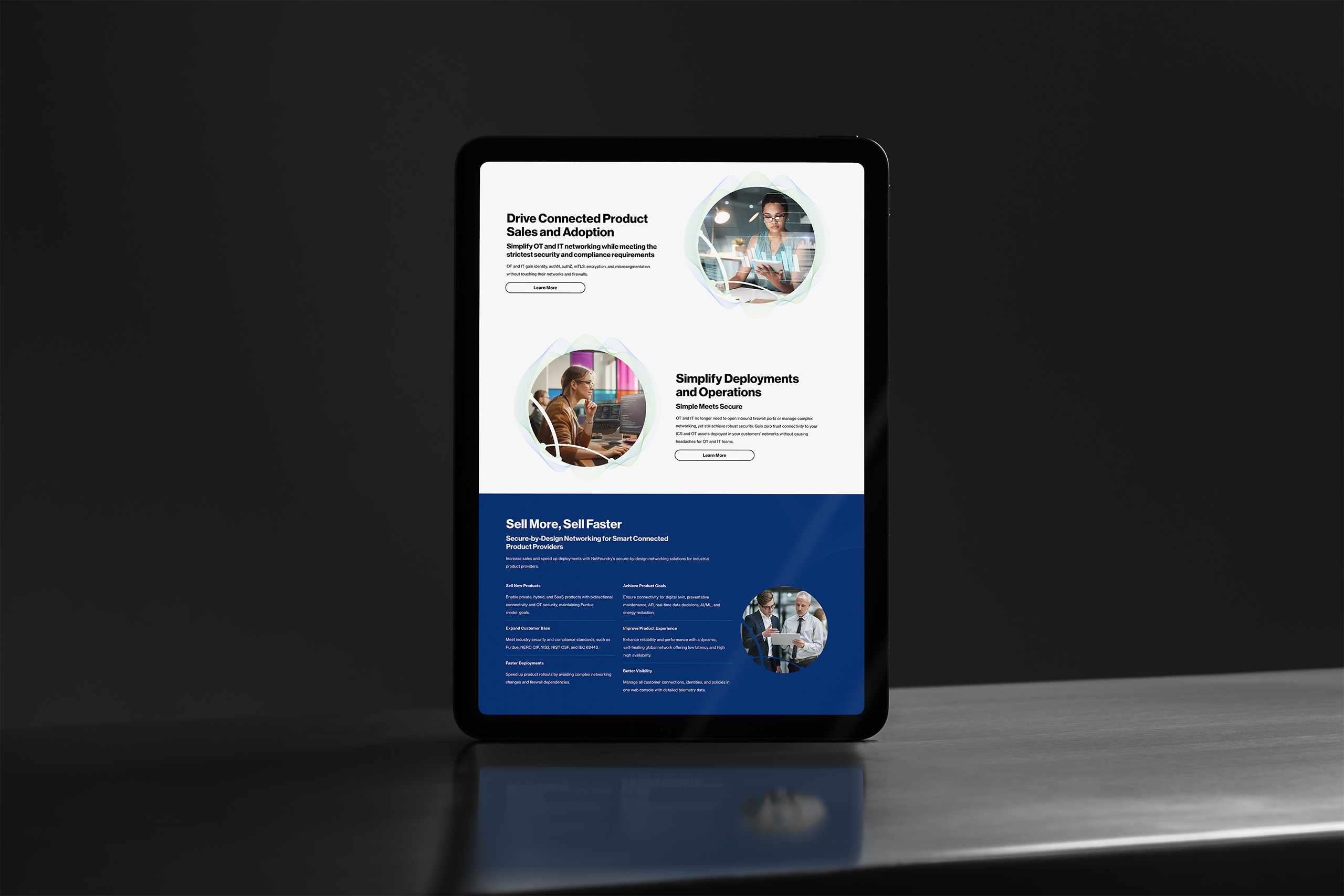
Tablet standing on steel showing the connected product sales page, circular team photos beside Sell More Sell Faster.
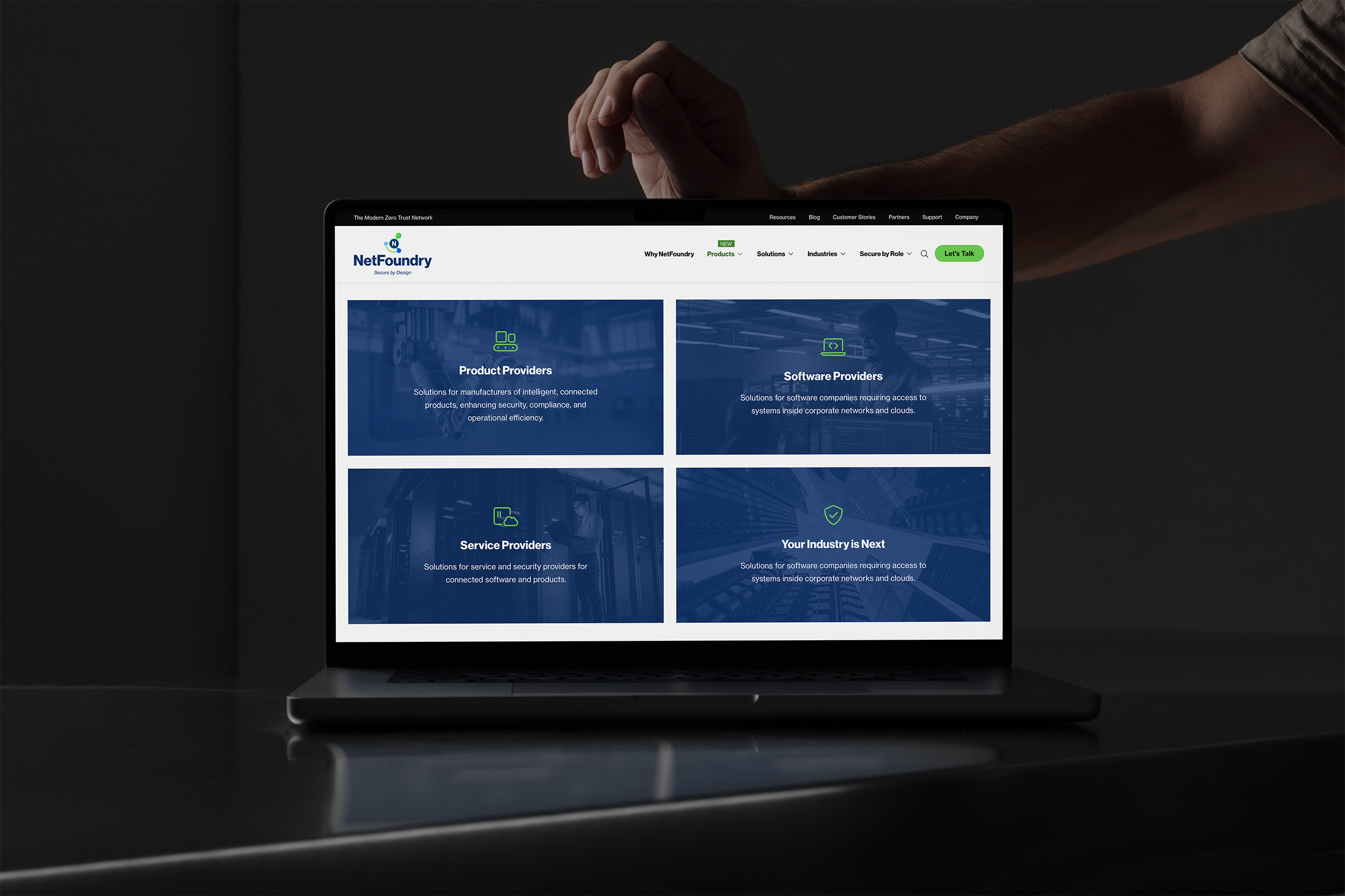
Hands reach over a laptop showing the four industry tiles from product providers to your industry is next.
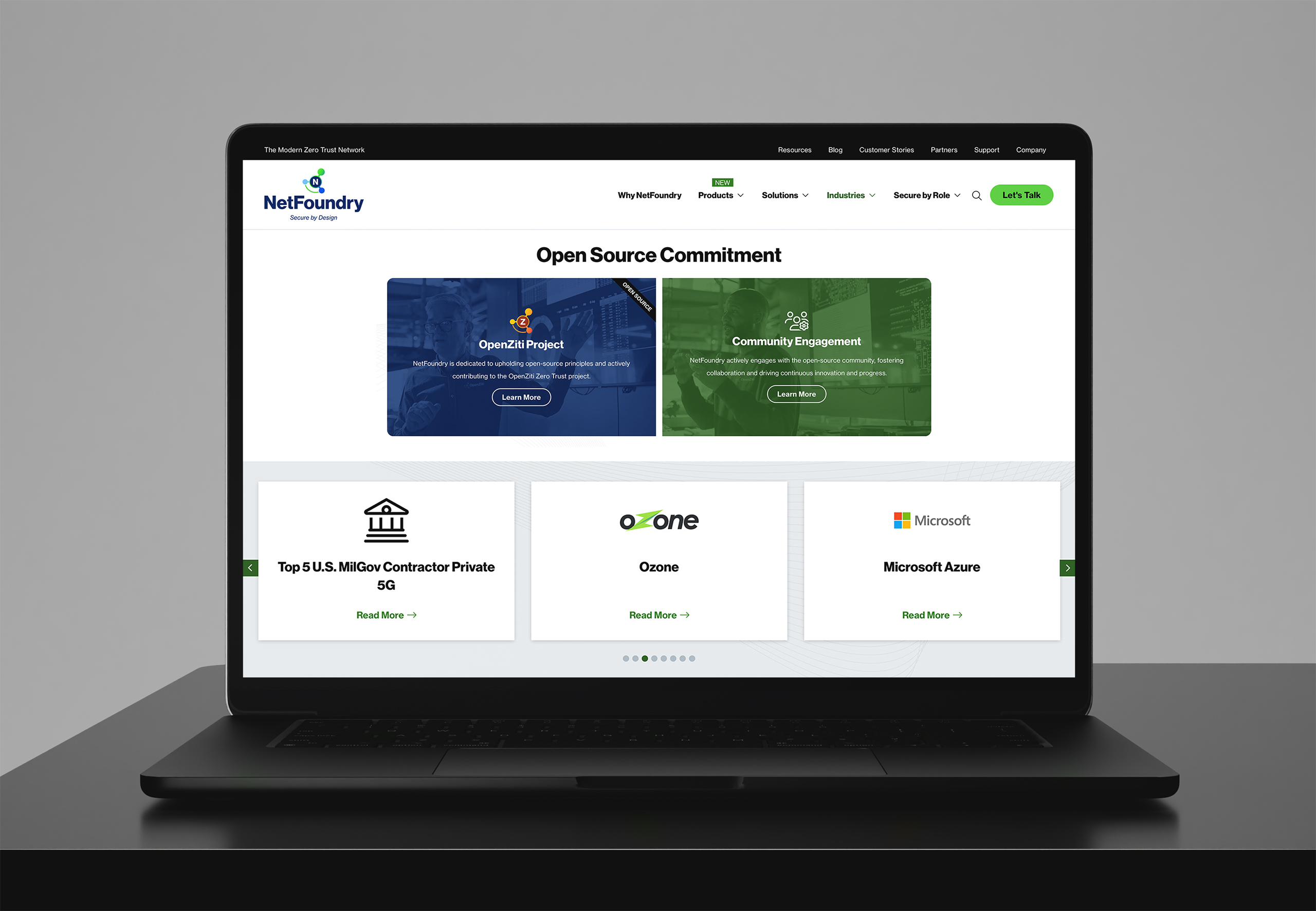
Laptop showing the Open Source Commitment page, OpenZiti project and community cards above customer story tiles.
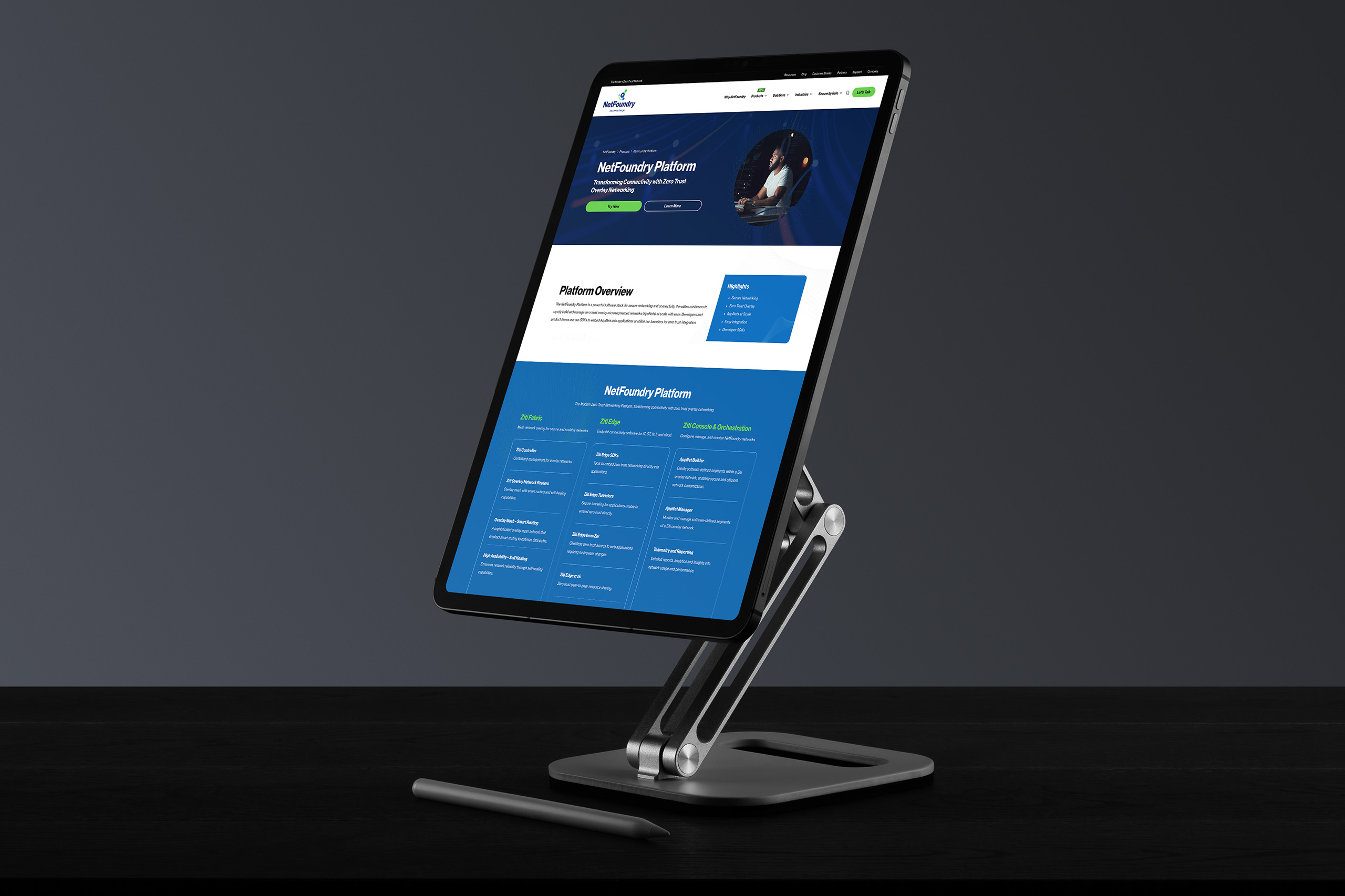
Stand-mounted tablet showing the NetFoundry Platform page, the overview panel above the blue capability grid.
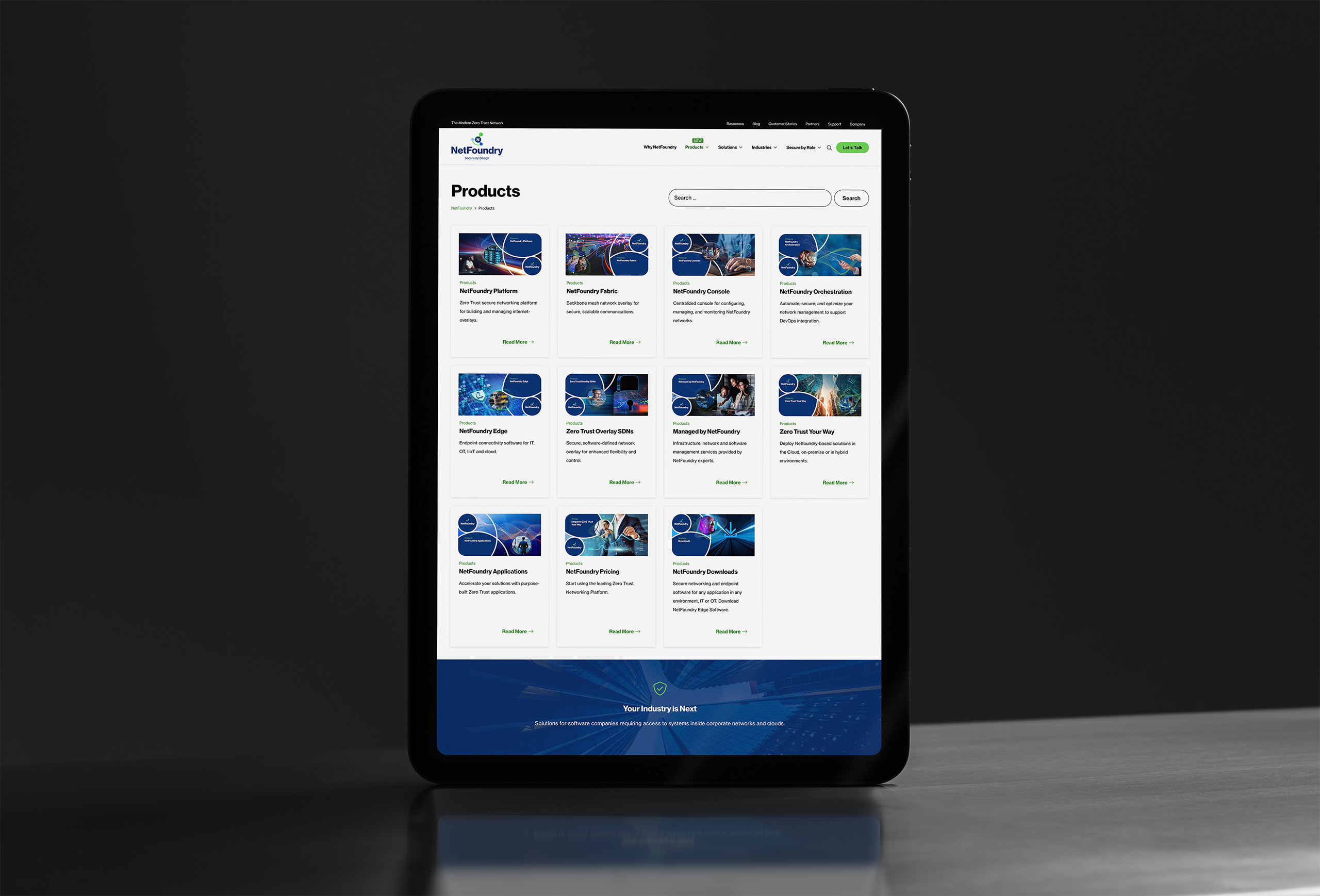
Tablet standing on steel showing the Products index, a dozen navy product cards from platform to downloads.
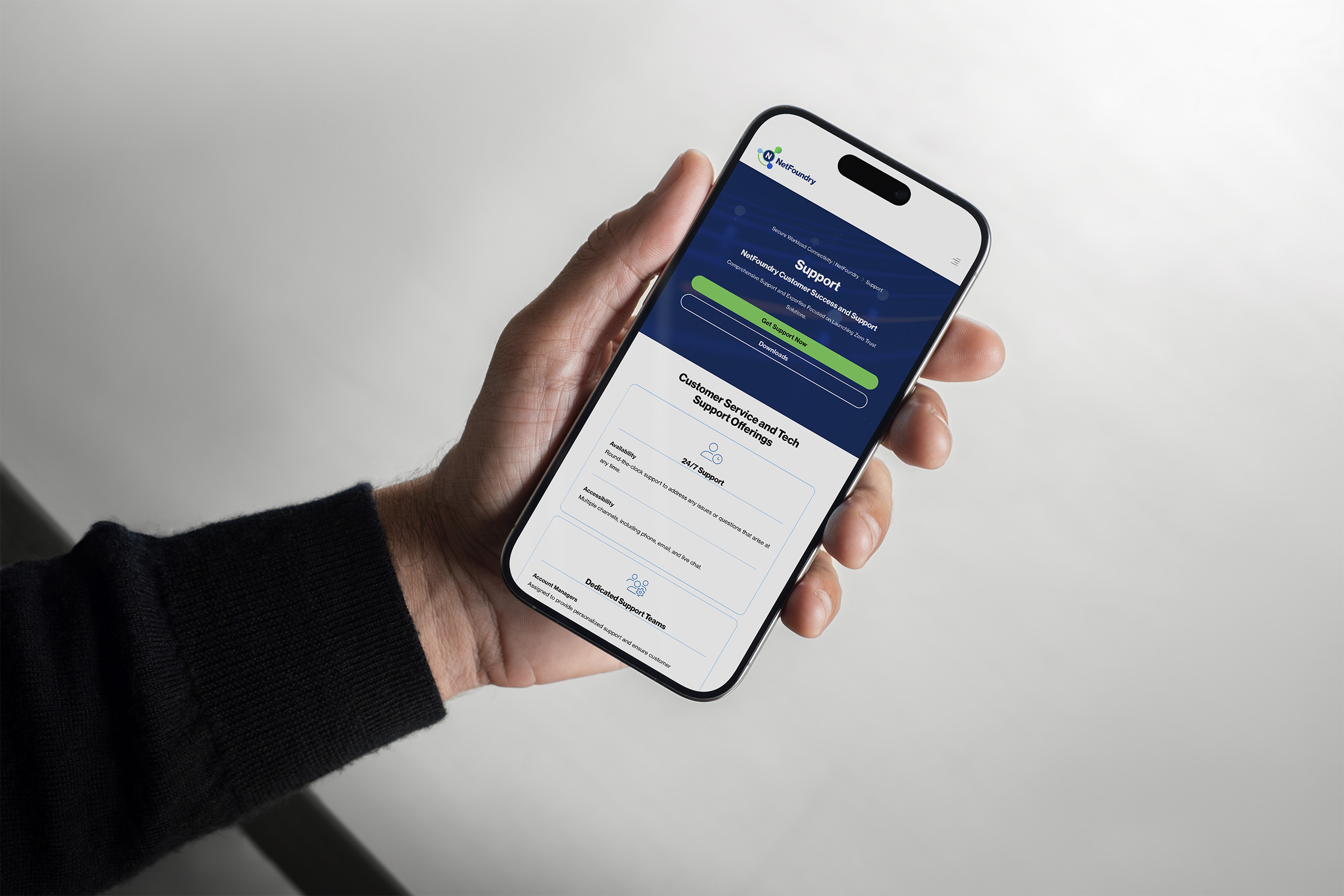
Hand holds a phone showing the Support page, customer service and tech support offerings listed beneath the navy header.
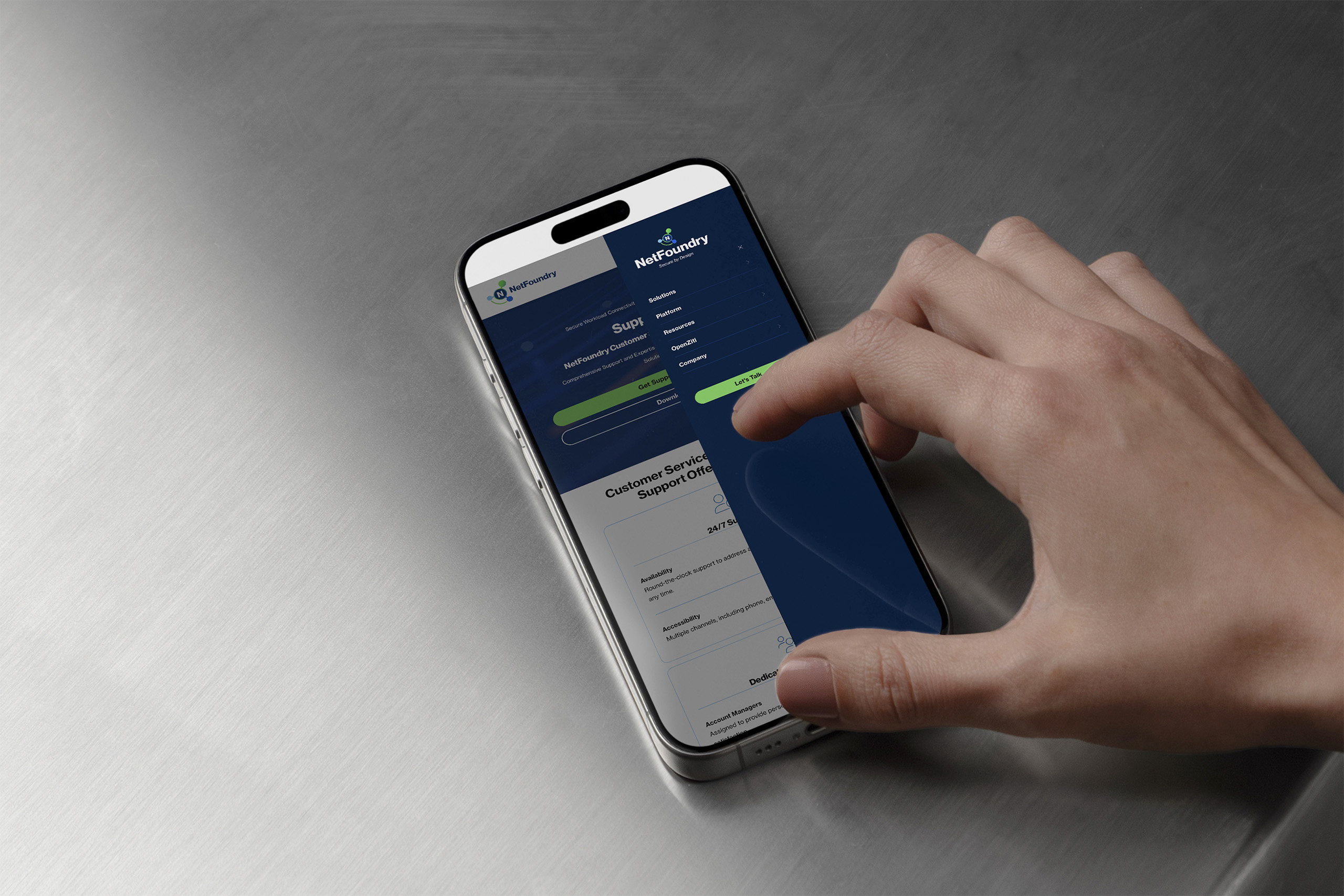
Finger taps the mobile support menu over the customer service page, green buttons stacking under the logo.
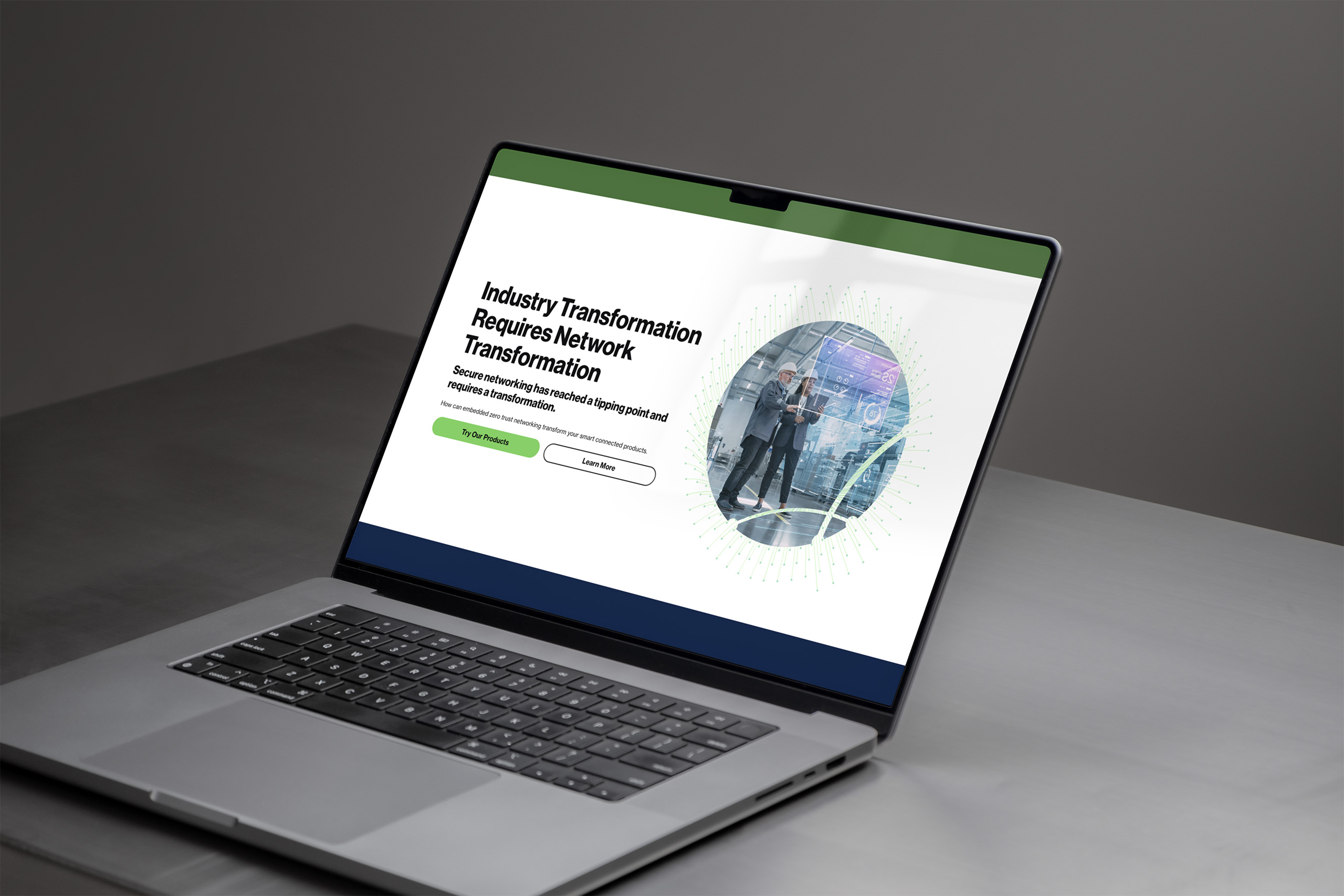
Laptop showing the Industry Transformation Requires Network Transformation hero, a skyline circle beside the green call-to-action.
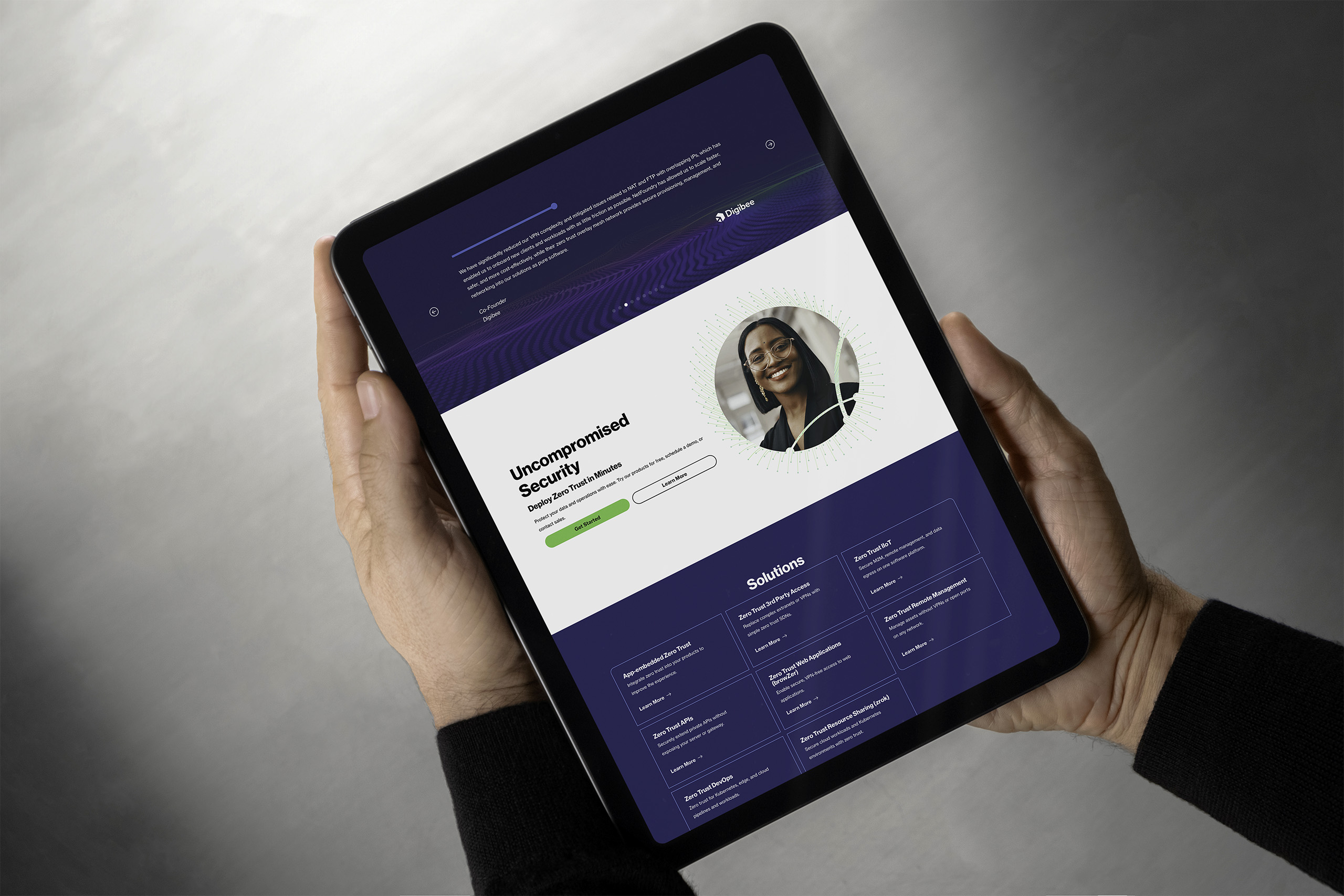
Hands hold a tablet showing the Uncompromised Security page, a portrait circle above the purple solutions grid.
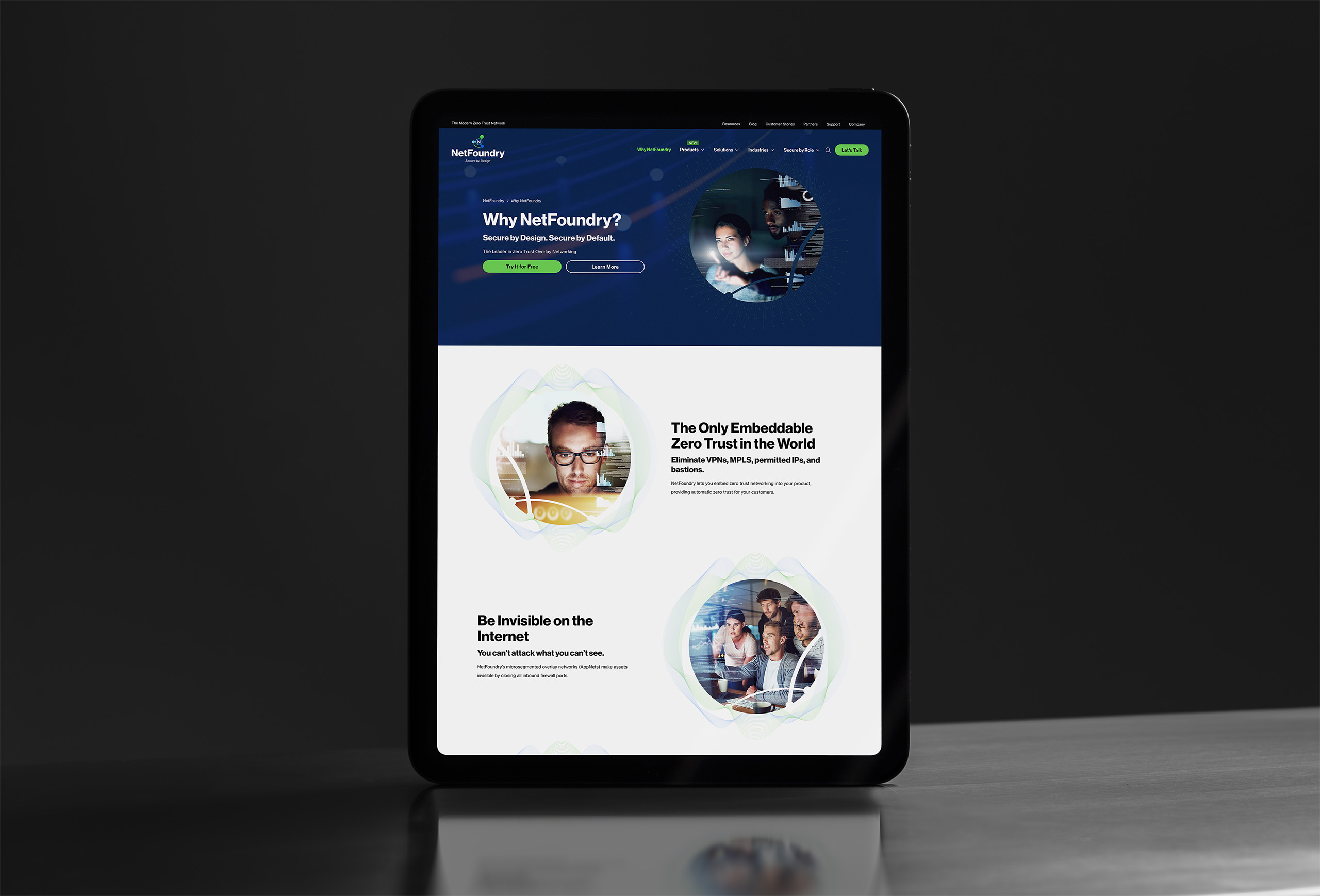
Tablet standing in low light showing the Why NetFoundry page, embeddable zero trust and Be Invisible on the Internet panels.
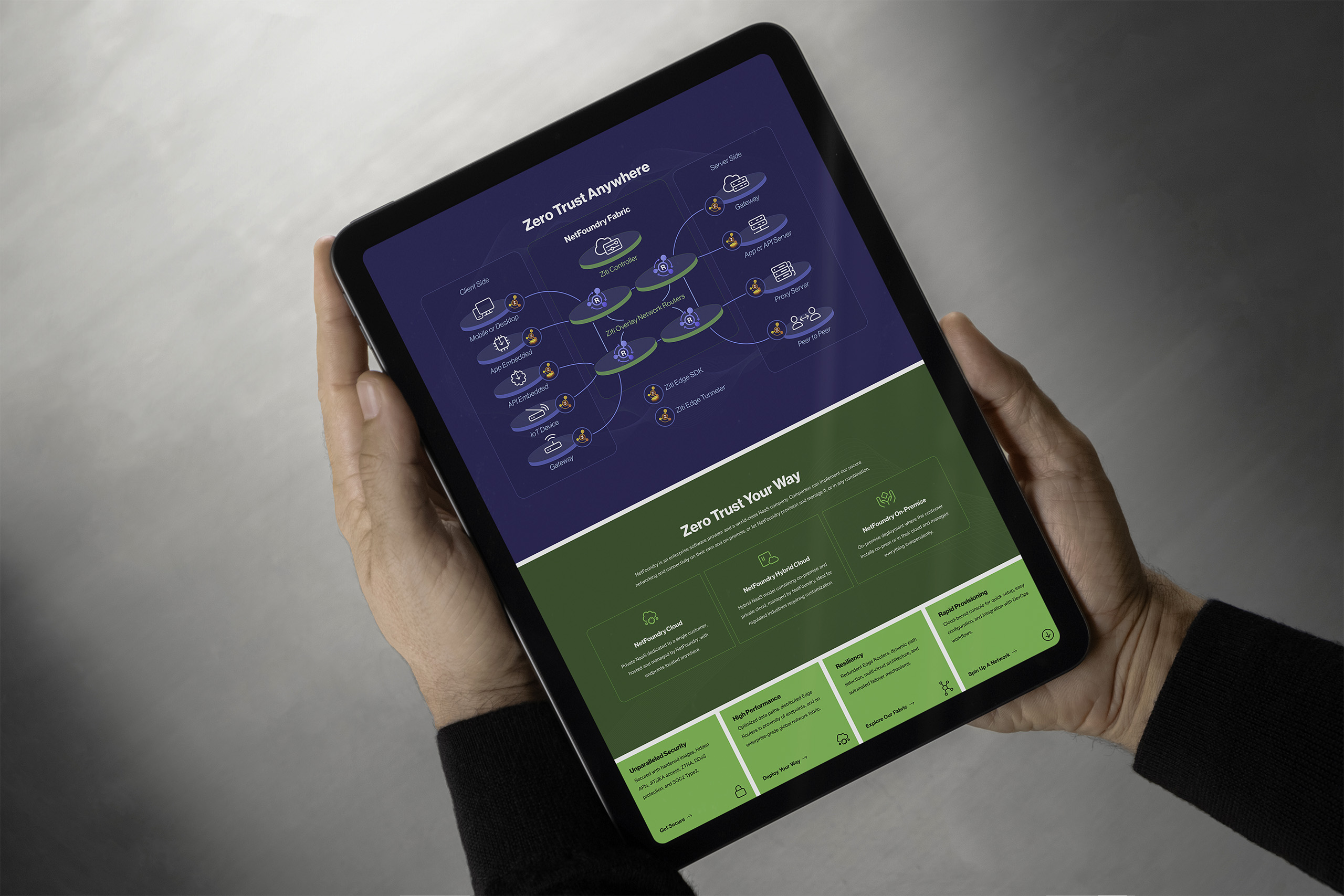
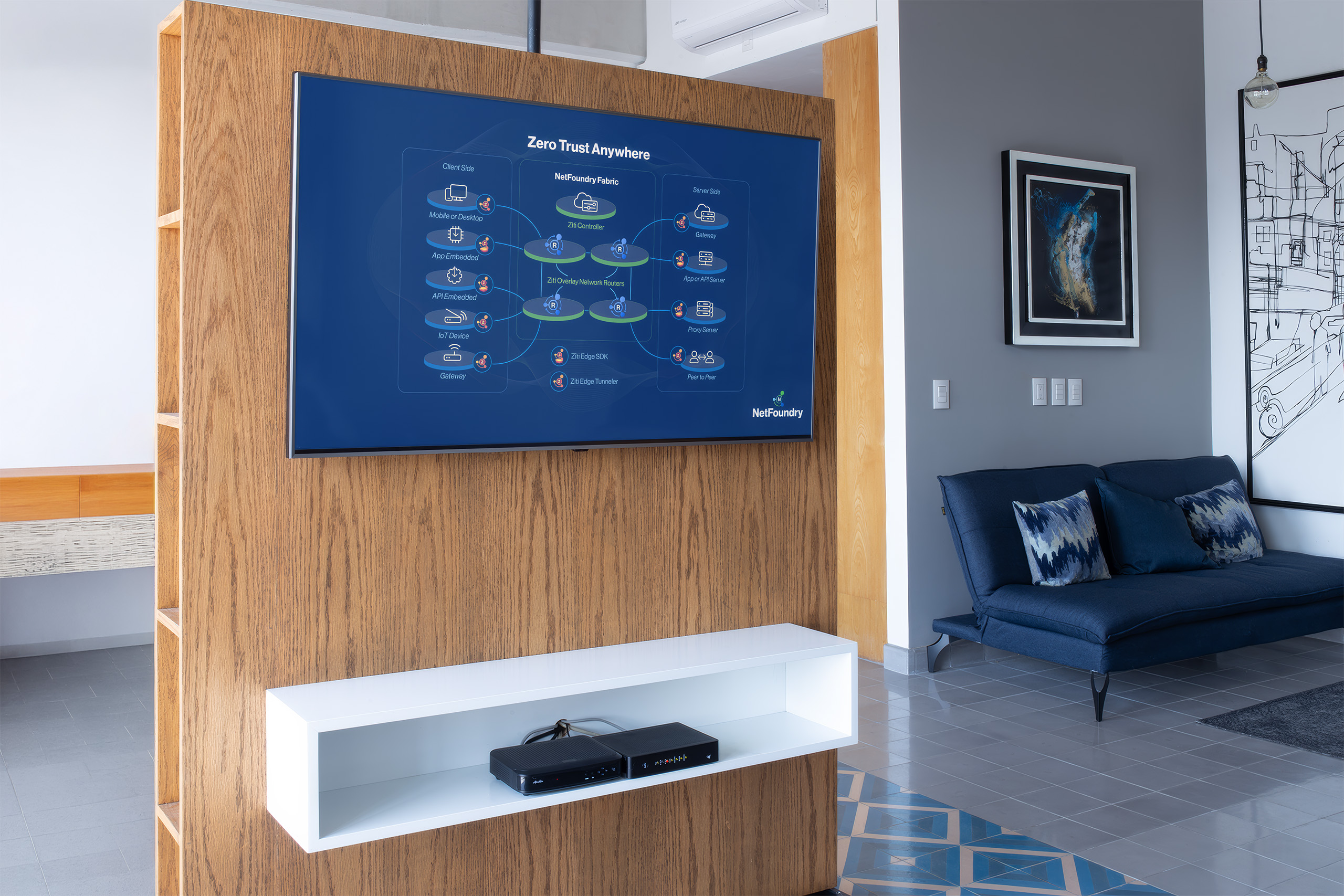
Hands hold a tablet showing the Zero Trust Anywhere fabric diagram above the green Zero Trust Your Way tiles.
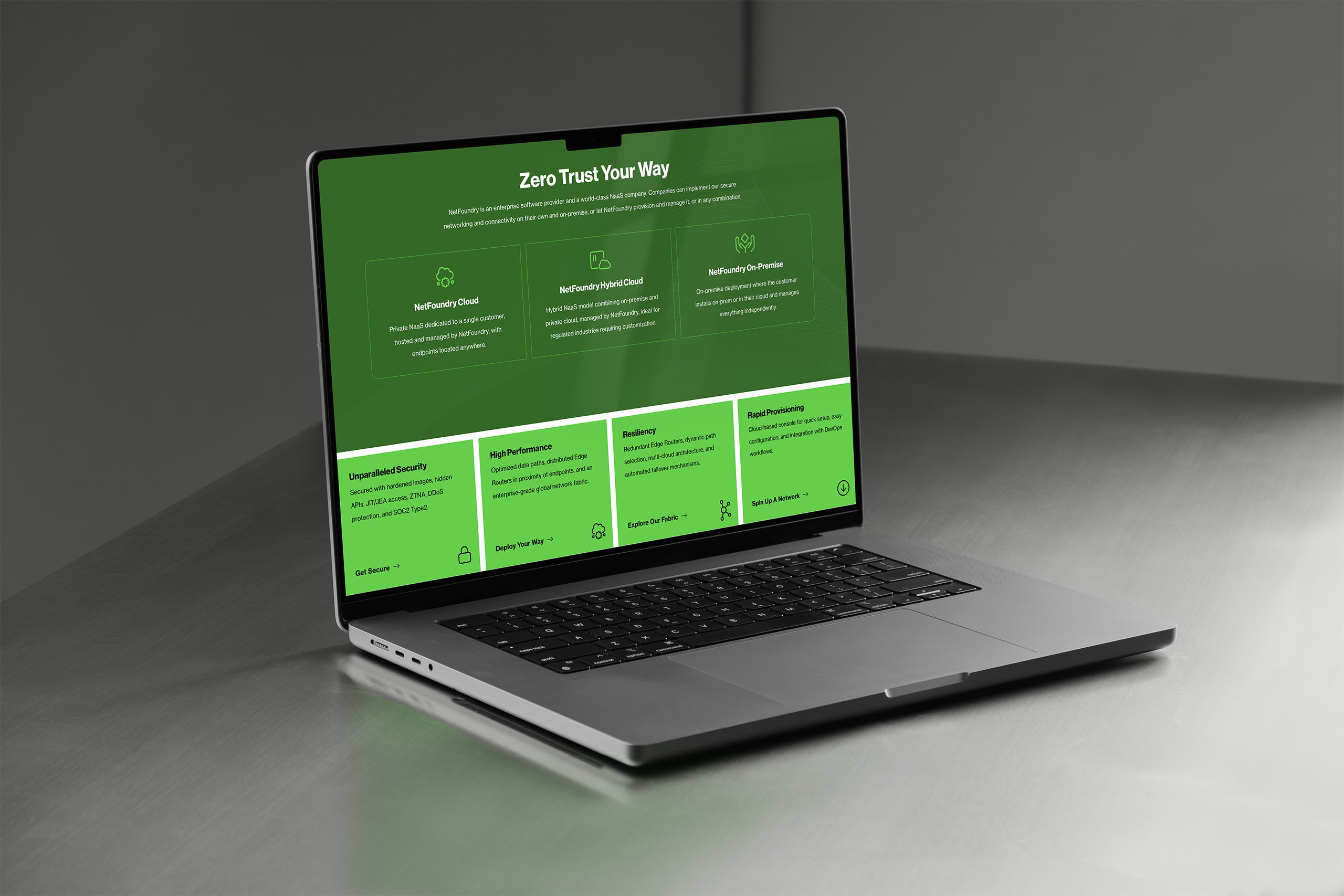
Laptop showing the green Zero Trust Your Way page, three deployment models above bright benefit tiles.
Finger scrolls the Zero Trust Your Way deployment options on a tablet, cloud details filling the navy panel below.
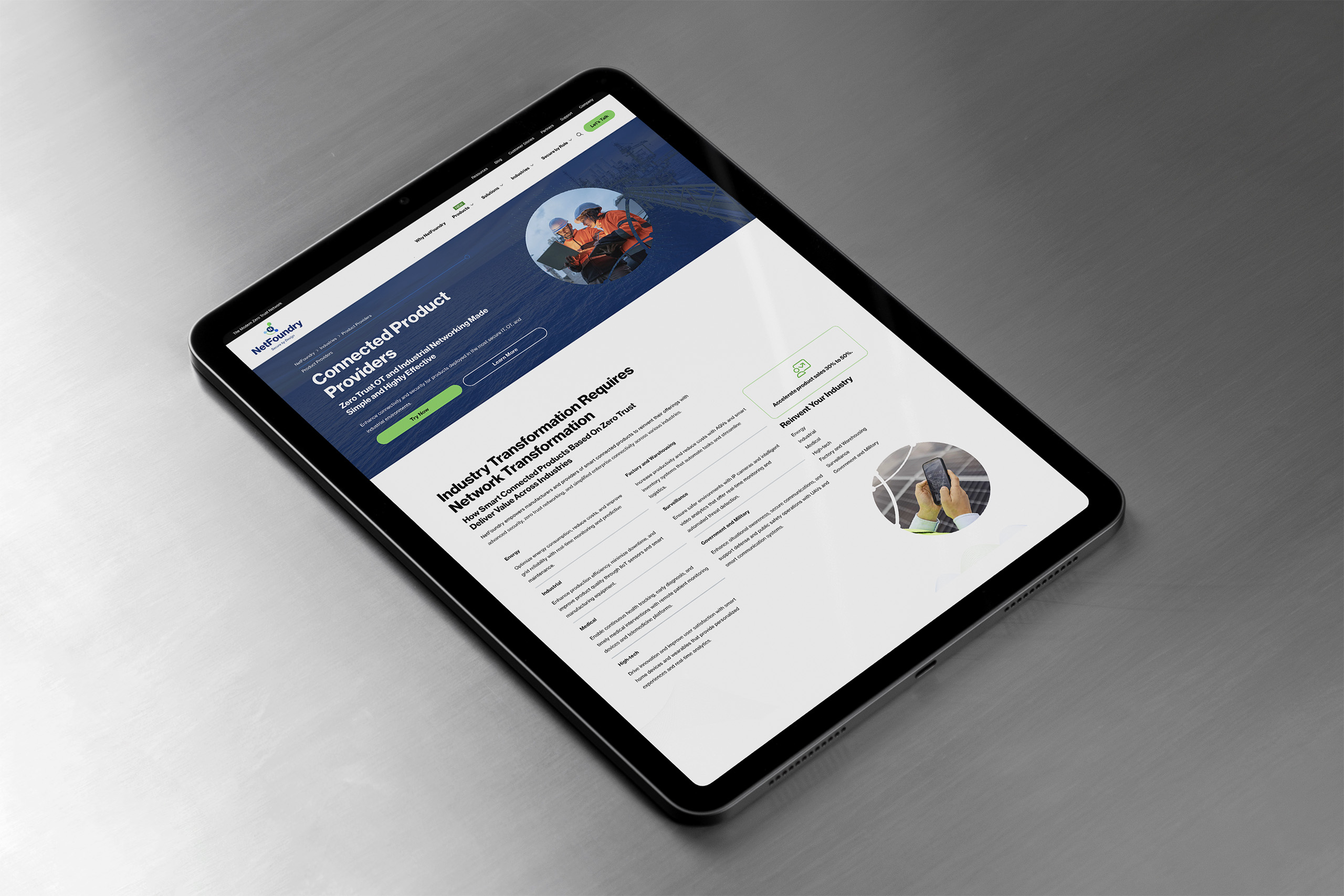
Tablet flat on brushed steel showing the Connected Product Providers page, industry transformation copy above answer panels.

Pitch Deck

NetFoundry’s product story had the same problem its website once had: too much truth for one straight line. A platform, its products, an open source project, three audiences, and three deployment models cannot march single file through a fixed deck without losing the room.

So I built the presentation the way we built the site: as a map. A ten-slide core tells the whole story at overview altitude, and PowerPoint’s Zoom feature turns each slide into a doorway. The presenter can drop into any product, audience, or proof point, then surface back to the big picture without breaking stride.

The deck reads the room instead of fighting it. An investor gets the arc in ten slides. An engineer pulls the conversation into the architecture and finds real depth waiting. Either way the presenter never scrolls, never apologizes, never loses the thread. The carousel shows both layers: the ten-slide spine and, behind it, the zooms a presenter can call on when someone asks for the depth.
Every slide keeps the identity’s geometry, so the deck feels like the website, which feels like the brand, which feels like the product. The sales team made it their favorite tool for pitching prospects and investors alike. Ten slides, when they are the right ten, can hold an entire platform.
Title slide for The Future of Securely Connected Industries, circuit-board and engineer photos in circles beside the logo.
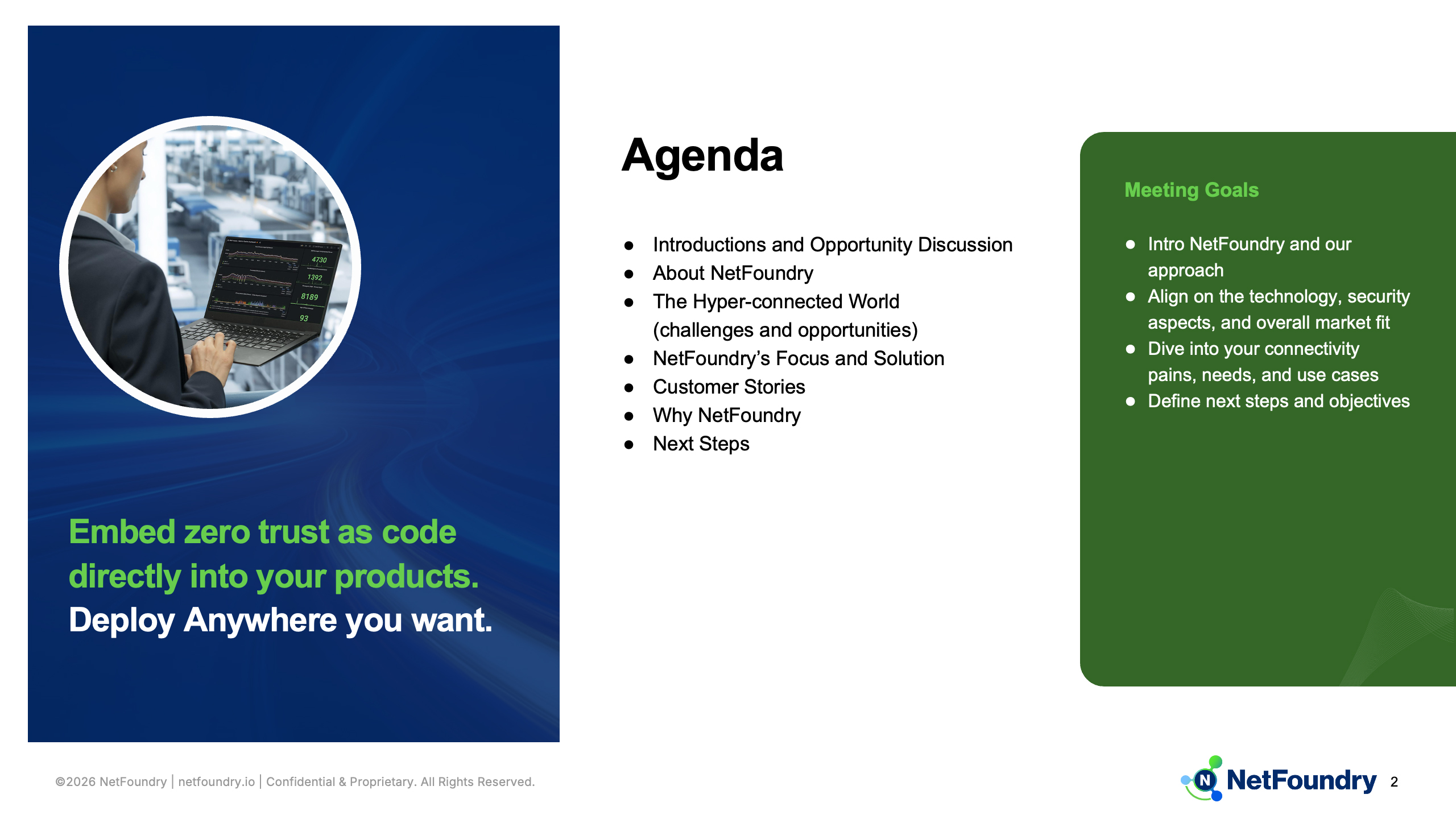
Agenda slide with meeting goals panel, embed zero trust as code directly into your products on the navy card.
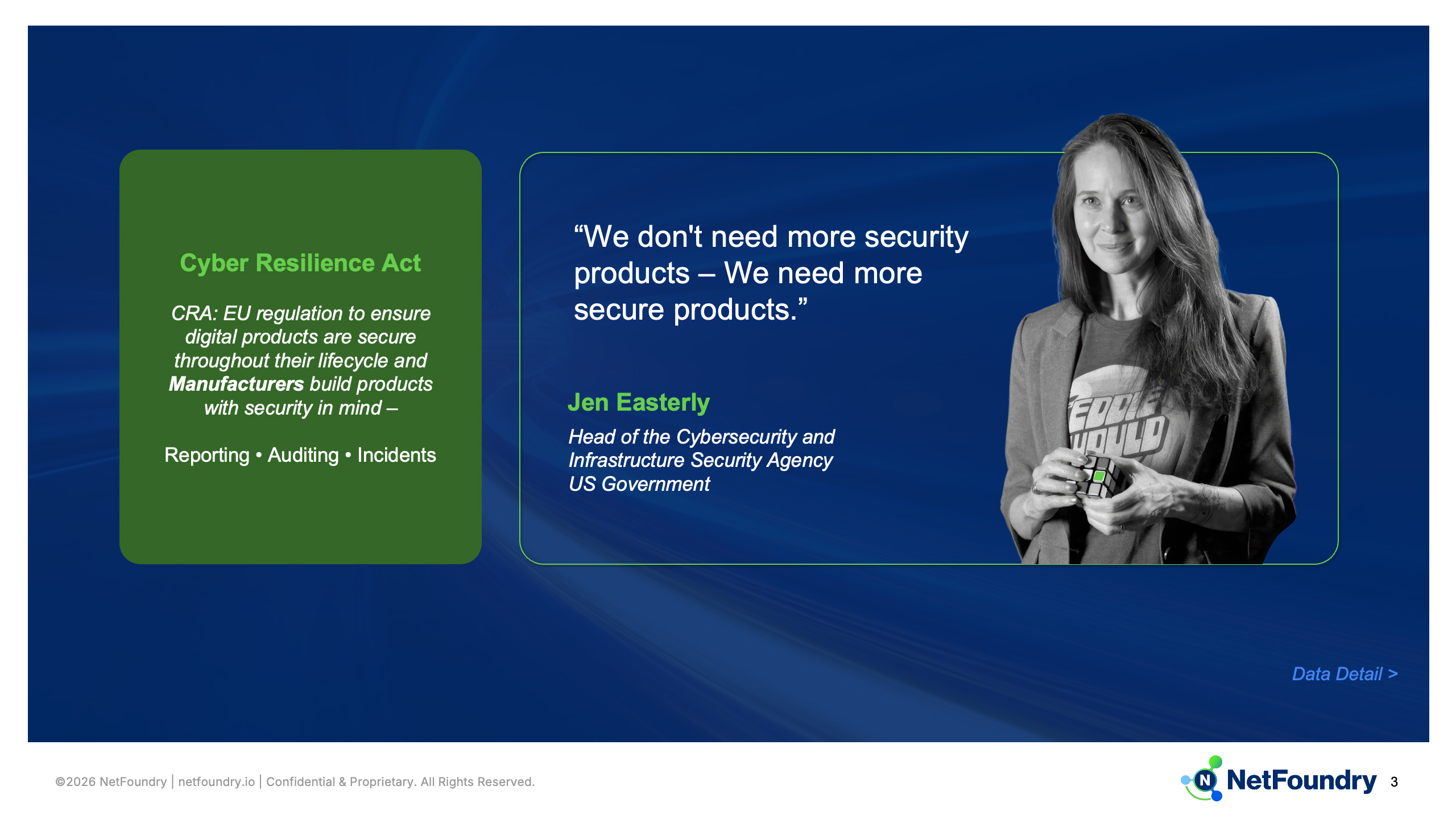
Slide pairing the EU Cyber Resilience Act summary with Jen Easterly quote, we need more secure products.
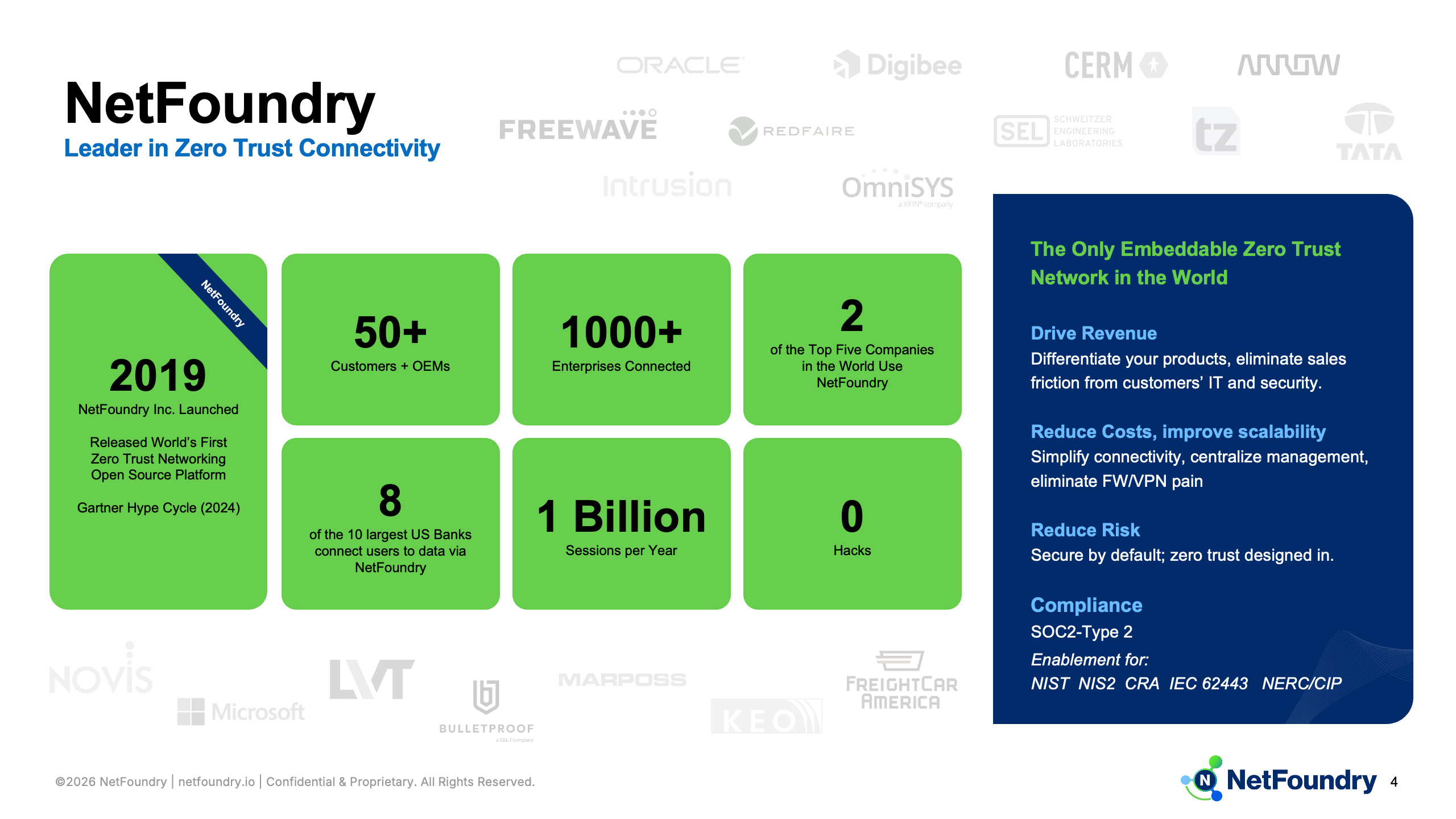
Stats slide ringed by customer logos, green tiles from 2019 launch to one billion sessions and zero hacks.
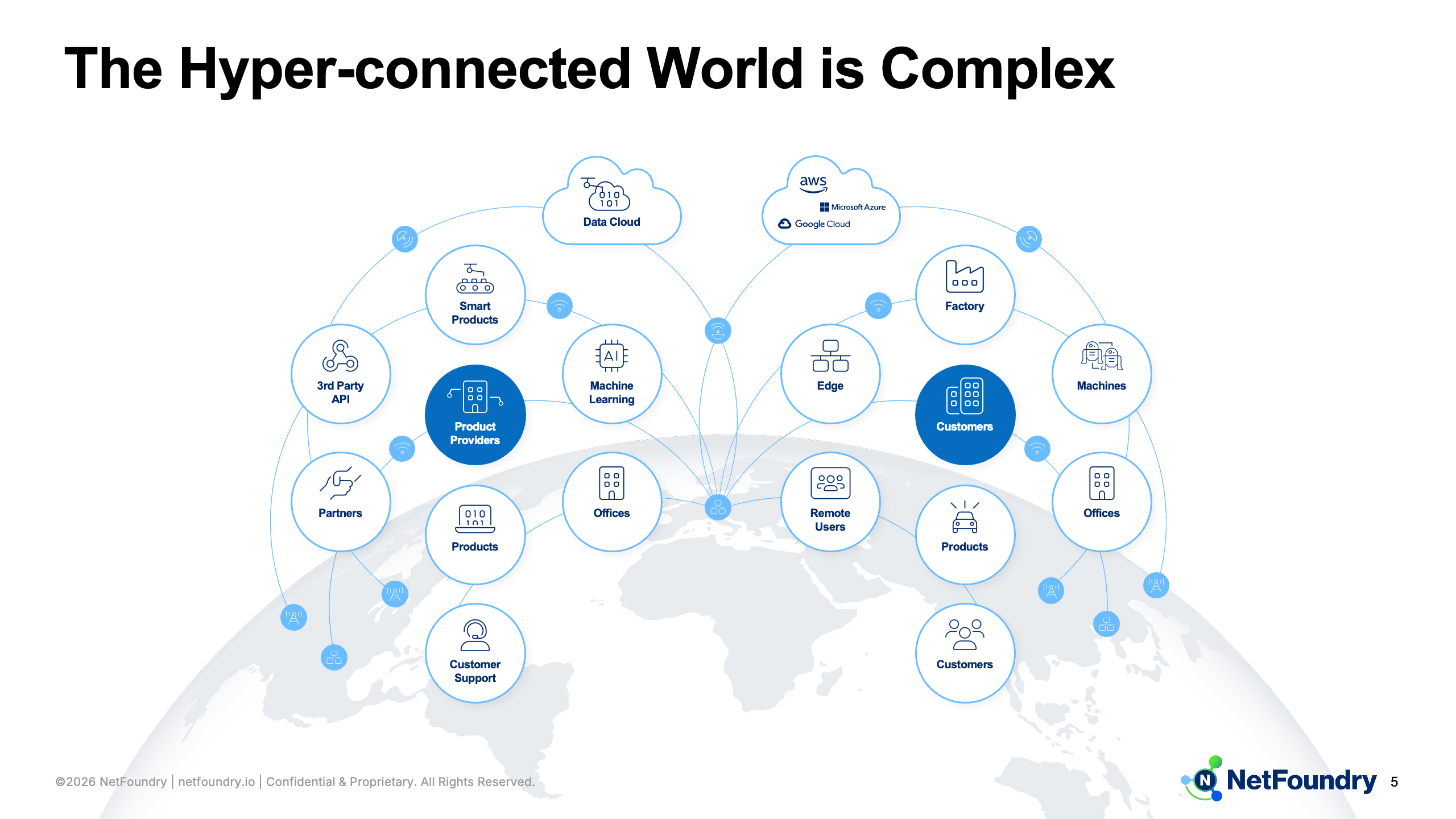
Slide mapping the hyper-connected world, provider and customer ecosystems arcing over the globe in linked circles.
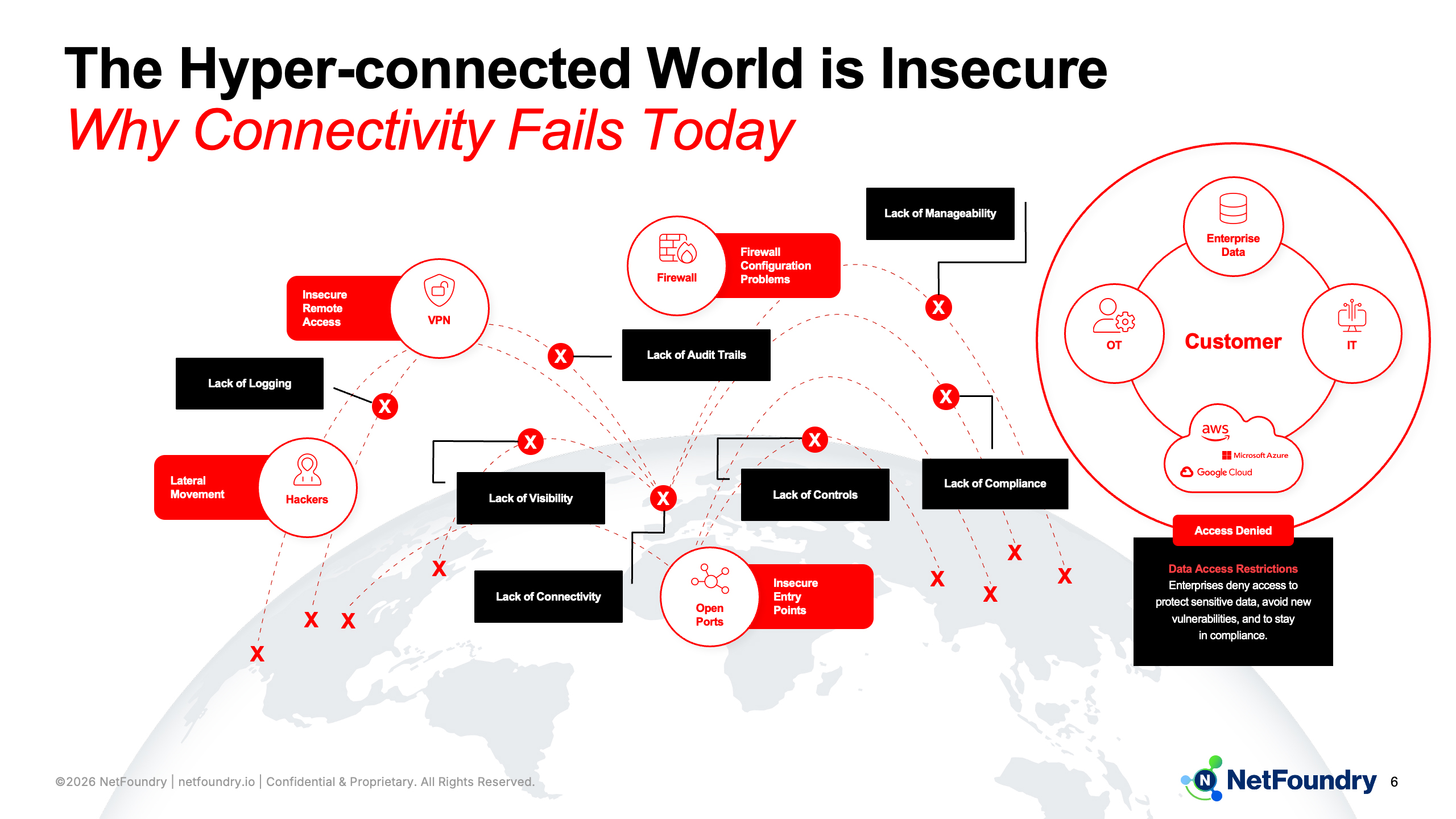
Red-flagged diagram of insecure connectivity, VPNs, open ports, and hackers crossing dotted paths toward the customer ring.
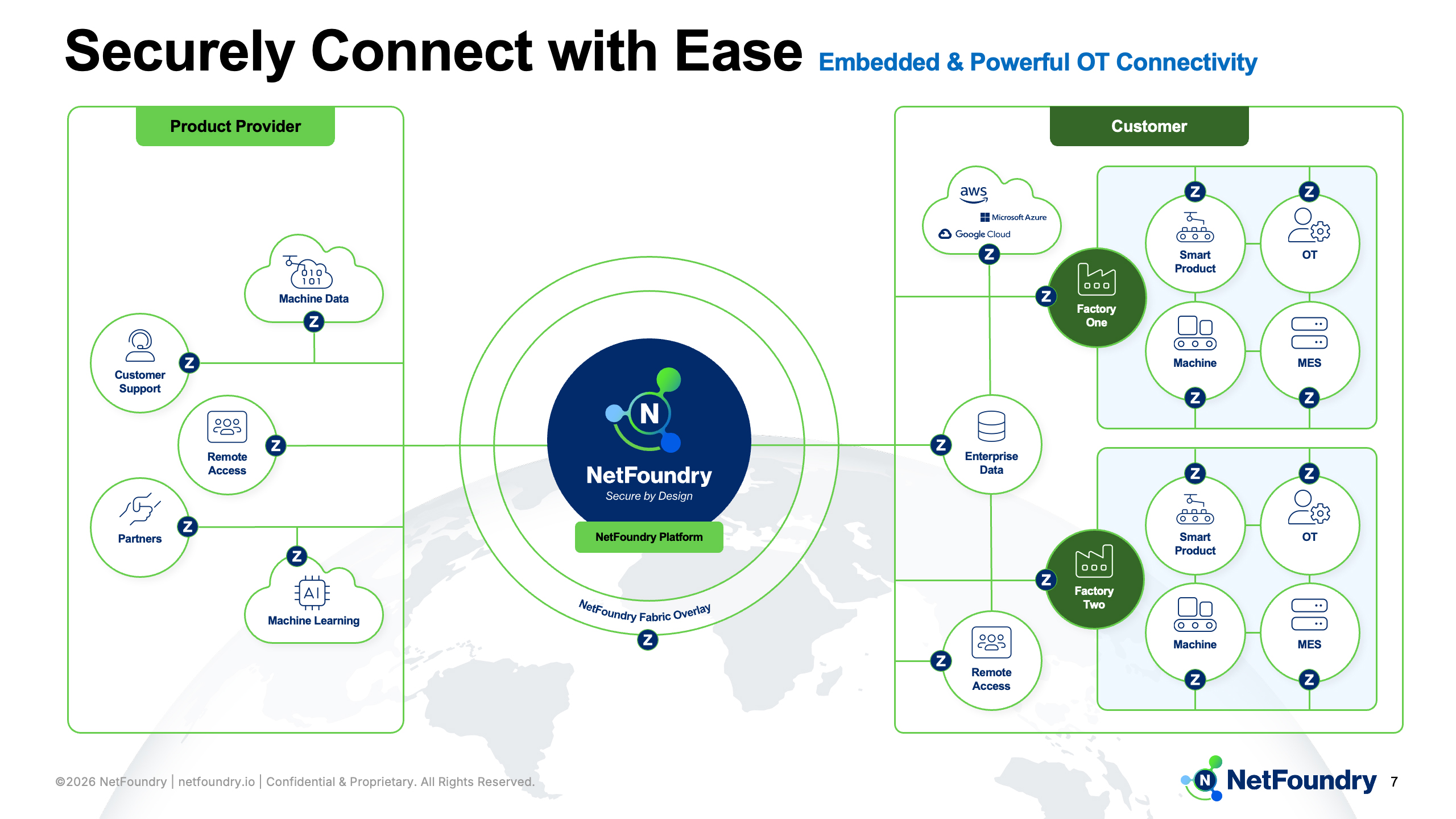
Diagram slide connecting provider ecosystems through the platform ring to customer factories over the fabric overlay.
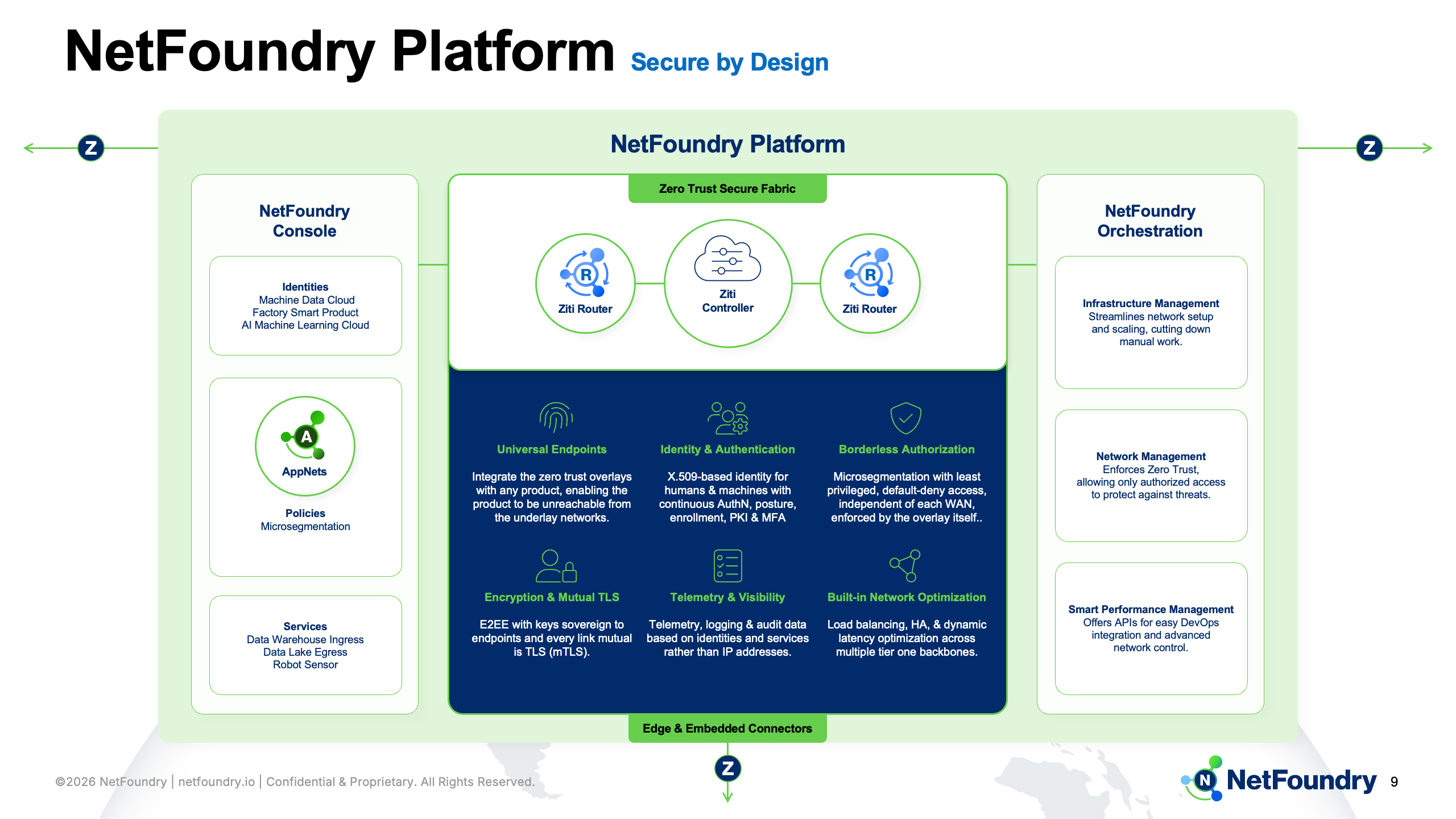
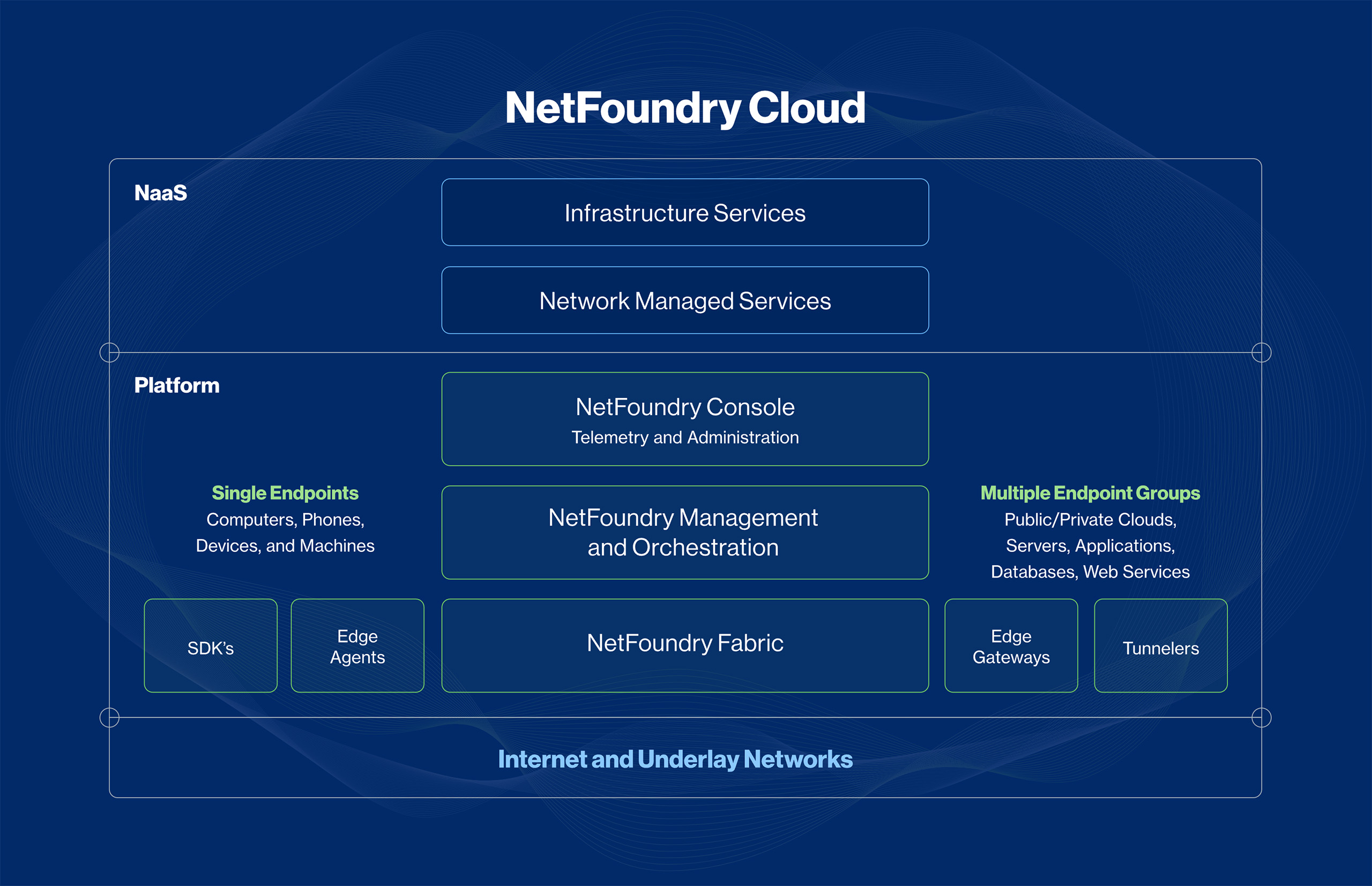
Platform slide detailing console, secure fabric, and orchestration columns beneath the Secure by Design banner.
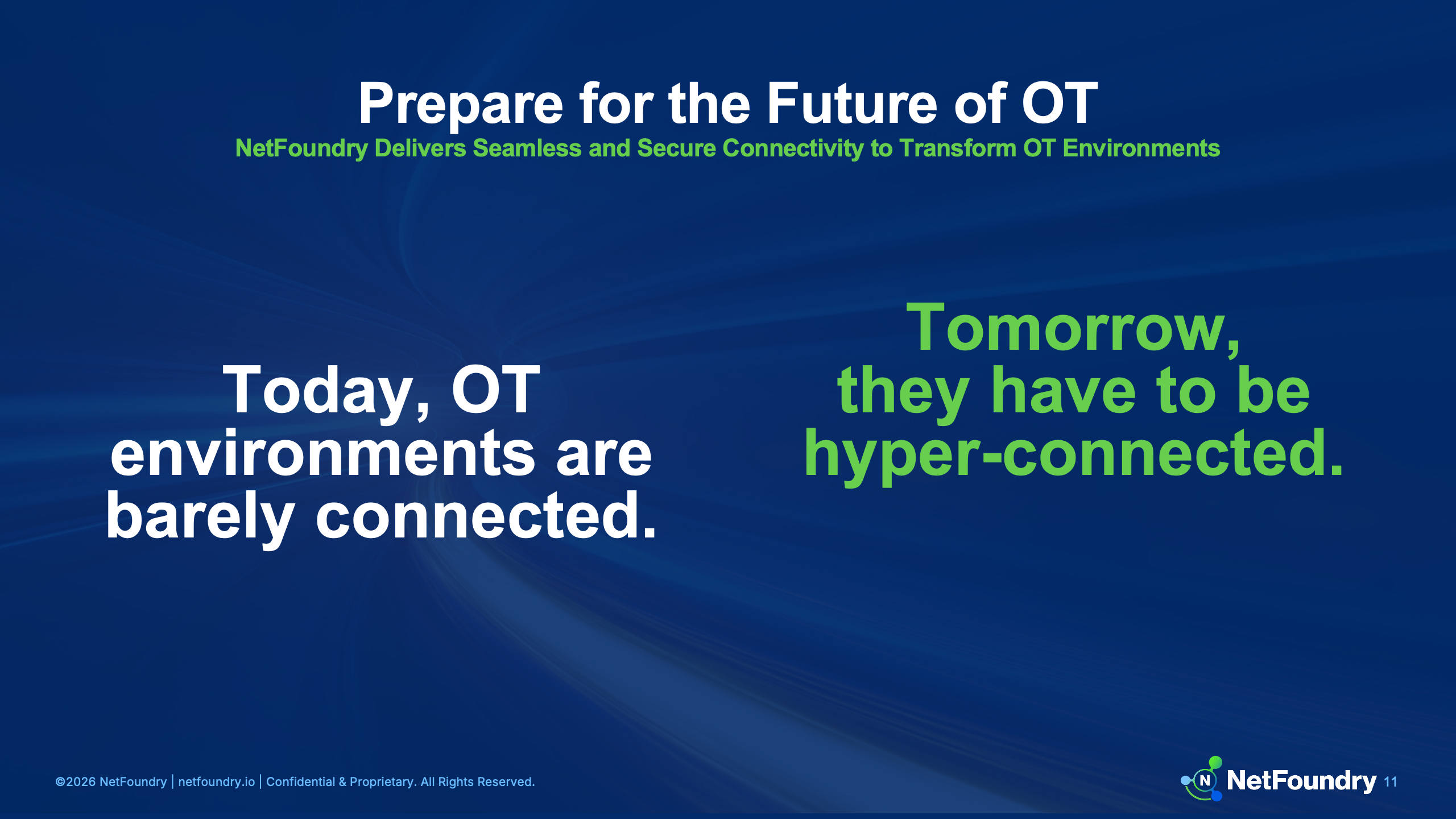
Message slide on navy, today OT environments are barely connected, tomorrow they have to be hyper-connected.
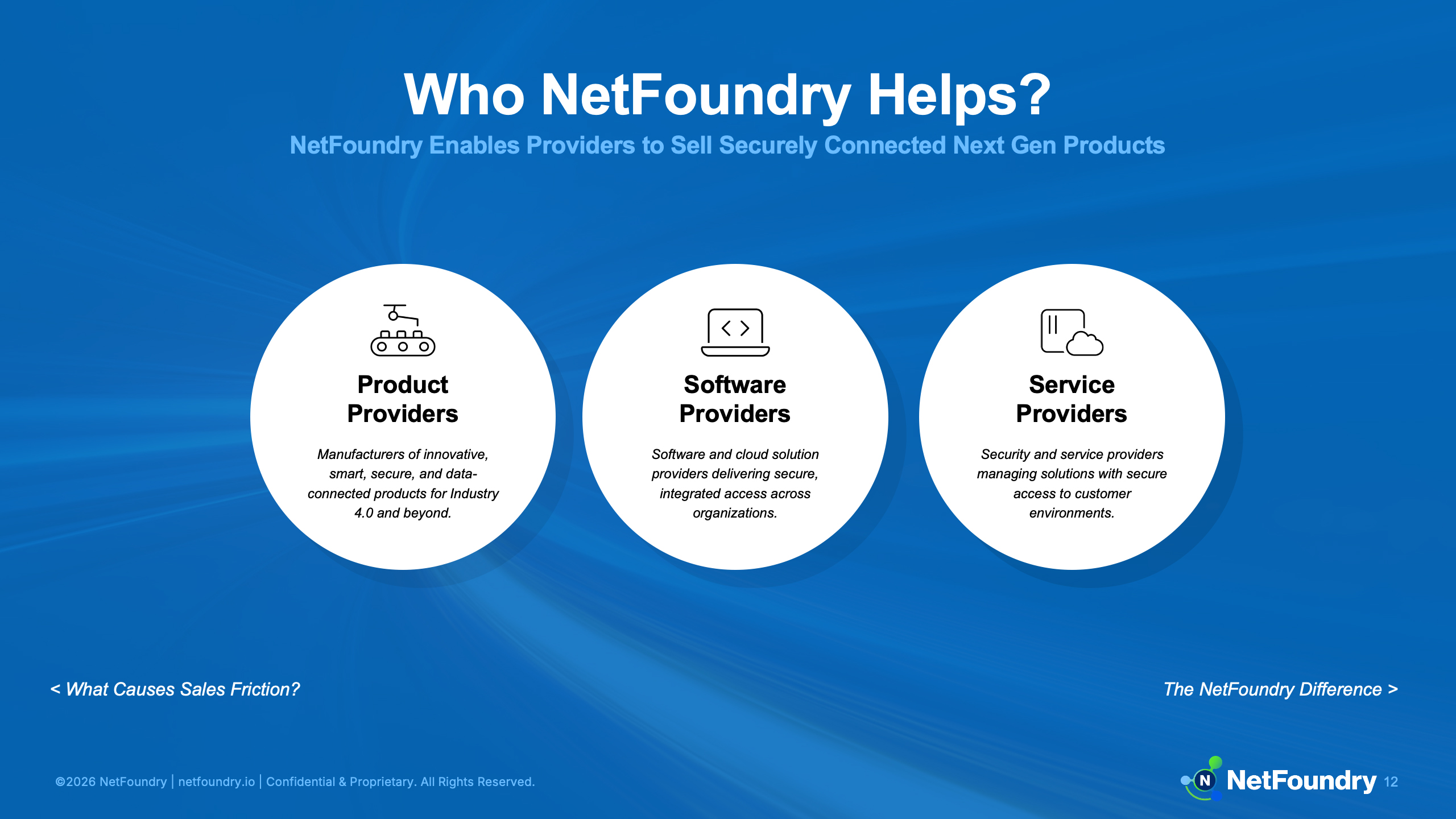
Slide of three white circles for product, software, and service providers under Who NetFoundry Helps.
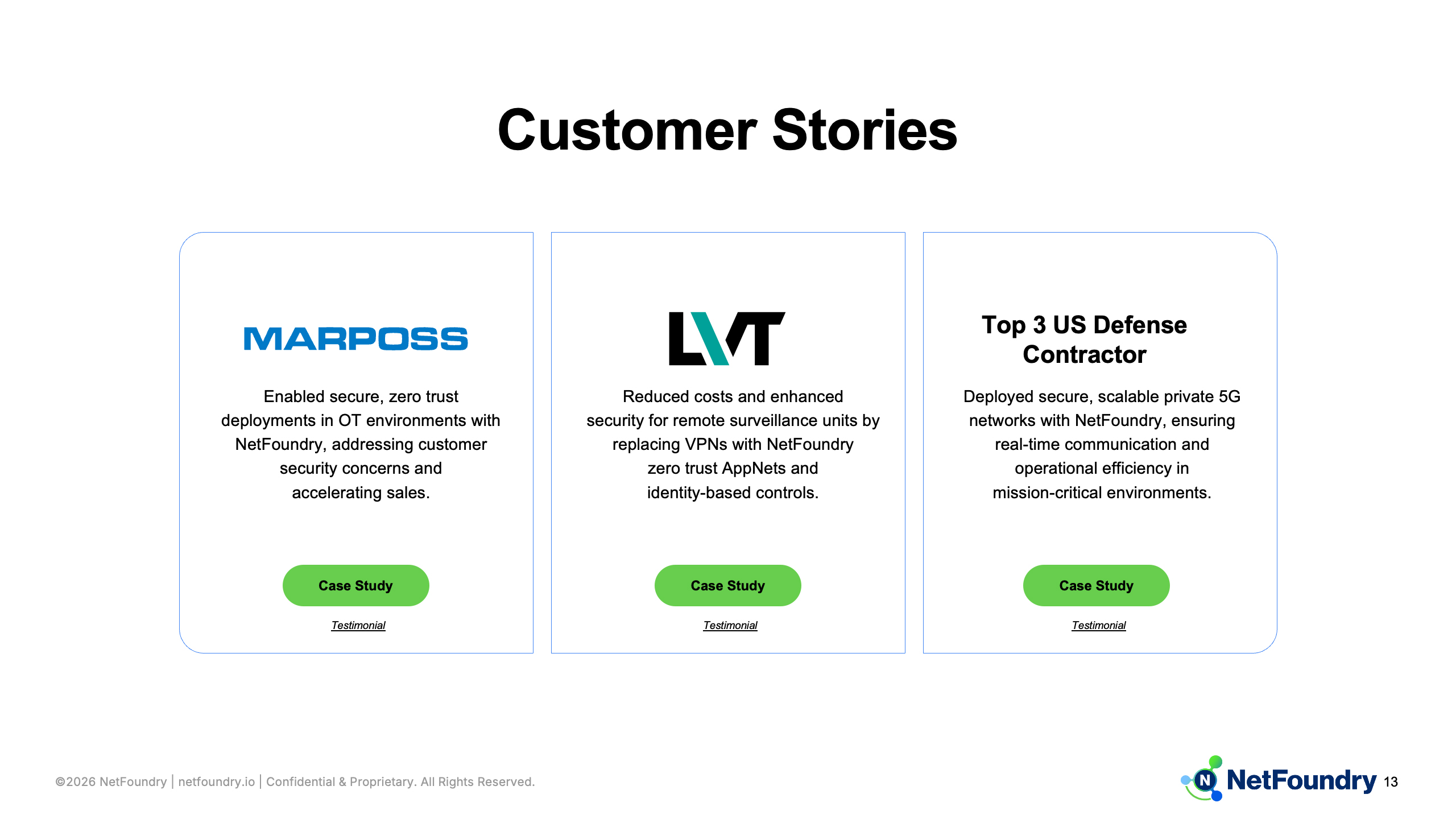
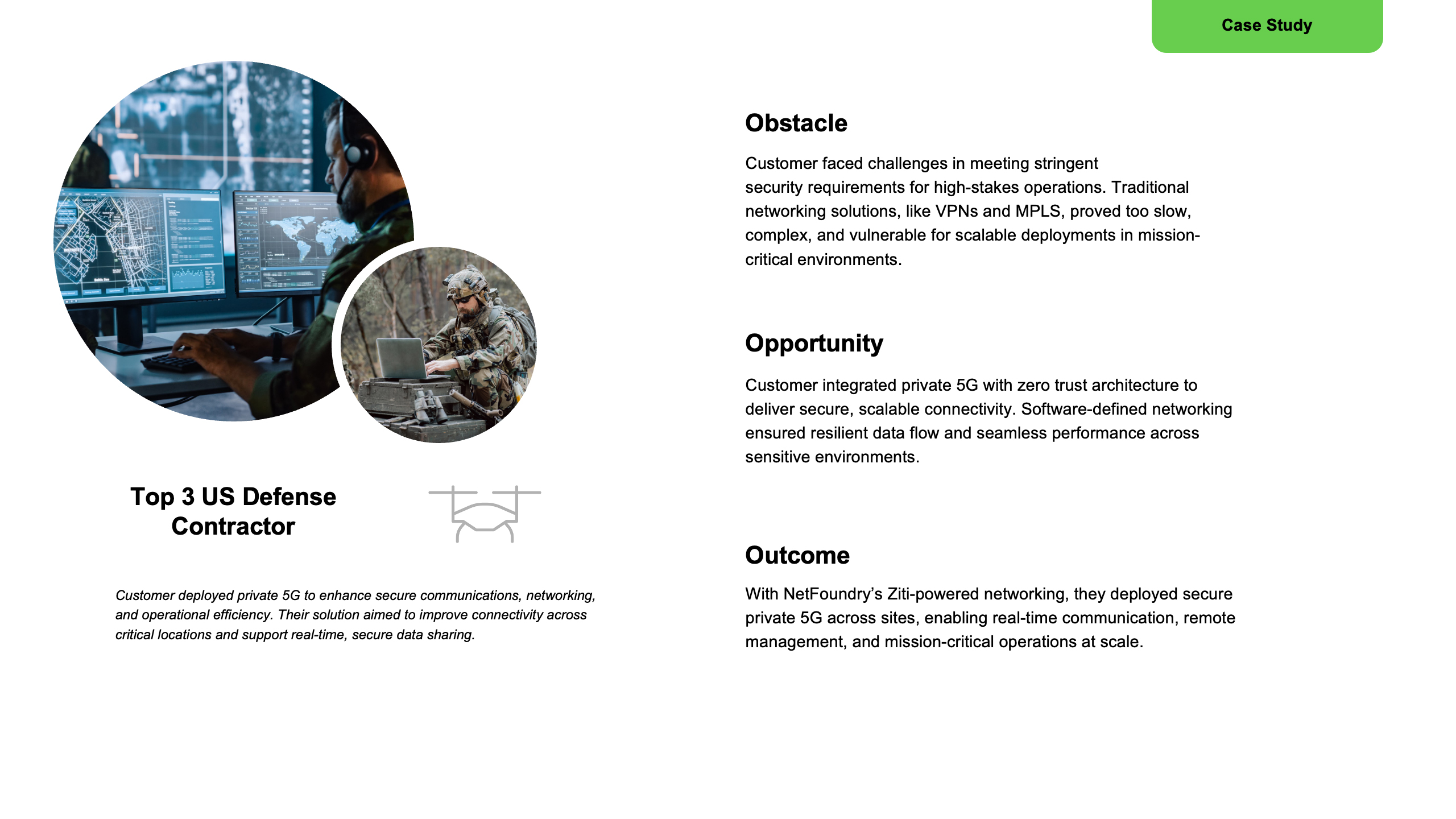
Customer stories slide with Marposs, LVT, and Top 3 US Defense Contractor cards above case study buttons.
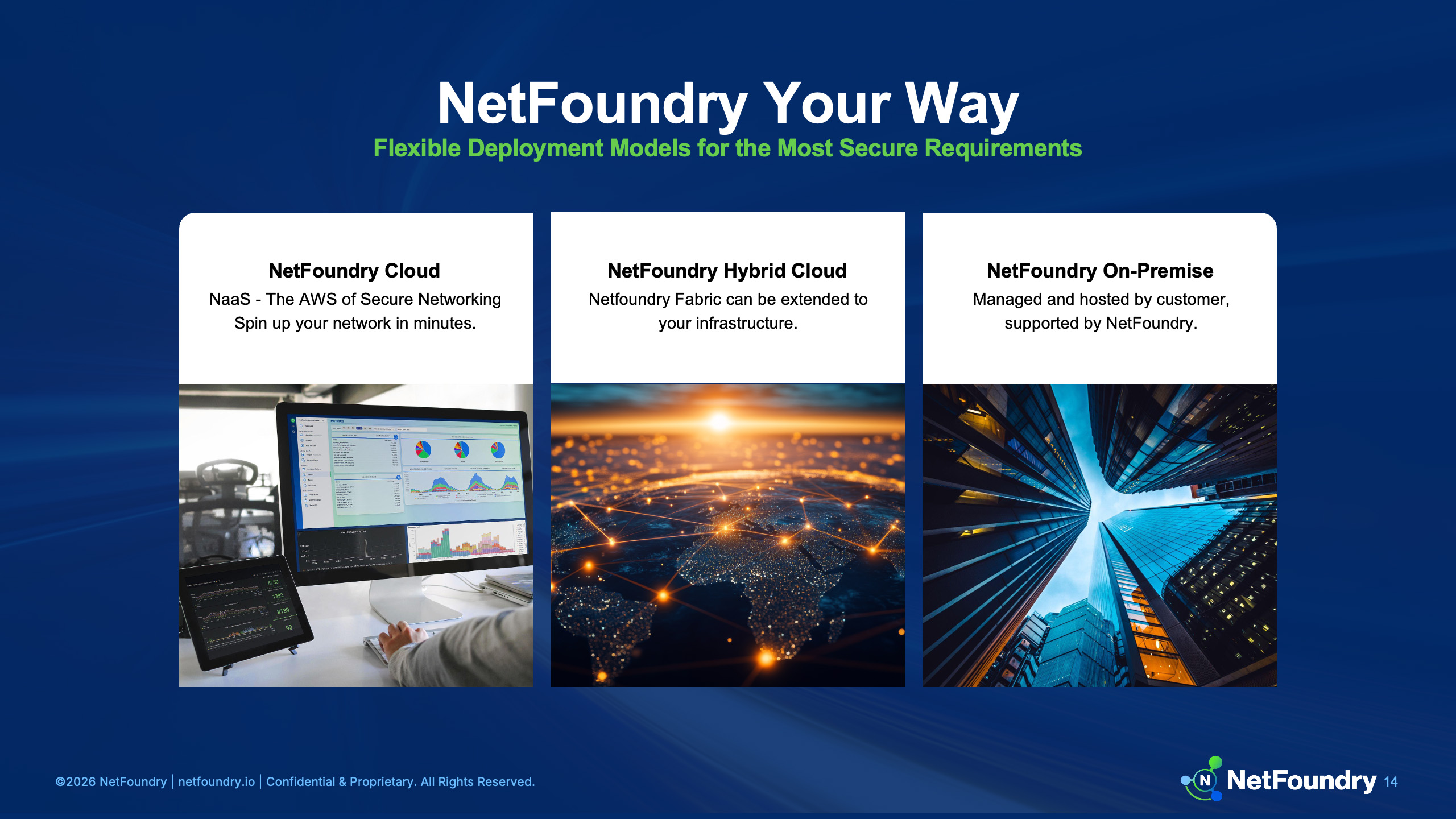
Deployment slide of cloud, hybrid cloud, and on-premise models, each over its own photograph panel.
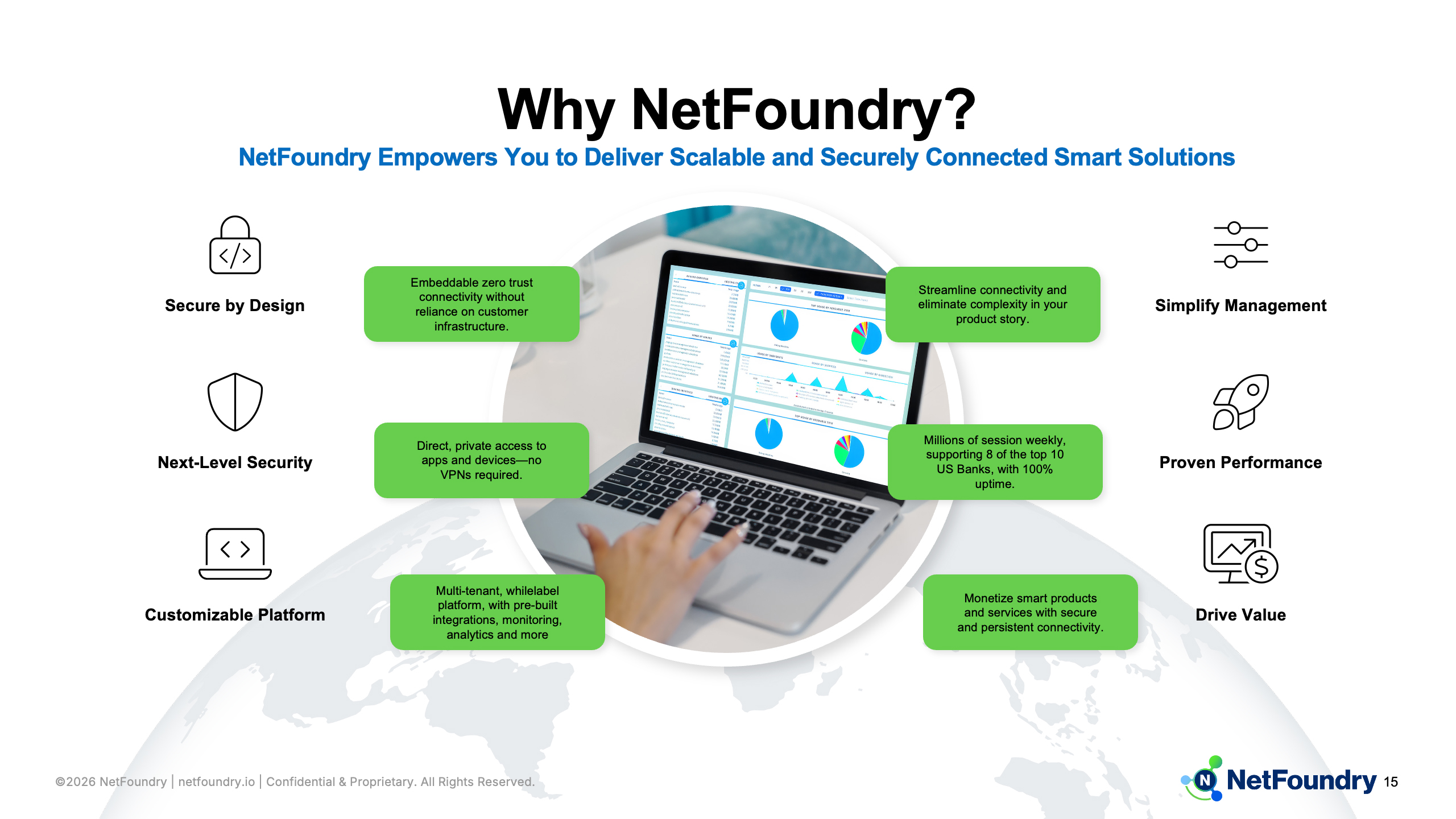
Benefits slide circling a dashboard laptop with six pillars from Secure by Design to Drive Value.
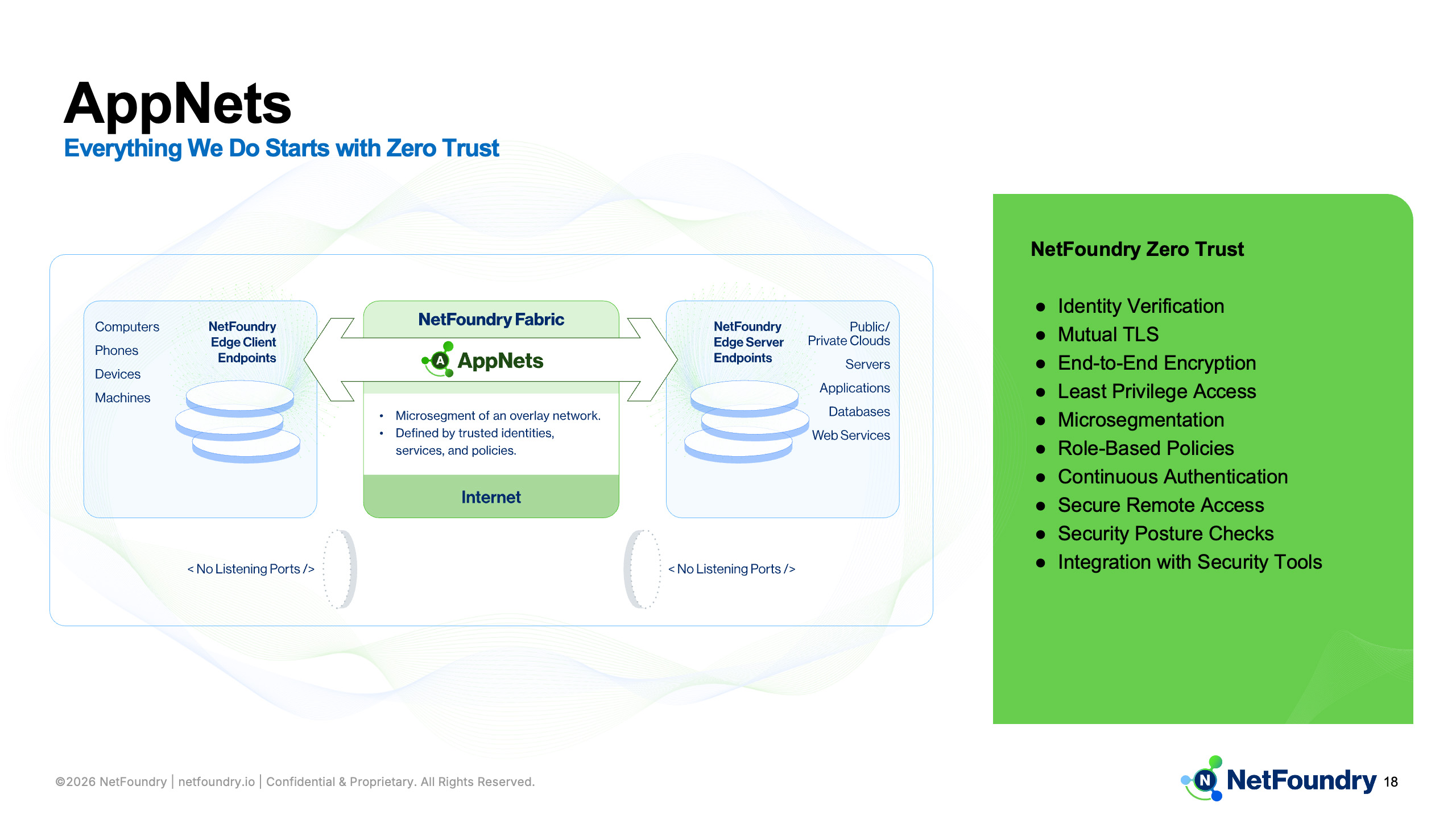
AppNets slide, endpoints crossing the fabric microsegment beside the green zero trust checklist from identity to integration.
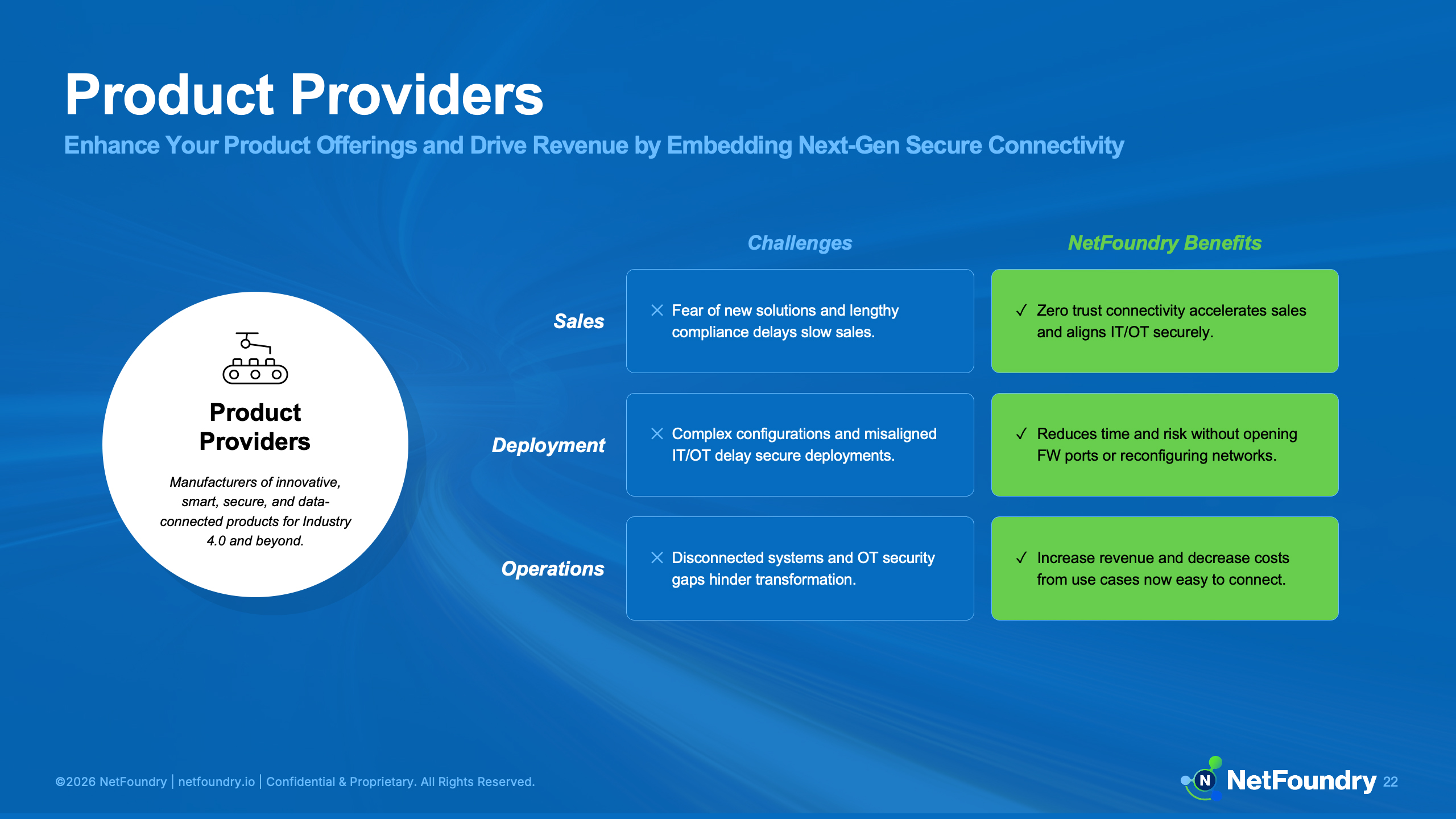
Product providers slide matching sales, deployment, and operations challenges to the green NetFoundry benefit checks alongside.
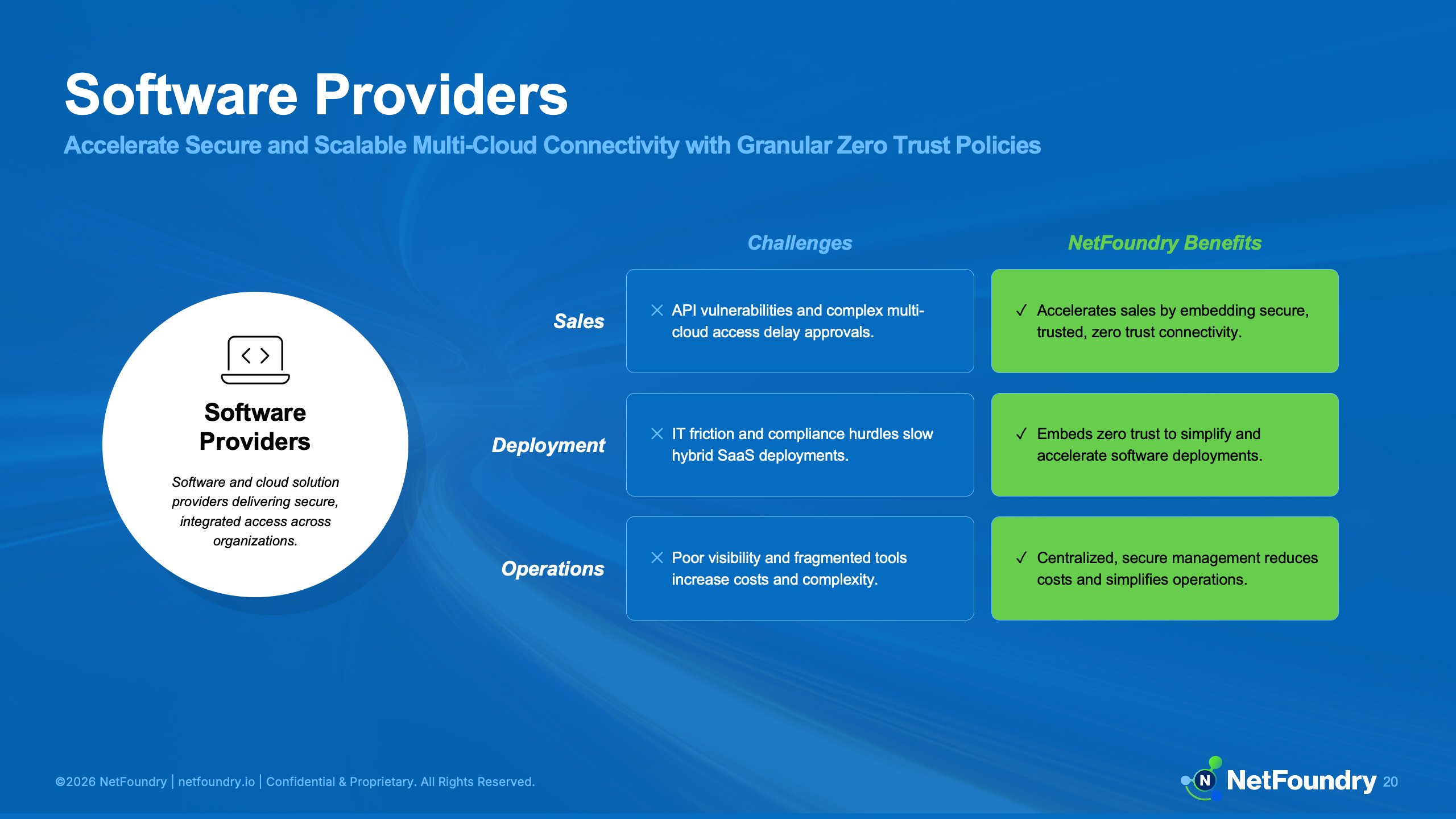
Software providers slide matching multi-cloud sales, deployment, and operations hurdles to embedded zero trust benefits.
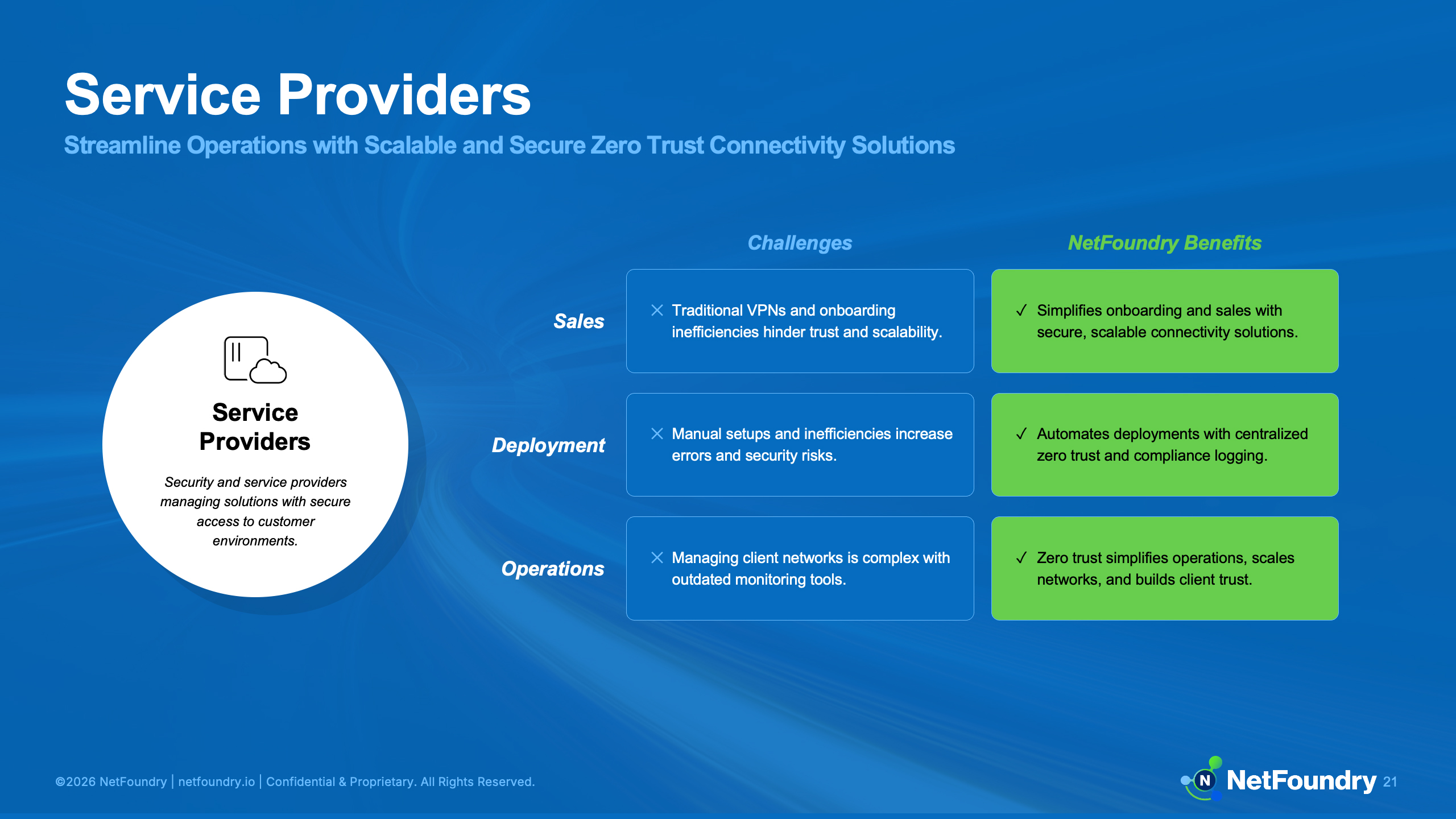
Service providers slide matching VPN and monitoring challenges to green checks for simplified onboarding and scaled trust.
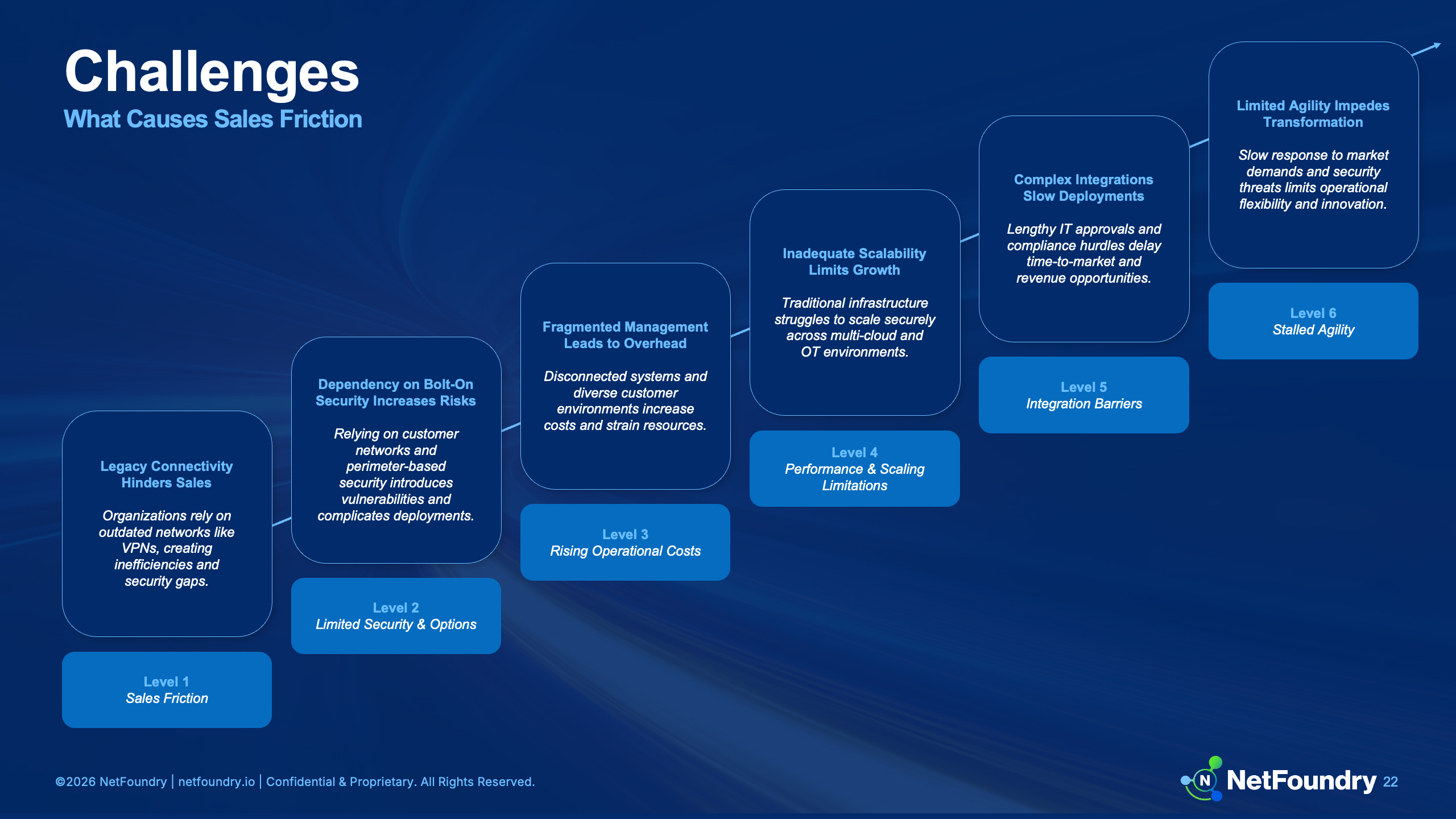
Challenges slide stepping five levels of sales friction from legacy connectivity to stalled agility across the dark stairway.
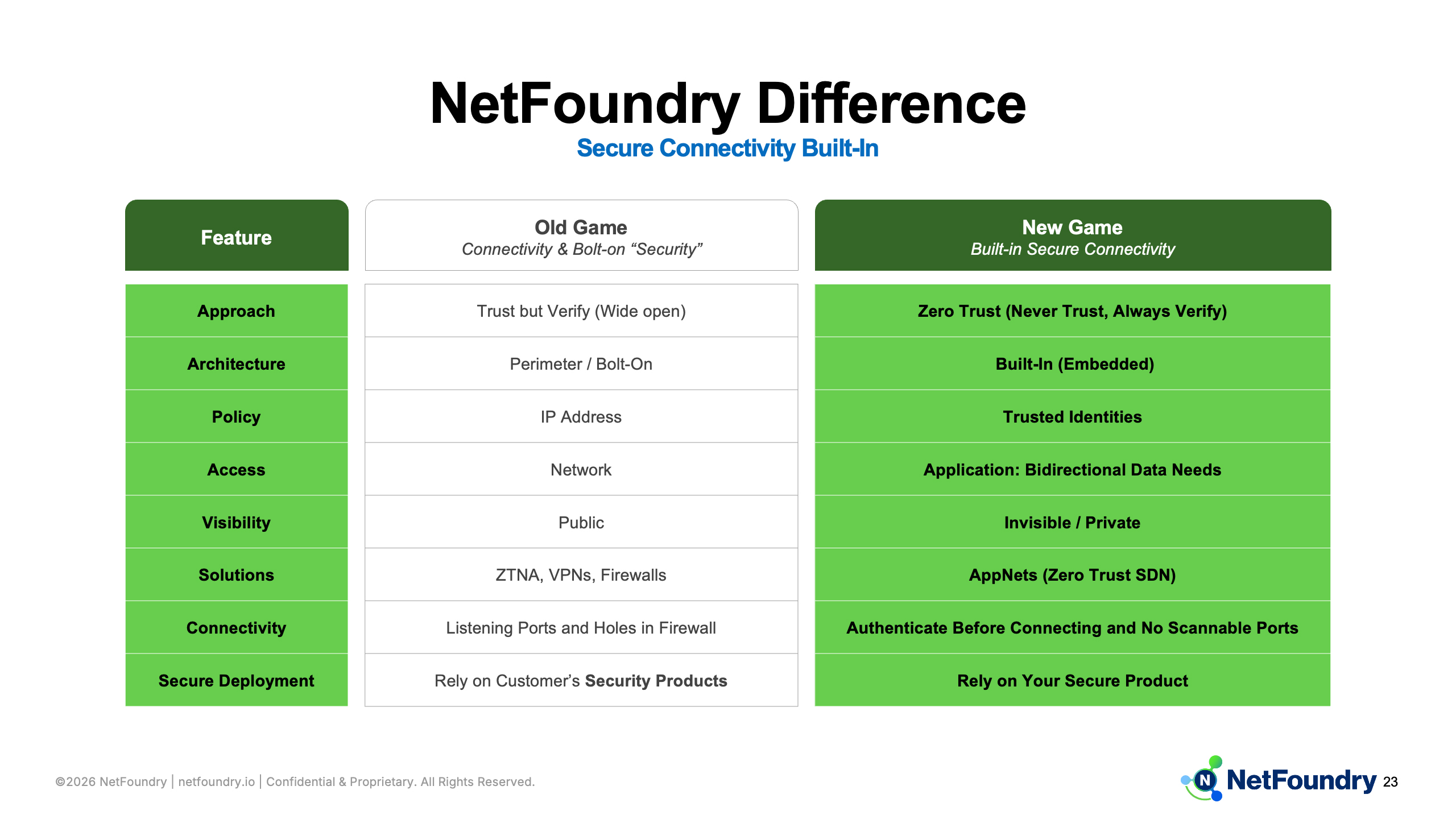
Comparison table slide, old-game perimeter security versus the new game of built-in zero trust across nine feature rows.
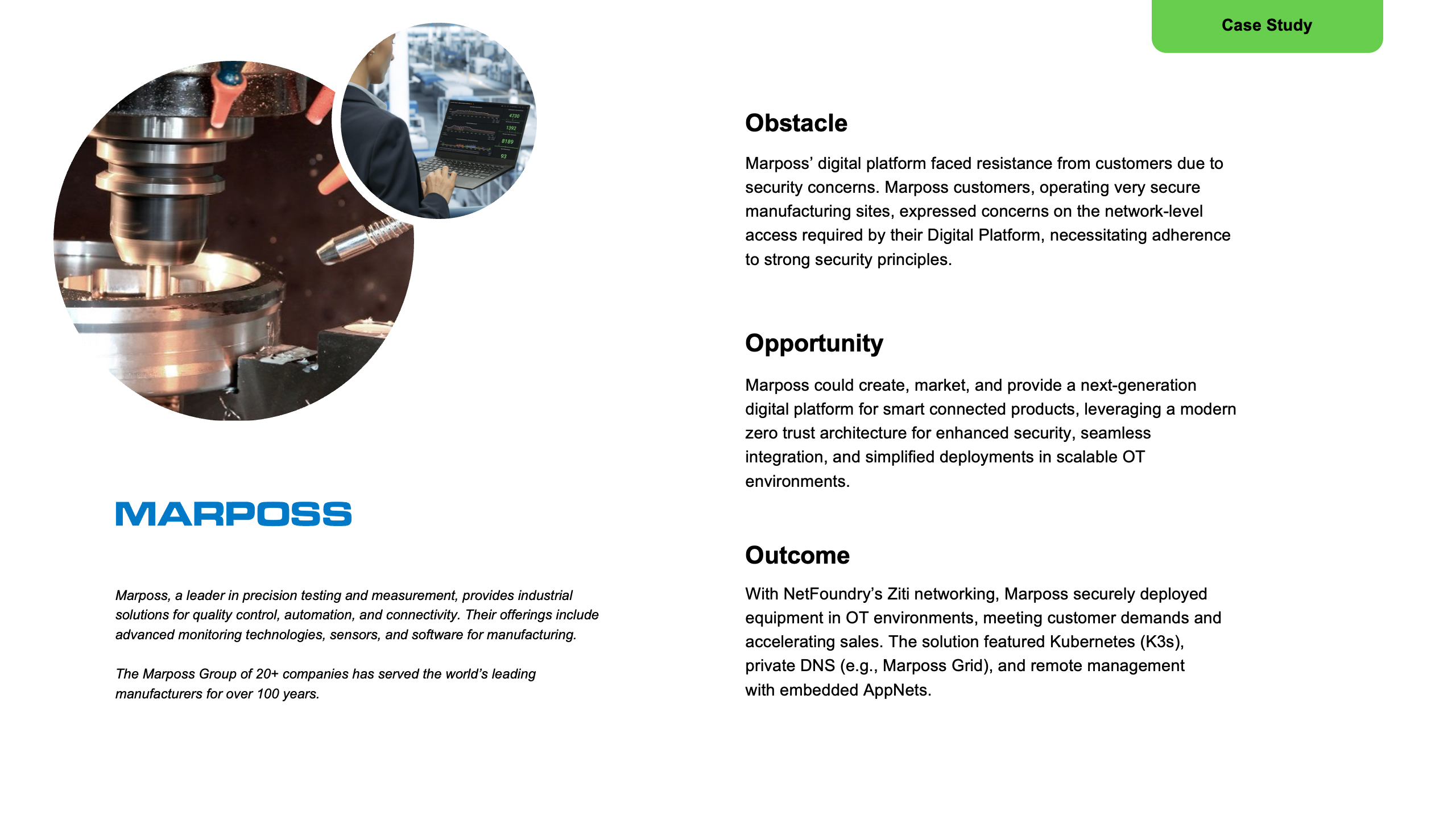
Marposs case study slide, precision machinery photographs in circles above the obstacle, opportunity, and outcome columns.
Navy quote slide from Marposs on Ziti networking unblocking sales in secure OT environments, particle wave below.
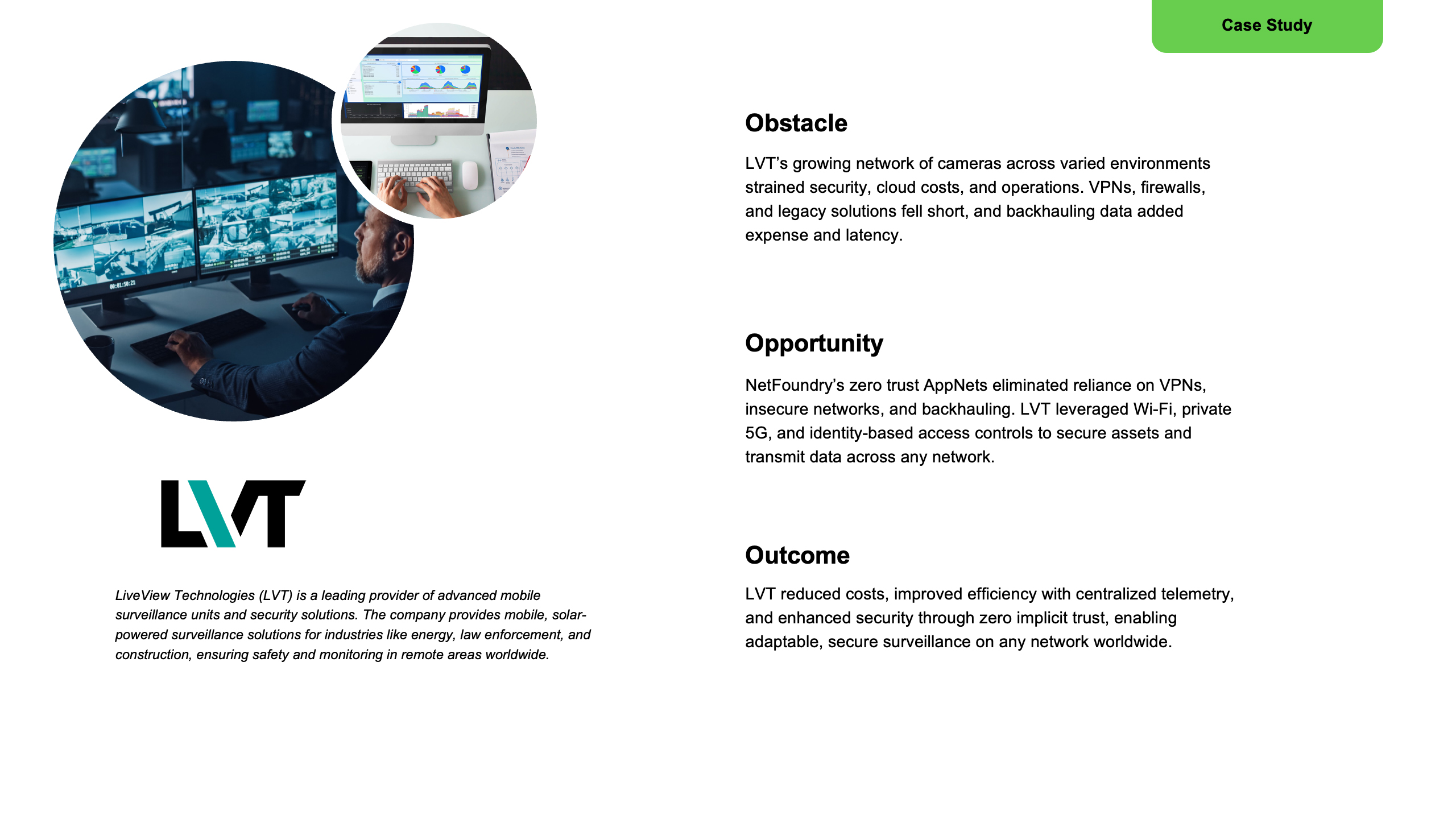
LVT case study slide, surveillance control-room photographs in circles above the obstacle, opportunity, and outcome columns.
Navy quote slide from Steve Lindsey of LVT on protecting client data by partnering with NetFoundry.
Defense contractor case slide, command-center and field photos above private 5G obstacle, opportunity, and outcome columns.
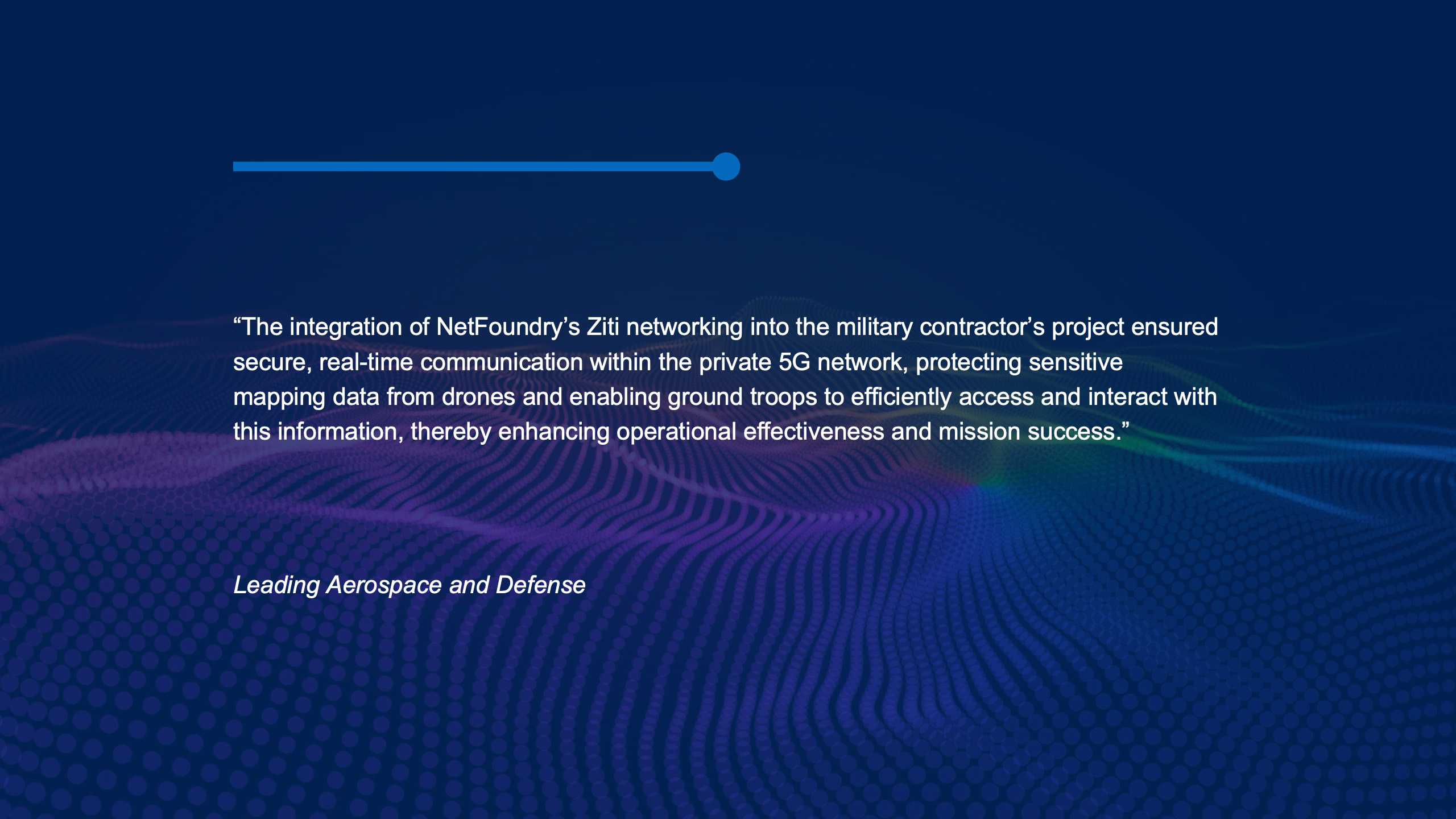
Navy quote slide from a leading aerospace and defense customer on secure real-time communication over private 5G.
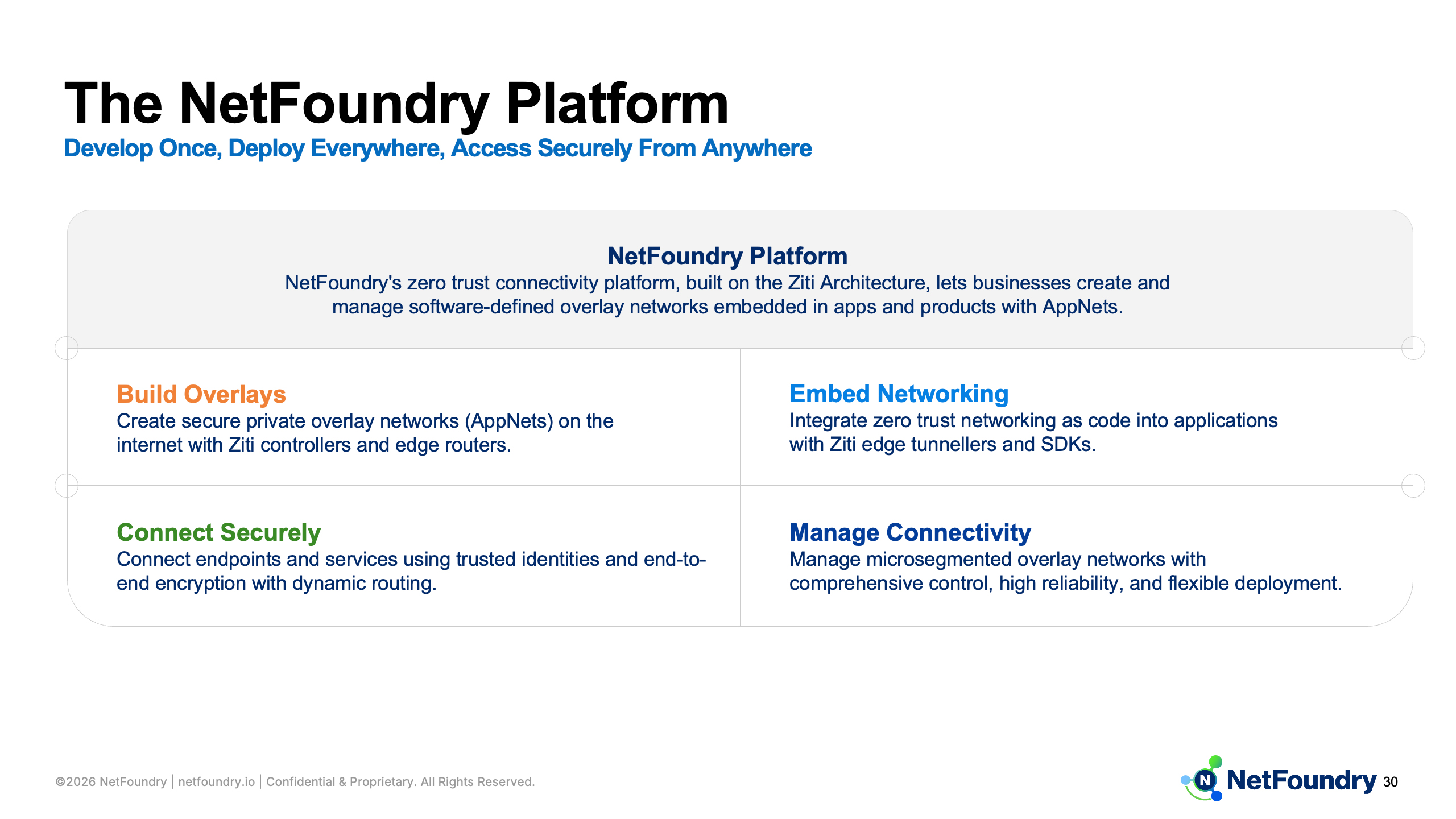
Closing platform slide, develop once deploy everywhere, four quadrants from building overlays to managing connectivity.

Infographics

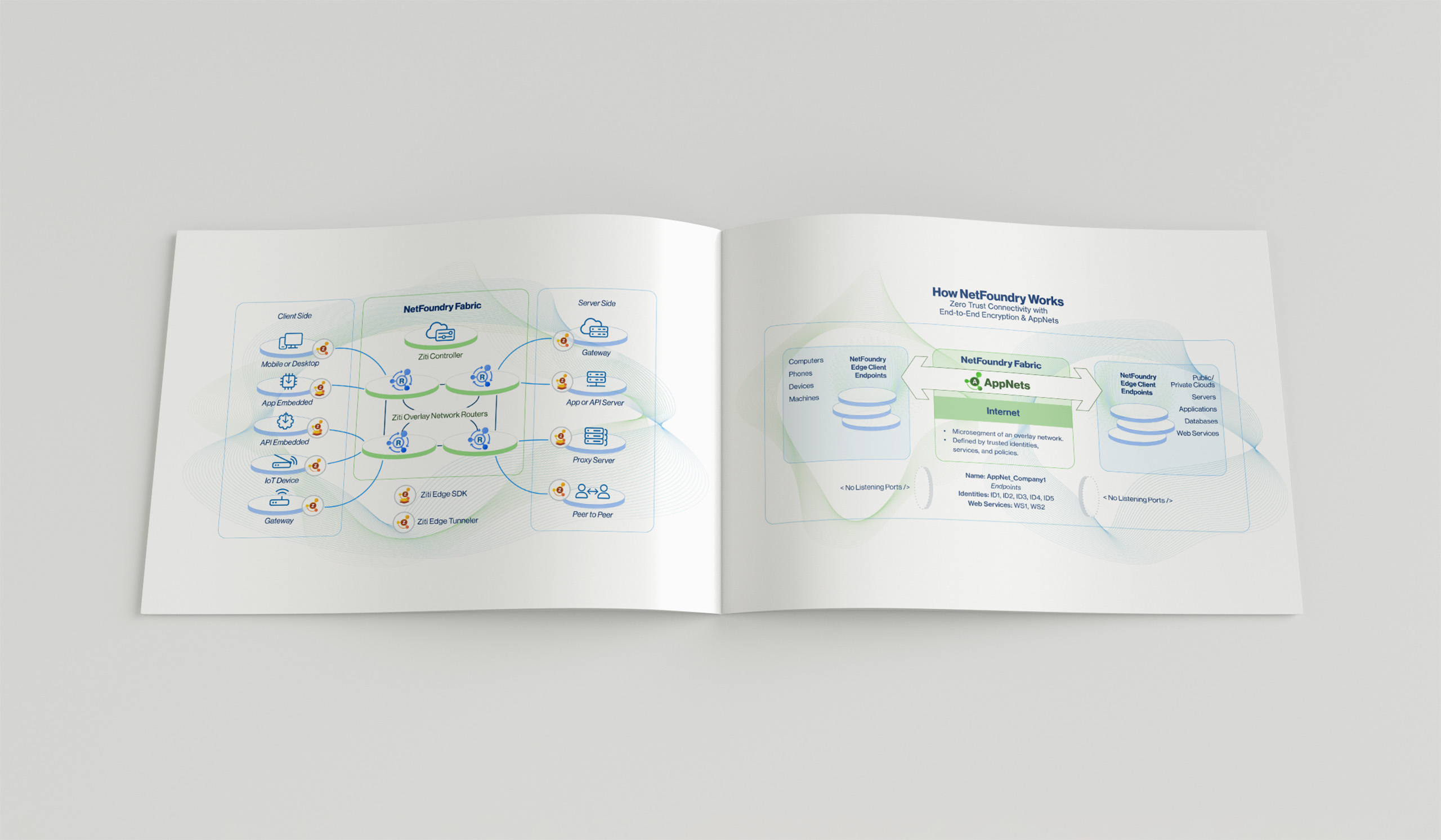
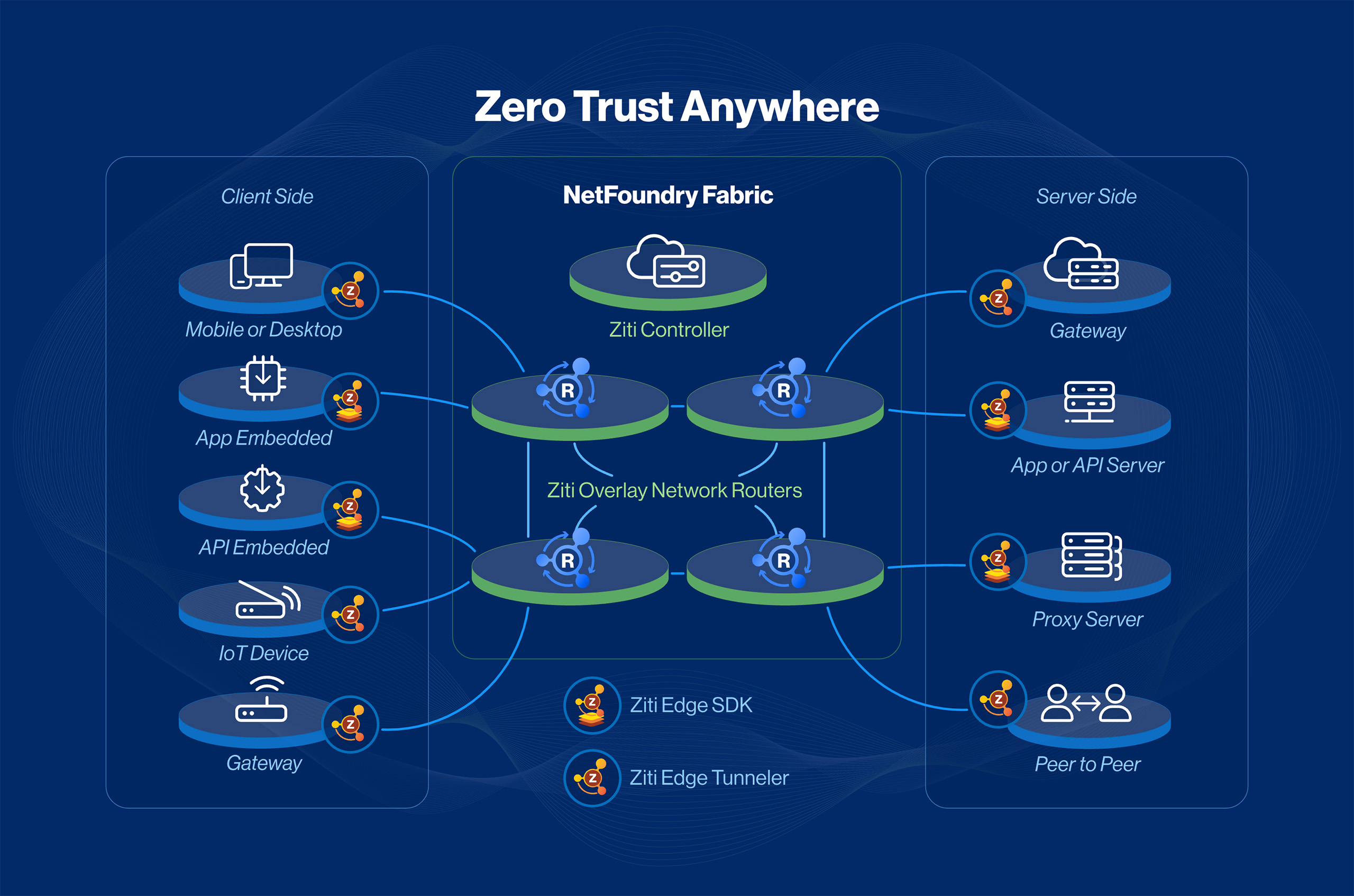
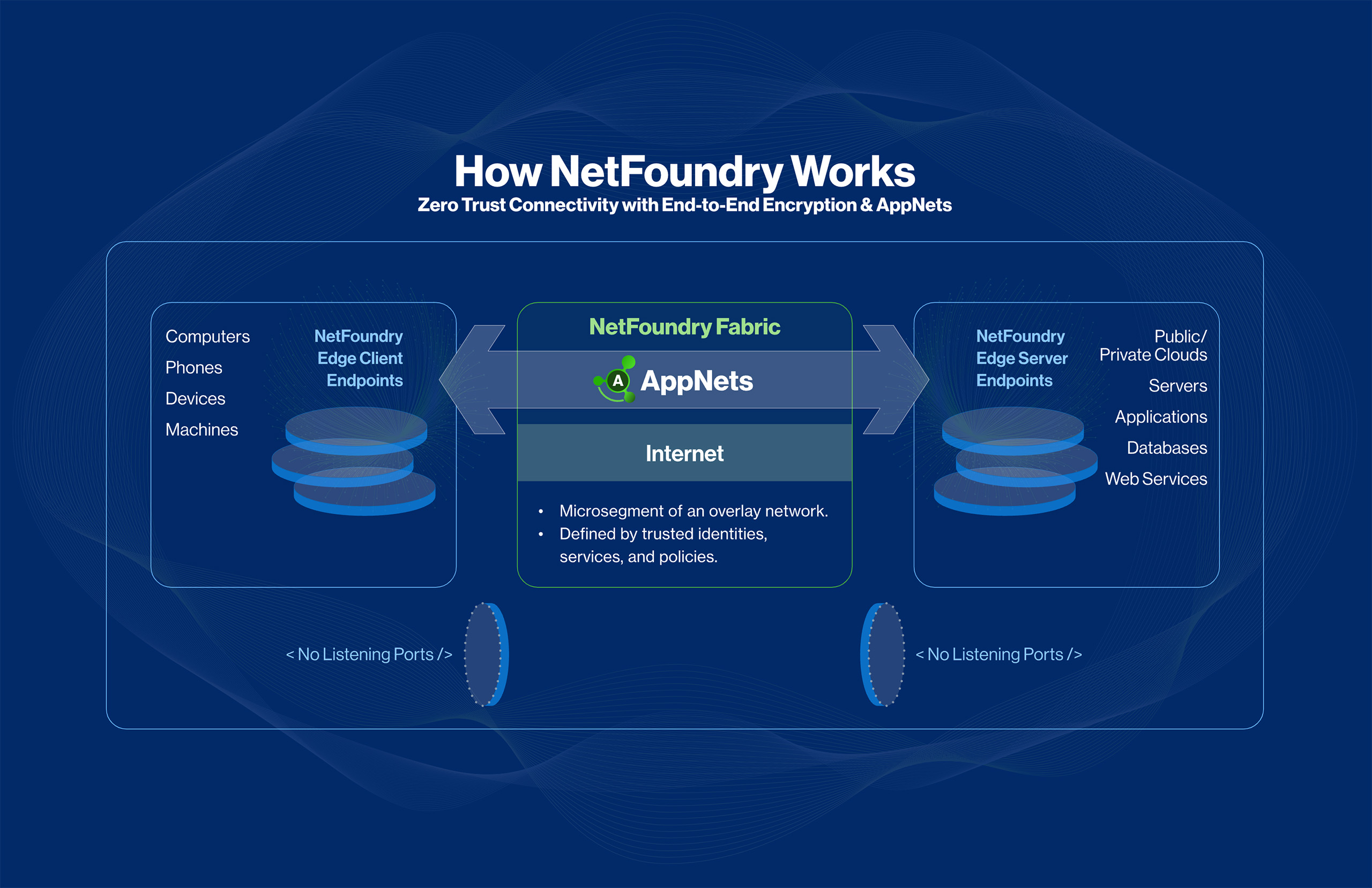
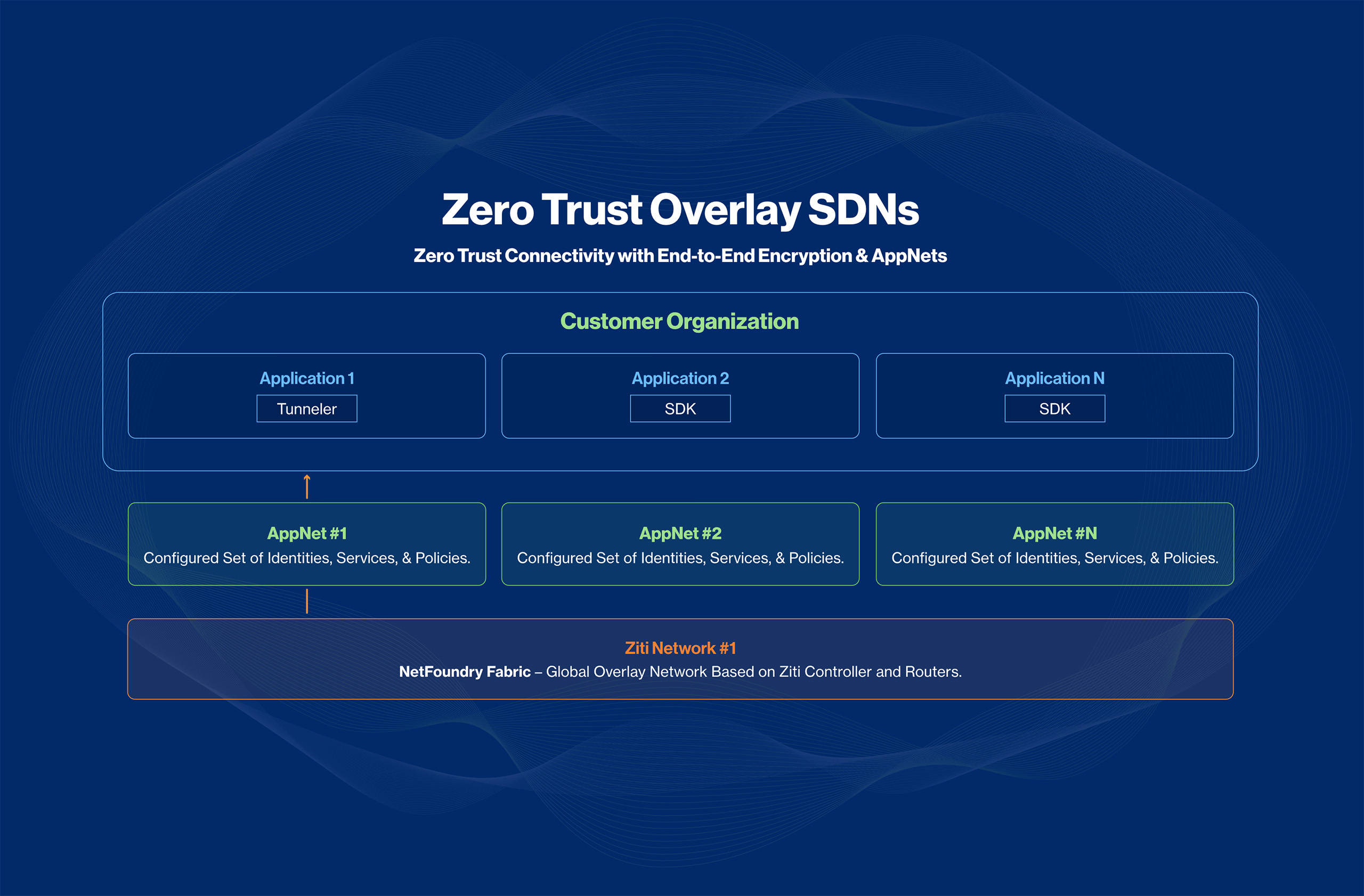
Some of NetFoundry’s hardest questions are answered better by drawings than by sentences. A set of infographics gives the platform’s invisible machinery a visible form: how NetFoundry works, how AppNets carry traffic, how the Fabric routes the world, and how Zero Trust Your Way maps to cloud, managed, and self-hosted deployment.

Each diagram is drawn in the identity’s own geometry of endpoints, connecting lines, and arrival greens, so the architecture reads as brand rather than whiteboard.

The pictures do what the category’s prose cannot: they let a buyer see the thing they are being asked to trust.

The shared visual grammar lets sales, marketing, and technical teams explain the same system at different levels of detail without changing the underlying story.

Compass mark of a navy N circled by endpoints, a light blue node entering along the green arc and leaving deep blue, protected.

Branded Backgrounds for Zoom

NetFoundry sells to the world from video calls: demos, support sessions, architecture reviews, funding pitches. A set of branded Zoom backgrounds puts the compass, the palette, and the platform’s imagery behind every engineer, seller, and executive, in every meeting.

It is a small system with an outsized audience.

The calls where customers actually meet the company now open on brand before a word is spoken, and the identity holds in the one venue where NetFoundry appears most often.

Even the everyday meeting window became part of the identity, giving remote conversations visual context drawn from the rest of the brand.

Compass mark of a navy N circled by endpoints, a light blue node entering along the green arc and leaving deep blue, protected.