
Good design works like music. Before someone can explain why it works, they feel its movement: what enters first, what holds tension, where the idea resolves, and what remains afterward.
That relationship is not a metaphor added after the work. It is how I learned to design. Music trained me to balance structure and emotion at the same time. A progression needs order, but order alone is not a song. A page needs hierarchy, but hierarchy alone is not an experience.
When people ask how I moved from musician to creative director, my answer is simple: I changed mediums, not methods. In both disciplines, I am composing a path from first contact to transformation.
Structure Gives Emotion Somewhere to Move
A song can feel spontaneous because its structure is doing quiet work underneath. Tempo, key, repetition, and contrast give every instrument a place. The listener does not need to name that structure to experience it.
Design works the same way. Grids, hierarchy, spacing, typography, and sequence are not the experience by themselves. They create the conditions that let an idea move clearly. When the structure is sound, bold imagery can feel expansive without becoming chaotic, and detailed information can feel substantial without becoming heavy.
The objective is not to make every section look alike. It is to make every difference feel intentional.
Tension Makes Transformation Meaningful
Every memorable song creates tension before release. A chord remains unresolved. A rhythm holds back. The chorus matters because something has prepared us to need it.
Brand and business stories need the same causality. A problem alone is a condition. A solution alone is a claim. The story becomes meaningful when people understand what the condition prevents, what changes when it is resolved, and why that change matters now.
This is why I do not rush from challenge to answer. The audience needs enough tension to recognize the stakes, but not so much that the story becomes pessimistic. The purpose of tension is movement. It prepares the transformation.
Composition Across a Page
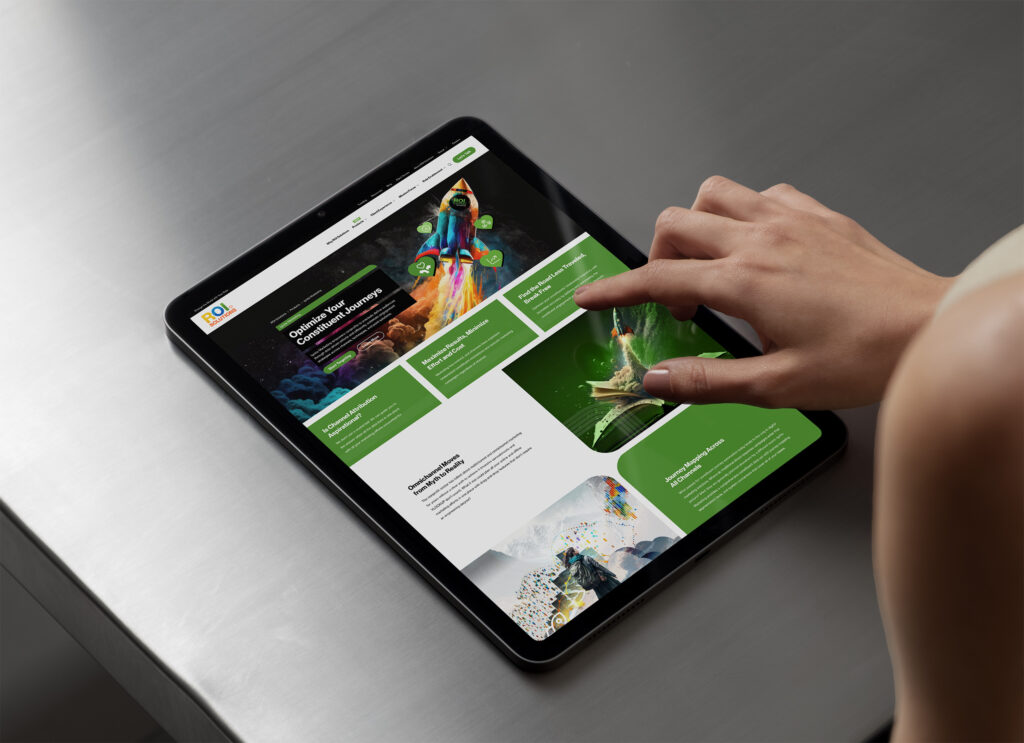
When I design a website, I think in passages rather than isolated sections. Some moments should be immersive: edge-to-edge color, motion, photography, or a line of copy with room to resonate. Other moments should be precise: bordered comparisons, structured evidence, tables, timelines, or clear next steps.
Emotion opens attention. Logic rewards it. Evidence deepens trust. The rhythm comes from moving among them deliberately.
A page that stays at one volume becomes tiring. If every section is dramatic, nothing feels important. If every section is restrained, the story never lifts. Composition gives each idea the amount of space, energy, and emphasis it has earned.
The Resolution Is the Business Change
The final resolution is not the logo, layout, application, or website. Those are instruments. The resolution is what people can understand, choose, or do afterward that they could not do before.
A technical company becomes explainable without losing its depth. A buyer sees how several capabilities work together. A marketing team can publish without reconstructing the brand. A complex system becomes something people can navigate and trust.
That is why people invest in outcomes rather than isolated outputs. They are not buying a louder arrangement. They are buying the change the whole composition makes possible.
Composing Experiences
Design is not decoration added after the thinking. It is the act of arranging understanding so another person can move through it.
Music taught me to listen for that movement: the opening that earns attention, the tension that makes the stakes real, the structure that keeps complexity legible, and the resolution that leaves the audience somewhere different from where it began.
That is the kind of design I aim for: one you can hear as much as you can see.
Boston Symphony Orchestra, One Digital Door for Four Institutions
Our Boston Symphony Orchestra work brought four institutions through one digital door. The experience had to create movement across a complex organization and resolve toward a clearer path for the audience.
The principle is clear. The visible arrangement succeeds when the underlying relationships move together.